Nerve Impulses & Synapses
Action Potential Propagation
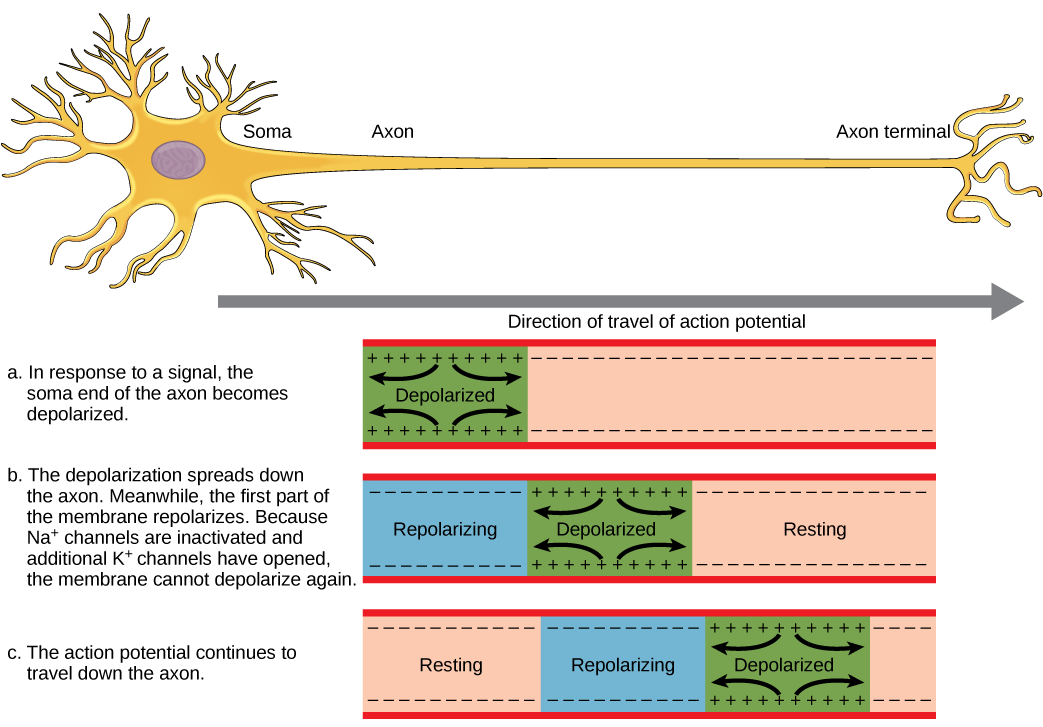
A nerve impulse is the spread of an action potential along a dendrite or axon, whereas an action potential is the movement of ions across the membrane (inside to outside) at one point.
Na+ rushes into the cell during depolarization at the start of the AP, and then it diffuses along the axon into an adjacent spot.
There is a charge attraction between the Na+ and the negative ions that exist on the inner face of the membrane.
The presence of Na+ makes the inside of the cell less negative (polarized) at that location.
→ Sufficient Na+ diffusing into the cell will make the membrane depolarize to the threshold voltage, initiating the AP.
AP only spreads in one direction because the previous section is still in the refractory period, where the Na+/K+ pump is actively restoring the resting condition. Any Na+ diffusing into this section will simply be pumped.
Saltatory conduction
Myelinated regions of the membrane do not have a resting potential difference because the myelin separates the outside and the inside.
→ Only the nodes of Ranvier can depolarize!AP does not have to occur in an entire membrane; it just depolarizes at each node, which makes the process 50 times faster!
AP at one node disrupts the electrical field at the next one enough to spread the AP to that region.
Saltatory conduction: jumping conduction from node to node.
Advantage: If fewer regions of the membrane depolarize or repolarize, then fewer ions leak across the membrane, and the membrane does less work to restore its resting condition. Thus, the speed of the conduction is significantly increased.
Information between neurons
Information can be transmitted from the previous neuron’s axon bulbs to the next neuron’s dendrites without having physical contact.
Synapse: a region of communication between a neuron and another neuron or a neuron and an effector.
Synaptic transmission
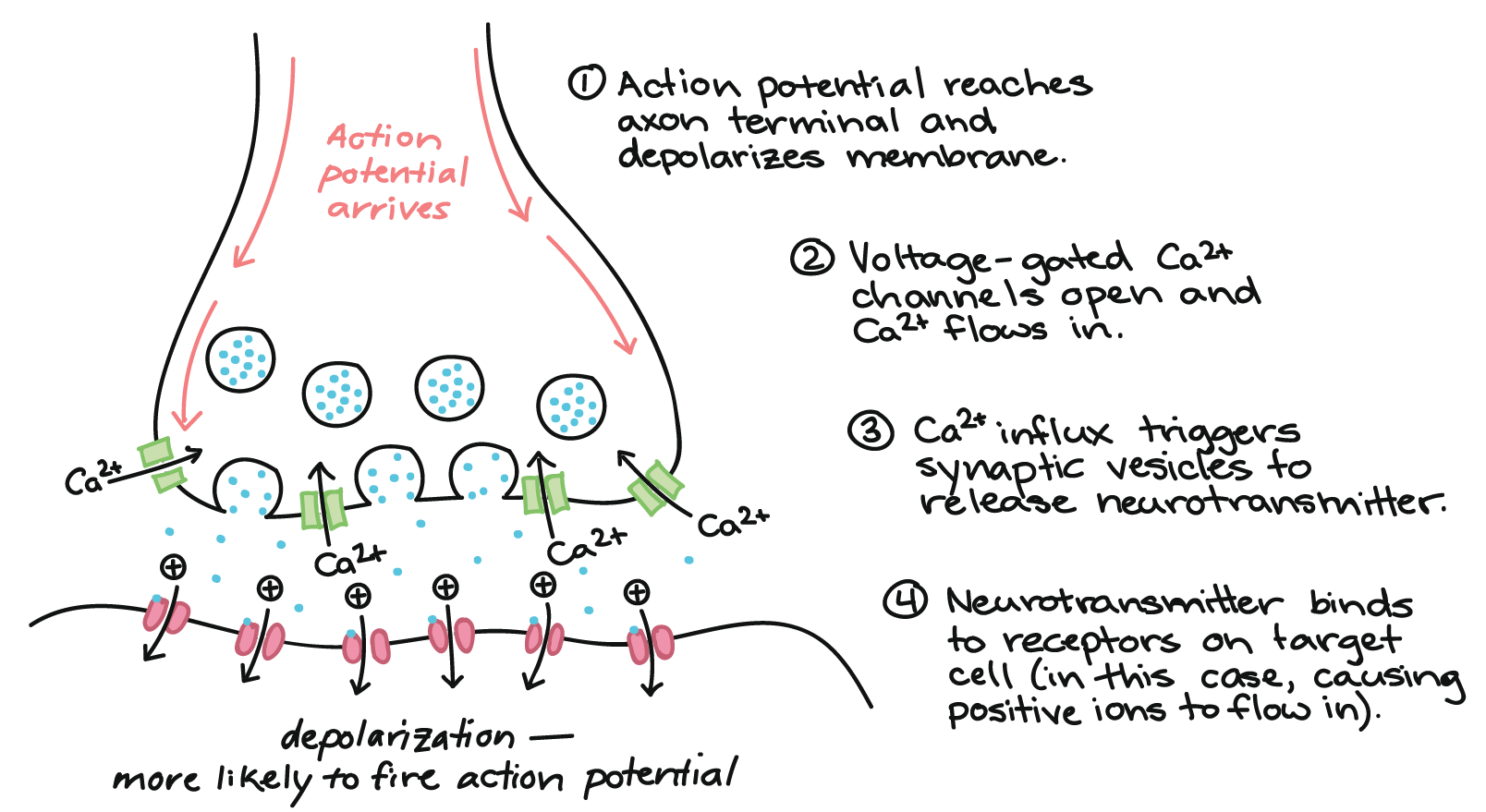
1. Ca2+ gates open
When a nerve impulse reaches an axon bulb, it triggers a Ca2+ gate to open.
Normally, [Ca2+] is higher outside the cell, so when the Ca2+ gate opens, a wave of Ca2+ diffuses into the cell.
2. Contraction of microtubule proteins
Ca2+ causes contraction of microtubule proteins, which pull vesicles containing neurotransmitters from the axon to the pre-synaptic membrane.
Vesicles & contents are constantly made by the neuron, which requires a lot of ATP, and thus, a lot of mitochondria.
3. Exocytosis
Neurotransmitter: a chemical substance that can diffuse across the synaptic cleft when the vesicle fuses with the presynaptic membrane.
Neurotransmitters are released from the neuron when the vesicles fuse with the pre-synaptic membrane through exocytosis.
Each neuron can only make 1 kind of neurotransmitter.
Ex: Acetylcholine (Ach) in most somatic motor neurons.
4. Neurotransmitters reach the post-synaptic membrane
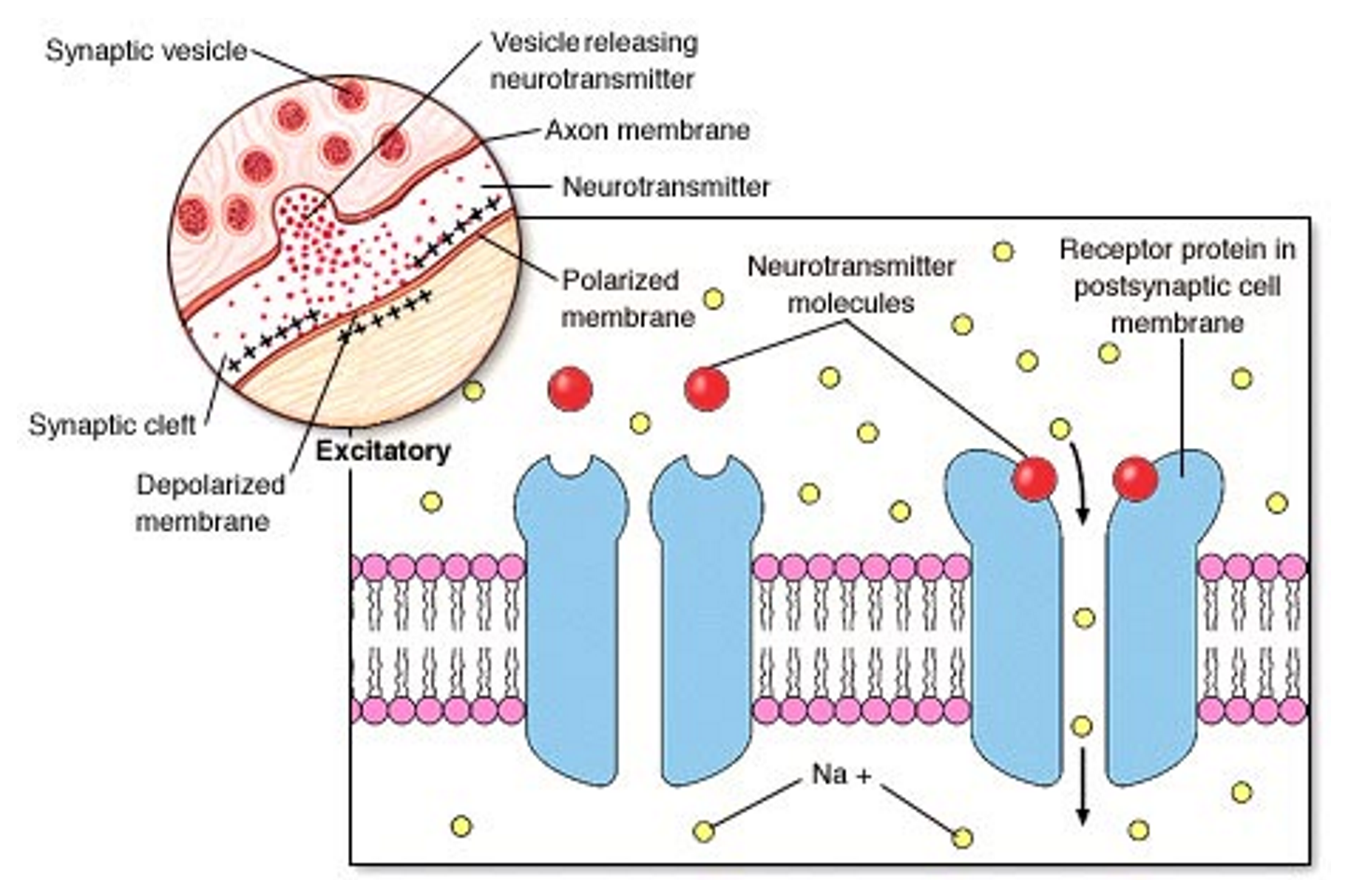
A neurotransmitter binds to the receptor protein on the post-synaptic membrane.
5. Receptors control either a Na+ channel or a K+ channel
Depending on what type of receptor is present, the binding of the neurotransmitter can have an excitatory effect or an inhibitory effect.
Excitatory effect: slight depolarization due to Na+ diffusion
Inhibitory effect: slight hyperpolarization due to K+ diffusion
Causes the next neuron to get closer (depolarization) to or move farther away (hyperpolarization) from the threshold voltage.
6. Return to the resting condition
Neurotransmitters must be removed from the synapse so that the post-synaptic membrane can return to resting conditions, and another impulse can be sent through the synapse.
Enzymatic destruction of neurotransmitters.
Ex: Cholinesterase, an enzyme present in synapses, destroys acetylcholine.
Reuptake of neurotransmitters back into the pre-synaptic membrane.
Summation: the inhibitory and excitatory signals will add up.
If the total is a change of 10 mV (e.g., a change of - 65 mV to - 55 mV), then a new AP will occur.
Drugs can affect nerve impulses at the synapse. The act by:
imitating neurotransmitters (compete for receptors, act as artificial NTs)
affecting receptors (blocking, destroying, simulating)
affecting how fast the NT is removed from the synapse.
Inhibitory signals are important because they cause the actions to stop.
Ex: Throwing a ball requires contraction and relaxation of the bicep muscle.
Thus, you have to stimulate and STOP stimulating the muscle.