Lecture 2 - Political Geography of Europe
Napoleon I
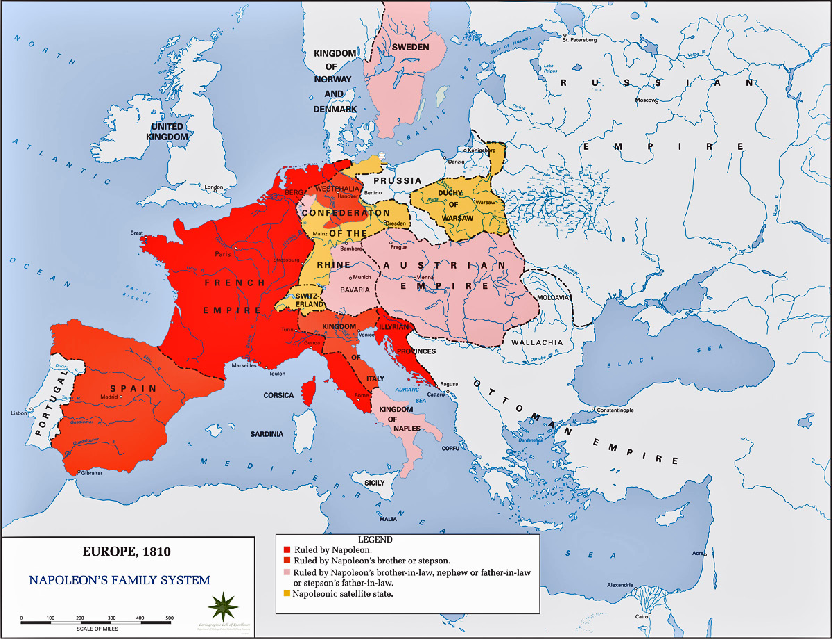
Came to prominence as a French general in the 1790s. After the initial phases of the French Revolution which focused on internal changes, the French republic became increasingly involved in a series of war with neighbours which became a triumphant military victory for the french armies. In 1799, there was the coup of brumaire which made him the dictator of France. Then in 1804, he crowned himself emperor, founding the napoleonic empire. the napolenic empire exported many of the achievements of the french revolution, reforming and modernising civil codes and laws, and the principle of popular sovereignty.
Europe, 1810
1812: French invasion of Russia
April 1814: Napoleon abdicated, exiled to the island of Elba
June 1815: The Battle of Waterloo
The Congress of Vienna, 1814/15

The four great victors (the coalition that defeated Napoleon) Austria, Prussia, Russia and the United Kingdom, were states still ruled by dynasties that derived their power from a concept of the monarchy based on divine grace and the tradition of a long heritage.
there was an attempt by ancient ruling houses to put an end to the principles and republican experiments heralded by the French Revolution (popular sovereignty, plebiscite, representation)
After the congress, the German Confederation existed (39 states including Bavaria and Saxony, but dominated by two rivalling powers (Austria and Prussia)
These two states had territories outside the boundaries of the German Confederation (now Poland and Lithuania)
After the Congress of Vienna, Europe did not see an independent Poland and no unified Italy. France was closer to what we know today but Nice and Savoy were still part of Piedmont-Sardinia.
During the 15th, 16th and 17th centuries, in personal union with Lithuania, Poland was one of the most powerful countries of Europe. Poland was dismantled by a series of partitions in the late 18th century due to dynastic inheritances and military defeats. What had been Poland was divided between Austria, Russia and Prussia
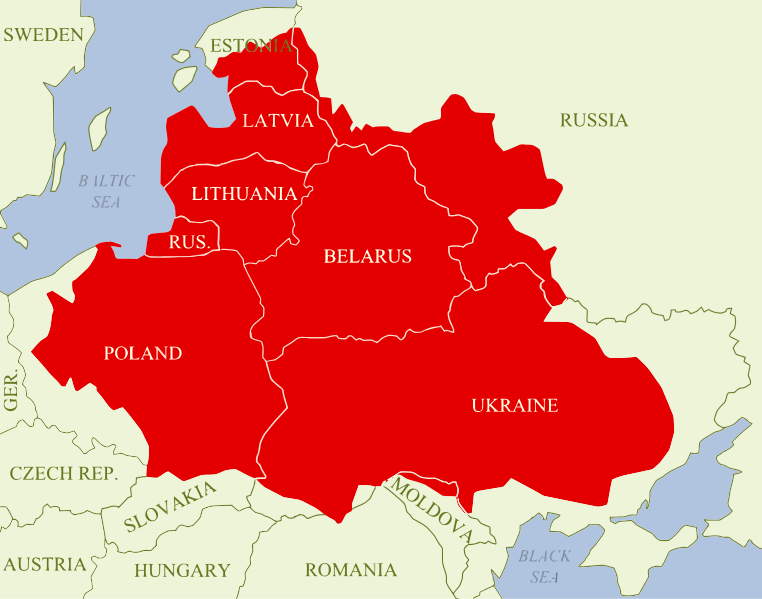
Map showing the Polish–Lithuanian Commonwealth at its maximum extent following the Truce of Деулино, superimposed on present-day national borders. The map shows in red all of the territory that Zygmunt III Waza ruled in 1619 (the Polish monarch at that time), which made up the Commonwealth; it can be further divided up into:
Crown of the Kingdom of Poland
Duchy of Prussia (Polish fief)
Grand Duchy of Lithuania
Duchy of Courland and Semigallia (Lithuanian fief)
Duchy of Livonia (joint dominion)
-
There was no unified Italy before 1860, it was split into smaller territories. Some northern parts were owned by Austria and France. Using the Kingdom of Piedmont and Sardinia as a starting point, its prime minister Cavour built Italian unity with help from France.
The second war of Italian indepence in 1859 was piedmont-sardiana against Austria
The Piedmontese cede the territories of Savoy and Nice to France in return for French military help. they annexed the territory of Lombardy with the city of Milan
in 1860 following its military victories and European diplomacy the kingdom and P-S, incorporated most other Italian states into the kingdom of Italy
the important parts outside the new Italian state: Rome is still part of the papal state, the capital of Italy is initially Turin then Florence. in the east, Venetia and triste stayed in Austria-Hungarian possession
-
in regards to the unification of Germany, Prussia could capitalise on its gains from the Napoleonic wars and its modern military and industrial power. Prussia was a latecomer to the European concert of the great powers, especially when compared with the ancient tradition of the Austrian House of Habsburg.

Boundaries of the german confederation ^
Blue: Prussia
Yellow: Austria
Grey: Germany

Blue: Prussia
Red: Austria
Pink: Austria’s allies
Green: Neutral/passive including Luxembourg
Yellow: The Disputed territories, the Duchy of Holstein and the Duchy of Schleswig
Indepence of the Balkan Peoples
1815: Much of SE Europe still Ottoman Empire
1820s: The Greek War of Independence creates an independent Greece which was once owned by the Ottoman Empire
The Balkan crises of 1875/76 pushed the Ottoman Empire Back
By 1914 the Ottoman Empire territory was reduced to the Eastern Thrace
Ireland
The 1800 Act of Union: Single governing body based in Westminster ruled britan including Ireland until the anglo-irish treaty of 1921 and subsequent establishment of the republic of Ireland
No welsh, Irish or Scottish parliaments.
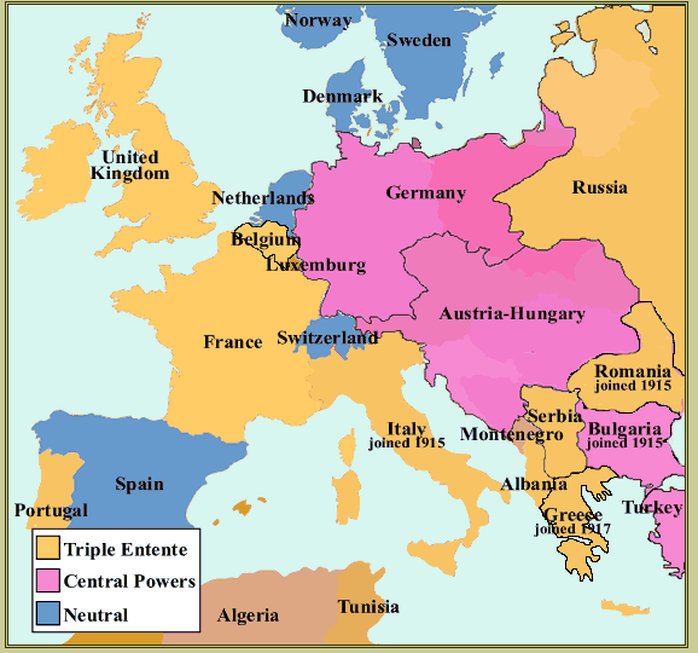
European map at the outbreak of WW1^