Clara Melancon - Mazzini and 1848 Italy (1)
IB European History
Italian Unification I: Mazzini 1814-1848
Synopsis from 1848 Year of Revolution (2008) by Mike Rapport
Post-Napoleonic Europe, 1815
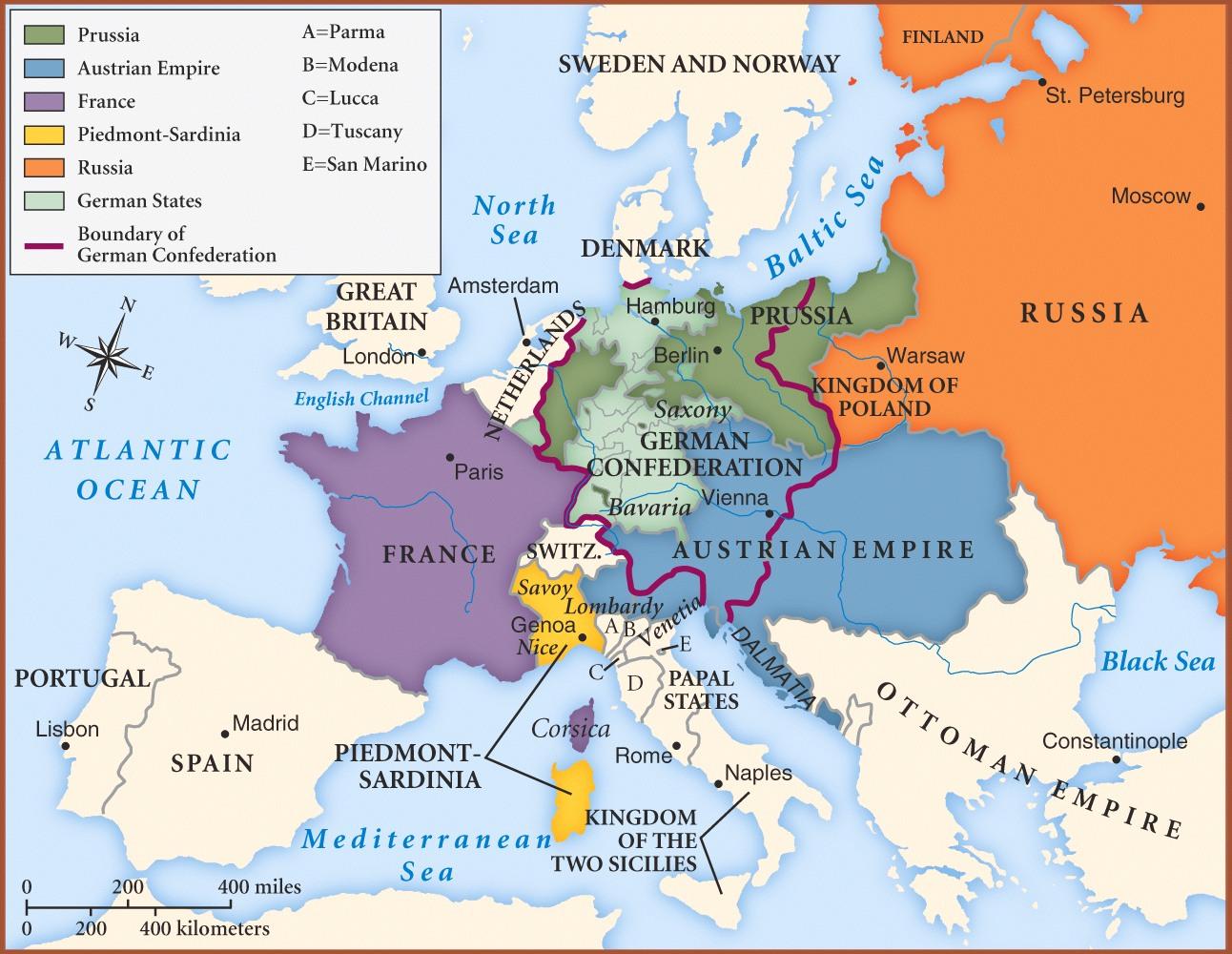
Restoration Europe 1815-1848 was created by the Congress of Vienna 1814-1815. Congress Europe, as it was also known, was reactionary, ultra-conservative and anti-liberal. Among the factions that supposedly threatened any society were liberals, republicans and nationalists, the three evils unleashed by the French Revolution 1789-1799. Five states met at Vienna to reestablish the European order: Habsburg Austria, Imperial Russia, Prussia, the United Kingdom and France. Of the five great powers, committed to maintaining the balance of power and dedicated to crushing revolutions wherever they might arise, only the last two, the United Kingdom and France had parliaments to temper royal power. The United Kingdom and France, however, were far from democratic. In England there was democracy for every one in five adult males, while in France only 170,000 of France’s richest men could vote: this was a mere 0.5% of the French population, 1/6 of those who enjoyed the right to vote in Britain after 1832.
The most effective outcome of the Congress of Vienna was the establishment of “balance of power” on the international level. Another mechanism of keeping peace at the Congress was the establishment of a “ring of iron” around France to keep it from expanding again in the future. The ring of iron was made of border states that could resist invasion effectively; the Rhineland was given to Prussia, Belgium was absorbed by the Netherlands, and most importantly for our current subject of Italian unification, the small kingdom of Piedmont-Sardinia was enhanced as as a power on France’s southeastern border.
Italian States, 1848
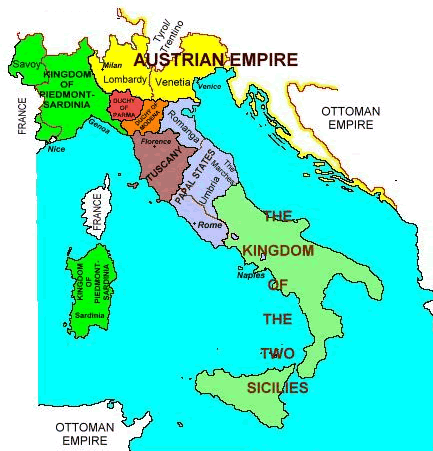
Italy was not a country. After 1815, Piedmont-Sardinia became the strongest part of Italy that was actually self-ruled by “Italians.” Most of the Italian peninsula was ruled by outside powers, so naturally when the 1848 revolutions exploded in all parts of Italy the Italian people were extremely involved.
Metternich had always viewed revolution and nationalism as French diseases that needed to be eradicated. It was in Italy, however, that Metternich pursued the most active counter-revolutionary and anti-liberal policies. In 1815 he famously insulted the claims of Italian nationalists by referring to Italy as a “mere geographical expression split as it was among ten kingdoms, duchies and tiny statelets.” He saw Austria’s role to keep it that way. The Congress of Vienna had arranged Italian affairs so that Austria would be the predominant power in the entire peninsula, permitting the Habsburgs to annex Lombardy and Venetia in 1815. The Austrians, however, had to tread carefully for northern Italy was one of the crown jewels of the empire: Lombardy’s fertile, irrigated plains were a bright patchwork of wheat, of well-kept vines and of mulberry bushes, upon which silkworms produced their precious fibers. The capital of the Duchy of Lombardy was Milan, and to the irritation of the fanatically proud Venetians, Milan was culturally one of the most vibrant cities in Europe, thanks in part to little state censorship, as compared with elsewhere in the Habsburg Empire. Lombardy-Venetia accounted for one sixth of the Empire’s population, but contributed one third of all Habsburg tax revenues—a fact that was not lost on Italian patriots. The populations of Lombardy and Venetia were highly literate, yet the best jobs were held for Austrians. Educated Lombards and Venetians complained that Austrians occupied some 36,000 government posts, preventing educated Italians from enjoying their fair share of government employment
After the long experience of Napoleonic occupation, the Austrian purpose in Italy initially was to ward off French influence, but the role soon developed into one of repressing Italian liberalism. Tuscany was ruled by a Habsburg grand duke, while the Duchies of Parma and Modena were governed by relatives of the Austrian Emperor, Ferdinand I. The Bourbon King of the Two Sicilies signed a military alliance with the Habsburgs, which bound the kingdom tightly to Austrian policy. Only the north-western kingdom of Piedmont-Sardinia remained completely independent. It was militarily the strongest of the Italian states and provided a strong buffer between Habsburg Austria and her blood enemy, France. Yet Austrian power in Italy was such that it was able to intervene militarily against liberal revolutions any time she chose. 1820-1821 Habsburg troops invaded Naples and Piedmont to crush liberal movements and following 1821 over 90 Piedmontese liberals were tried and imprisoned by the hated Austrians.
The central swathe of the Italian peninsula was controlled by the Papal States. The Austrians were given the right to garrison the fortress of Ferrara in the Papal States. The Papal States were territories administered and controlled by the Vatican in Rome. In the 19th century the Holy See was not merely a religious institution, it had temporal sovereignty in these Italian territories under control of the Pope. As hundreds of years of Papal history had shown, without a strong military to protect its interests, the Papacy and her states were prey to the imperial and dynastic ambitions of Catholic kings in Europe. The Pope maintained a small army, but throughout the 19th century, Rome depended on the arms and good will of Catholic Europe. In other words, the very survival of the Pope depended on the good graces of Spain, France or Habsburg Austria.
The capital of the Papal States was Rome. In fact, Rome represented the heart and soul of the Italian nation. The ancient Roman Empire supplied much of the historical justification and the nationalist pride for Italians in the 19th and 20th centuries. As the home of the Vatican, the Eternal City was the spiritual head of the world’s Catholics and as such had both an international forum as well as international influence. Even during the Renaissance 1350-1550, when the peninsula was divided into a patchwork of hundreds of tiny city-states and kingdoms, Rome as the seat of the papacy had a degree of influence not enjoyed by the other city-states of Italy. It was therefore impossible for Italian nationalists to establish a politically unified Italy without Rome as its capital.
In the years following the Congress of Vienna, Italy slumped back into political and economic stagnation. Economically Italy was massively agricultural, almost feudal. Agriculture labored under sometimes primitive techniques and was always under-capitalized. In the 19th century, the only other European power more backward economically than Italy was Imperial Russia. Tariff barriers cut the peninsula and the states within the peninsula from north to south and east to west, stifling trade and discouraging even moderate gains in economic efficiency or technical innovation. This was all made horribly worse by the intense localism that gripped the Italian peninsula. There was absolutely no sense of being “Italian.” Regional dialects were so profound that villages but a hundred miles distant from each other could barely communicate. Nobody spoke “Italian.” Everybody spoke their own local dialect. Locales sought to preserve ancient privileges, regulations, and traditions at the expense of economic efficiency and political unity. Politically, the states of Italy, under Metternich’s guidance, were reactionary conservative and took every opportunity to suppress liberal reform. The Vatican controlled education throughout the peninsula. This only reinforced conservatism and anti-liberal views throughout the peninsula. With the European peace that accompanied the defeat of Napoleon in 1815 came a dramatic drop in demand for agricultural prices and an increase in production that sent prices even lower.
It is not surprising, then, that there grew in Italy a dynamic and radical reform movement, though all underground. Secret societies blossomed in the years between 1815-1848 in Italy and across all of Europe. These secret underground organizations were primarily middle class that met to discuss liberal, democratic and nationalistic ideas—ideals all spawned by the French Revolution 1789-1799. These secret societies met to pass out banned literature and, occasionally, to plot murders and uprisings. The Carbonari was a secret group of Italian freedom fighters. Their symbol was black charcoal that glowed until it burst into bright flame. The Carbonari emerged out of a guild of charcoal burners to become a secret society opposed to Napoleonic rule 1804-1815. By the 1820s, the Carbonari targeted their attacks on Habsburg officials and troops. The Carbonari saw themselves as Italian freedom fighters; the Habsburg Empire viewed them as violent anarchists. Looking to revolts in Spain and South America for inspiration, a revolt broke out in Sicily in 1820 forcing the Bourbon king, Ferdinand, to grant a liberal constitution. This was crushed the next year by intervention of the Austrian army acting under terms of the Congress of Vienna. In 1821 another revolt broke out in Piedmont which was also crushed by the Austrian army. After the success of the Revolution of 1830 in Paris, revolts and insurrections spread across the Italian peninsula. These met the same fate as the rebellions of 1820-1821 when Pope Gregory XVI asked for Austrian military aid.
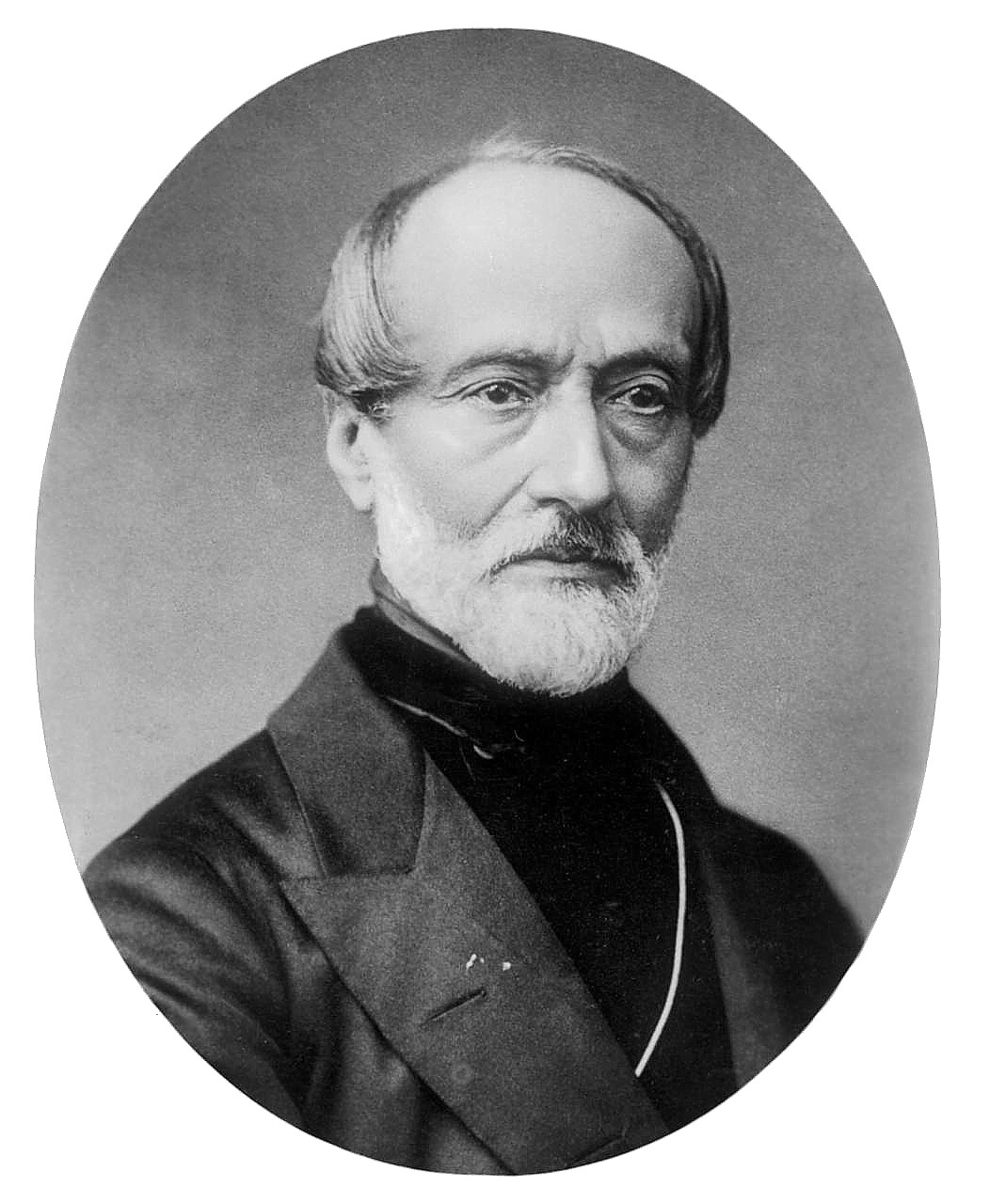 Giuseppe Mazzini
Three leaders were extremely important in the process of unifying Italy. From the “Italian Trinity” of unification—Mazzini, Cavour and Garibaldi—Mazzini was “the beating heart of the Risorgimento.” Mazzini’s importance began long before the revolutions of 1848 or the final unification of the country. During the Revolutions of 1830 one of the most fanatical voices for Italian independence was Giuseppe Mazzini. In other words, it was Mazzini that was the face of the movement to liberate the peninsula from the Habsburgs. Mazzini was a middle-class intellectual from Piedmont. In 1831 he joined the Carbonari, formed the giovane Italia (Young Italy) and planted the ideal of a republic in the minds of many Italians. Giuseppe Garibaldi, who would play a major role in the Roman Republic of 1849, joined the ranks of the Carbonari in 1833. Mazzini saw the nation-state as “the totality of citizens speaking the same language associated together with equal political and civil rights in the common aim of bringing the forces of society progressively to greater protection.” As a radical republican, Mazzini was a vocal advocate of universal male suffrage, a liberal constitution that promised civil liberties and a government of elected officials, responsible to the will of the electorate. Mazzini’s views were highly romantic. In 1831 he penned, “Italians! Dream of the Risorgimento, the resurgence of a united Italy! Italy in popular revolution will be strong enough to defeat three Austria’s!”
Like most romantic thinkers Mazzini believed that for the Italians, and indeed for all people, to reach their full potential as humans, liberty, both personal and national, was necessary. It is in this moral component that 19th-century Romanticism had its most profound impact on nationalist movements. For many Romantics, nationalism was not merely a practical end to a more efficient and modern state. Rather it was an imperative to the progress of human society. Mazzini was a Romantic nationalist in many ways and believed that the unification of Italy was more than just a political exercise, but also had moral, intellectual and spiritual dimensions that would transform Italy and, in turn, the rest of Europe. According to Mazzini, Italian unification would be the result of a massive and spontaneous public uprising; the people would instinctively know how to rise up to overthrow the Habsburg occupiers. Following the revolution, a republican government would rule Italy. For these radical views and for plotting to overthrow the Habsburg government in his native Piedmont, Mazzini was arrested by Austrian officials on 31 October 1831. During his imprisonment he devised the outlines of a new patriotic movement aiming to replace the unsuccessful Carbonari. Although eventually freed, Mazzini chose exile instead of life confined in a tiny Italian village which was requested of him by the police. Mazzini moved to Geneva, Switzerland to wait for the next opportunity of spontaneous revolution in Italy.
By the great year of 1848, Italian nationalists were ready to make another attempt to overthrow the old order Austrian occupation. Momentum toward the Revolutions of 1848 began with the elevation in 1846 of Cardinal Giovanni Maria Mastai-Ferretti to the papacy as Pope Pius IX. The new Pope inaugurated his papacy with some limited reforms—amnesty for political prisoners, reform of Rome’s municipal government, the creation of a civic guard, and the creation of an advisory council of laity—which was greeted with popular enthusiasm throughout the Papal States, but was greeted with concern in Vienna. The Pope stood up to Metternich when the Austrian Foreign Minister placed a garrison of Austrian troops at Ferrara in the Papal States. This act of defiance endeared Pius IX not only to liberals but to liberal nationalists. In all, however, the Pope was far more of a moderate reformer than a confirmed liberal or nationalist as many hoped. Nevertheless, as the urban middle class saw the door to reform open just a tiny crack, they grew determined to push it open further. By the dawn of 1848, liberal ideas were openly discussed throughout Pius’s domains, especially in Rome, eventually spilling over into the Habsburg duchies of Tuscany, Modena, and Parma and, eventually, into Piedmont and the Austrian territories of Lombardy and Venetia.
Revolution erupted, not in Rome or even in Piedmont, but rather in Palermo on the island of Sicily in January of 1848. In very short order the revolutionaries had forced a constitution on the Bourbon King of Naples, Ferdinand II. Even this early success, however, was held back by localism. Much of what drove the Sicilians to revolt revolved around the economic hardships faced by the peasants. Those of the revolutionaries who thought beyond economic complaints to a broader vision wanted a return to a form of constitutional independence that the island enjoyed under Napoleon in 1812, not unification with the Italian states. This, then, would seem to be an example of the divisive manifestation of nationalism with an eye more to the past than to the future. This had the potential to set up competing nationalisms within any broader Italian unification project and in fact demonstrated the divisions that would contribute to the failure of the Revolutions of 1848 in Italy, the German states and within the Habsburg Empire.
In the north, King Charles Albert of Piedmont-Sardinia had begun to follow the reforming examples set by Pope Pius IX in late 1847, granting some civil liberties and eventually a constitution to his subjects. Charles Albert also took this opportunity to expand the Piedmontese army, suggesting that he perhaps had ambitions beyond a more liberal Piedmont. A stronger army, on the other hand, would allow him to resist any threats against his liberal reforms from reactionary, conservative Austria. The likelihood that any such threats could actually be carried out is doubtful. Piedmont-Sardinia was one of the buffer states positioned between France and the rest of Europe by the Congress of Vienna. If Austria were to violate this sovereignty, it would call into question the balance of power established in 1815 and perhaps provoke a reaction from one or more European powers. On the other hand, if Charles Albert saw Piedmont-Sardinia as the anchor-state in a unified Italy as many Piedmontese middle-class liberals had advocated, it would require a strong army to defend such a unified state and to militarily seize the other Italians states from the Austrians. Certainly, there were many liberal nationalists in Piedmont who were urging the king to embark on a crusade of Italian unification. Excitement and enthusiasm for Charles Albert’s reforms spilled into other regions of Italy, including Lombardy and Venetia. Popular demonstrations against the Habsburgs forced a constitution in Tuscany. These demonstrations quickly developed into street fighting in Milan, the capital of Lombardy, by 18 March on news of revolts in Vienna. By 21 March 1848, revolutionary mobs had driven the Austrian garrison of 13,000 troops out of Milan. The pattern repeated itself in Venice, which proclaimed an independent republic on 24 March 1848.
With the Austrian army on the run in Northern Italy, Charles Albert saw his chance to take the reins of Italian unification. The Piedmontese army invaded Lombardy on 23 March 1848 and quickly pushed the relatively small Austrian force to the Venetian frontier. Along the way, volunteers and regular forces from the Papal States and Naples rallied to the Piedmontese flag. Mazzini, who quickly returned back from exile to Lombardy, urged all class and ideological differences to be ignored until the Austrians had been thrown from Italy. By July of 1848 Tuscany, Venetia, Lombardy, Parma and Modena voted to join Piedmont-Sardinia against the Habsburg occupiers.
On 15 June 1848 Field Marshal Radetsky convinced the Habsburg government that war in Italy was winnable. Six days later the Emperor unleashed Radetsky and 75,000 élite Habsburg troops (mostly Serbs and Croats) against the Piedmontese army of Charles-Albert. Radetsky was given a single command: “Save Austrian power in Italy with one decisive battle.” The omens were good. Charles Albert had divided his forces in Lombardy, with 28,000 in front of Verona and another 42,000 laying siege to Mantua. Radetsky planned on driving a wedge between the two armies, destroying one before annihilating the other. The attack began on 22 July. On 24 July 1848 the Piedmontese army was decisively defeated at the Battle of Custozza. The full weight of the Austrian army was brought to bear on the parched and exhausted Italian units, sweeping them from the slopes. For the Italians, the Battle of Custozza was not just a military disaster but a political bombshell: faith in Charles Albert and belief in the dream of Italian unification was all but shattered. From July 1848 to the end of the year, Habsburg troops under Radetsky pounded Italy back into submission. All of the great cities—Milan, Florence, Bologna and Venice—were ringed by Austrian siege trenches and suffered massive weeklong bombardments. Austrian artillery raked the Italian lines. Thousands of civilians died from cholera, starvation and Austrian high-explosive shells. By January 1849 only Rome remained defiant.
Mazzini and two other republicans declared a Roman Republic on 9 February 1849. Pope Pius IX had fled on 24 November 1848 disguised as an ordinary priest. This left a power vacuum to be filled by Mazzini’s radical republicans. The Republic succeeded in inspiring the people to build an independent Italian nation. It also attempted to economically improve the lives of the underserved by giving some of the Church's large landholdings and giving it to poor peasants. What was most remarkable about the Roman Republic were its forward looking reforms. Capital punishment was outlawed. Mazzini insisted that conditions for inmates of prisons and insane asylums were to be dramatically improved. All male Romans were given the vote. The Republic did away with state censorship and public education was wrestled away from the stranglehold of the Vatican. In a remarkable gesture of religious toleration, the Inquisition was outlawed. For the first time in over four hundred years, Roman Jews were allowed to live outside of the ghetto. No longer were they required to wear the Star of David in public. They too could now freely move about Rome as Romans.
The idea of a foreign invasion to restore the Pope to Rome was discussed immediately after the Pope fled to the fortress of Gaeta in the Kingdom of Two Sicilies in November. In February 1849 Cardinal Antonelli proposed that the Catholic powers of Sicily, Spain and Austria, possibly joined by France, should launch a massive invasion of the Papal States to restore the Pope to power. True to his nature of jumping into European adventures, President Louis-Napoleon Bonaparte of France at first wanted to invade Italy to fight Austria. When his advisors tried to point out that France was not at war with Austria, the future French Emperor changed his mind and decided to invade the peninsula to win over the French electorate. After all, what better way to garnish votes in Catholic France than to launch a mighty crusade to rescue the Pope? Louis-Napoleon was also aware that there was now an intense competition in Catholic Europe to see which country would march first. France won. On 24 April 1849 6000 French troops left Marseilles (the port of Nice was still a part of Piedmont-Sardinia) to invade Italy. On 30 April 1849 French troops marched on the Vatican, but assorted Italian democrats—with up to 9000 men commanded by the military genius Garibaldi, who along with Mazzini was another of the “Italian Trinity”, —beat them back, inflicting considerable carnage: the French lost over 500 dead and wounded.
The defeat was deeply embarrassing to Louis-Napoleon, whose fundamental appeal to the French voter was the name “Bonaparte” associated with the military glories of his uncle. Louis-Napoleon was devastated by the setback, worried that the hated Austrians would grab the crown jewel of Rome. In the words of Thiers, a popular French politician, “to know the Austrian flag was flying over the Vatican is a humiliation no Frenchmen could bear to exist.” Action seemed all the more urgent because the Austrians were marching south, the Spanish had embarked some 5000 men bound for Italy and troops from the Kingdom of Two Sicilies were marching north. On 19 May 1849 Garibaldi again displayed his importance and military brilliance, defeating the troops from the Kingdom of Two Sicilies. Wearing his famous red shirt, which Garibaldi claimed was bullet-proof turning him into a ‘red devil,’ the “Italian Napoleon” launched a masterful two-pronged attack winning the day for the Roman Republic.
In a cruel twist of fate, throughout the Revolutions of 1848-1849 the Italian republicans had prayed for French intervention to save them from the Austrians. Eventually France arrived, but it was not on the side of the revolution. Louis-Napoleon was determined not to make the same mistake twice. By 3 June 1849 30,000 élite French troops and over fifty heavy siege guns surrounded Rome. Facing the French were 16,000 Roman led by the brilliant Garibaldi. For three weeks the French pounded Garibaldi’s trenches. French shells rained down on Rome day after day, as French troops moved closer and closer to the city. The night of 29-30 June 1849, three French divisions broke through the walls of Rome. Fighting tooth and nail Garibaldi’s defenders, now all wearing the famous red shirts of their leader, were finally routed. On the morning of 30 June 1849 Garibaldi told Mazzini the military situation was bordering on disaster. Both men wanted to continue the fight, but not at the expense of Roman civilians. Garibaldi proposed melting into the Apennine Mountains to wage a guerrilla campaign against the French and the Austrians. On 2 July 1849 Garibaldi and 3000 men broke through the French lines into the Italian countryside. Pursued by both the French and the Austrians, Garibaldi and his pregnant wife Anita ran day after day. Anita, burning up with fever, finally died in the Comacchio swamps north of Rome. Garibaldi carried her lifeless body around for five days. When he finally reached the Italian coast, Garibaldi had fewer than 300 men. Fleeing Italy, Garibaldi sailed for refuge in the Italian community in New York City. Mazzini fled north once more to exile in Switzerland. Swearing to wear black until Italy was unified, Mazzini spent the rest of his life talking to his pet canaries about what might have been.
On 4 July 1849 the “Red Triumvirate,” so called because it consisted of three cardinals who dressed in scarlet, returned to Rome accompanied by French soldiers with fixed bayonets. On 12 September 1849 the Red Triumvirate reintroduced the death penalty (by guillotine), restored public flogging and the Inquisition, and ordered the Jews back into the ghetto. When the Pope eventually returned to Rome in April 1850 it was to a sullen, depressed reception. French troops propped up the Pope until they were withdrawn at the outbreak of the Franco-Prussian War in 1870.
How then do the 1848 spasms of Italian nationalism relate to the great unification projects of the coming decades? The participation of established rulers, especially the Pope and Charles Albert, gave the impression of a true nationalist movement that encompassed all social classes. While this might have been the reality in some of the Italian states, the reality was that the relationship between the ten Italian states was much more complex than “working towards Italian unification” and, more importantly, eventually one of these states would have to dominate the others in order to unify the peninsula. The Italian peninsula was infected with the disease of “regionalism.” What was good for one region of Italy, say Piedmont-Sardinia or Venetia was considered unacceptable to the others. Sicily had little in common with Tuscany. In addition, the inclusion of all social classes in the Revolutions of 1848 was an initial benefit, but ultimately led to serious fragmentation in the revolutionary cause. Plunging as it did into a war against Austria at the very onset of the revolution did not allow the various class interests to negotiate a mutually satisfactory social platform for the “new” states such as Lombardy, Venetia, Tuscany, and Rome. The pressures of war expose cracks in the social foundation of even the most stable societies, let alone those barely a few months old. Also the doomed Roman Republic of Mazzini and Garibaldi showed the extent to which popular and Romantic enthusiasm can carry a cause in the face of large and organized states and the overwhelming military might they can muster. Future nationalist interests would have to wed popular enthusiasm with the kind of administrative and military stability of established states. In short, Mazzini’s vision of spontaneous, popular revolutions held little weight against the might of superior firepower.
.