Robustness & Adaptation
Key Terms
Cells
Cells are adaptable and robust, so they are able to cope with a wide variety of environments.
Extreme Environments
Temperature extremes
low oxygen environments
low nutrient environments
toxic environments
Robust
Robustness - The ability of a cell to maintain performance and function in the face of internal and external perturbations
which genes are essential depends on:
environment conditions
which other genes are also expressed
Core essential genes | Conditional essential genes |
Cell cycle | Metabolism |
RNA processing | Morphogenesis |
Ribosome biogenesis | Transport |
Translation | Signalling & communication |
Protein degradation | Stress responses |
A recent study in human cells identified 1,878 essential genes for cell proliferation and survival out of 18,166 genes studied .
Cell proliferation is the process by which cells grow and divide to produce more cells.
9.2% of our genome is essential for cell survival.
Dynamic
Dynamic - Cells need to be able to adapt to changes in their environment
The cells contain duplicate information, so if one cell fails, the system can continue operating correctly.
so has redundancy and is fault tolerant
Surviving High temperatures
slight increases in temperature can be beneficial in the short term but at higher temperatures cells encounter problems and become stressed.
Changes:
more saturated fatty acids = more vicious
more cholesterol = more stable
introduction of heat shock proteins
Heat Shock Proteins - A group of proteins that are produced when a cell is exposed to elevated, sub-lethal temperatures.
protect the cell if it is subsequently exposed to what would have been lethal temperature rises.
They increase in expression in response to other stresses such as deprivation of oxygen or nutrients.
Function - help proteins fold properly so they can then function properly.
Examples
Deep-sea hydrothermal vents can harbour a variety of life despite high pressure and temperatures in the range of 85-120°C.
Geogemma barossii is a prokaryote from the Archaea domain that was found growing in a sulphur and iron-rich hydrothermal vent at 121°C and can survive at 130°C.
Adaptations include: DNA content (high GC levels in third codon position), supercoiling DNA, temperature stable proteins and changes to membrane composition (including ether bonds in phospholipids rather than ester bonds).
Surviving in low temperatures
problems caused by:
slow enzyme reactions
rigid & viscous membranes
Ice crystals
Examples
Antifreeze glycoproteins are used by Antarctic fish to stop them freezing.
Can stop ice crystal formation down to -2 ⁰C
Some animals can even freeze solid and survive temperatures as low as -16 ⁰C
The wood frog, Rana sylvatica, can survive multiple freeze-thaw cycles through the use of antifreeze glycoproteins and high glucose levels.
These biological antifreezes have important medical applications where low temperature storage is required and ice crystal formation is damaging e.g. including improved protection of blood platelets and human organs at low temperatures.
Bacteria
Many bacterial species thrive at low temperatures.
The record is held by Planococcus halocryophilus, a bacteria that can grow at -15˚ C and stay metabolically active at -25˚ C
Psychrophiles have proteins and metabolism optimised for cold temperatures.
Metabolism is very slow.
Proteins are structurally much more flexible.
Glycoproteins & Glycolipids
Glycoproteins - proteins with sugars attached
formed through glycosylation
this is a post-translational modification
Glycolipids are also present in the plasma membrane and have similar protective functions
Many glycoproteins are present in the plasma membrane with the carbohydrate region presented outside the cell.
The attached sugars function to stabilise the protein structure in the extracellular environment therefore offer some protection from the environment
Carbohydrates are attached to proteins in the rough ER.
A glycosidic bond links a carbohydrate to the side chain of the amino acids asparagine (N-linked) or to the side chain of serine or threonine (O-linked).
Surviving low oxygen
Importance of oxygen
essential in ATP synthesis as it is the final electron acceptor
accounts for 90% of the total oxygen uptake in most cells
low oxygen levels are therefore extremely toxic to cells and lead to them dying through necrosis
How does low oxygen occur
oxygen concentration decreases quickly as the distance from the blood vessels increases
cells are usually within 0.5mm of a blood vessel
Hypoxia can set in at 150 nanometers from a blood vessel
Hypoxia
when environmental oxygen levels are low
in premature babies
following poisoning
anaemia
Hypoxia causes
Ischaemia - blood supply is cut off following heart attacks and strokes
Cancer - tumour growth collapses blood vessels
Cellular response to Hypoxia
Cells have special oxygen sensing mechanisms.
A range of transcription factors (Hypoxia Inducible Factors, or HIFs) move to the nucleus and alter gene expression in response to hypoxia.
HIFs are normally degraded by the proteasome when oxygen is present.
The cell cycle stops (arrested at G1 phase)
The cell switches to glycolysis and anaerobic metabolism to produce ATP
There is rapid down-regulation of protein synthesis
Angiogenesis
Making new blood vessels
in response to hypoxia, cells activate a range of hypoxia response genes
these genes are growth factors that stimulate cells in the nearby blood vessels to branch off, proliferate and move towards the hypoxic cell, thus delivering oxygen to the deprived area.
Surviving in nutrient deprivation
Quiescence - state of reversible cycle arrest that can grant protection against many environmental stresses, including nutrient deprivation and starvation.
Also helps cells survive low temperature and low oxygen.
Cellular quiescence is often (but not always) associated with a low metabolic state characterized by a decrease in glucose uptake and glycolysis, reduced protein synthesis rates and activation of autophagy as a means to provide nutrients for survival.
Autophagy - a protective mechanism that allows cells to survive in response to multiple stresses including deprivation and starvation
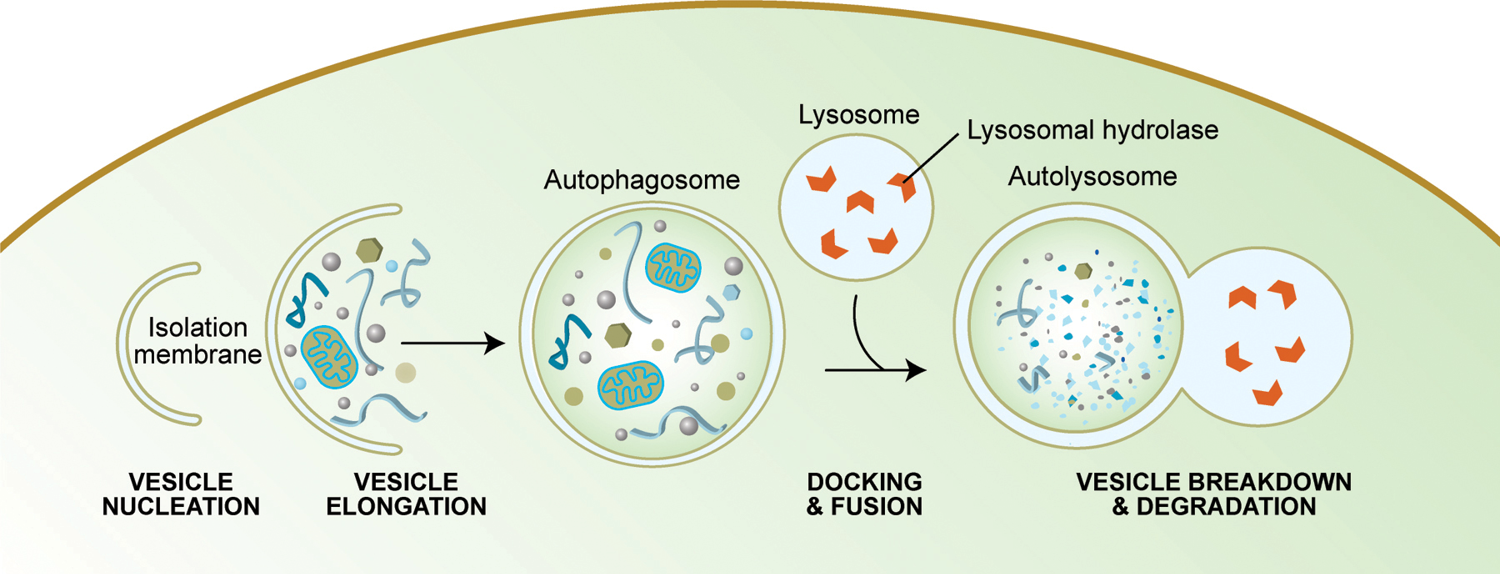
During autophagy, cells form double-membraned vesicles, autophagosomes, that sequester organelles, proteins, or portions of the cytoplasm for delivery to the lysosome.
The membrane to form autophagosomes comes from existing organelles such as the ER, Golgi, plasma membrane or mitochondria.
This allows rapid formation of autophagosomes in response to stress.
Lysosomes - Contain a loads of degradative enzymes
Fusion of lysosomes with autophagosomes leads to degradation of the contents.
This allows cells to eliminate damaged or harmful components and recycling their constituents to maintain nutrient and energy homeostasis.
On a smaller scale to autophagy, the proteasome is also able to recycle cellular components.
Proteasomes - multi-protein complexes that are able to degrade unwanted or damaged proteins, effectively recycling the amino acids to allow for more protein synthesis.
It plays an important role in the general stress response including heat shock, infection and oxidative stress by degrading damaged or misfolded proteins proteins
Surviving toxic environments
Cells can be exposed to a wide variety of damaging, toxic environments. These include:
• Radiation (especially UV light)
• Free radicals and oxidative stress
• Toxins and poisons (from bacteria, food etc)
These toxic agents can cause a wide variety of damage to the cell, so the cell needs a flexible system for both protecting itself and for repairing the damage.
The process of producing ATP through the electron transport chain relies on oxygen as the ultimate electron acceptor.
In this last step oxygen accepts four electrons. Sometimes this doesn’t work properly and highly reactive oxygen species are created.
Anti-oxidant defences
Cells have a range of anti-oxidant defences that help protect it from damage.
Glutathione is the major anti-oxidant in cells. It is synthesised in high amounts in cells (up to 5 mM in the liver). In its reduced form it readily donates electrons to reactive oxygen species, forming more stable molecules.
Superoxide dismutases are enzymes that convert highly reactive superoxide free radicals (O2-) to less reactive hydrogen peroxide (H2O2).
Catalase (located in peroxisomes) then converts hydrogen peroxide to water and oxygen.
Repairing DNA damage
Damaged DNA must be repaired or mutations (permanent alterations to the DNA) will be formed.
In the DNA damage response cells do the following:
DNA damage is detected
Cells stop going through the cell cycle
DNA repair is initiated
If the DNA damage is too extensive the cell undergoes apoptosis


Cancer
Cancer is a disease that is characterised by a loss of control over our own cells.
This is a problem for all multicellular life.
Loss of control happens when genetic damage occurs in cells that is not correctly repaired and the mutations are passed on to daughter cells during mitosis.
Some mutations can change the way cells respond to signals, meaning that these cells proliferate when they shouldn't.
The mechanisms that allow cells to cope with stress - robustness - also help to prevent cancer which is why cancer is generally a disease associated with old age.