Star Formation and Stellar Evolution
Foundations of Stellar Physics and the Hertzsprung-Russell Diagram
Fundamental Principles of the Main Sequence:
Stars spend the majority of their active stellar lifetimes on the main sequence of the Hertzsprung-Russell (H-R) diagram (approximately ).
A star located on the main sequence is defined by three core physical conditions:
It is in hydrostatic equilibrium, where inward gravitational force is balanced by outward pressure (dominated by thermal gas pressure in solar-mass stars).
It sustains steady nuclear fusion of hydrogen () into helium () within its central core.
The star is in approximate thermal equilibrium: energy generated by nuclear fusion balances energy radiated from its surface, with energy transported through radiation and/or convection.
The Mass-Luminosity and Lifetime Relations:
Main-sequence stars adhere to an empirical mass-luminosity relationship:
Because the total available fuel is proportional to stellar mass (), the main-sequence lifetime () depends inversely on stellar mass:
Applying solar values yields the normalized lifetime equation:
Consequence: Higher-mass stars possess substantially more fuel than low-mass stars, but consume it at disproportionately extreme rates, resulting in dramatically shorter main-sequence lifespans.
Theoretical versus Observational H-R Diagrams:
Theoretical Coordinates:
Vertical axis: Stellar luminosity ( or ), plotted on a logarithmic scale increasing upward.
Horizontal axis: Effective surface temperature (), measured in Kelvin (), plotted on a logarithmic scale increasing to the left (hotter stars on the left, cooler stars on the right).
Stefan-Boltzmann connection: Stellar luminosity, radius, and effective temperature are fundamentally linked across the H-R diagram by:
Observational Coordinates:
Vertical axis: Absolute visual magnitude (), plotted with brighter absolute magnitudes at the top and dimmer at the bottom.
Horizontal axis: Colour index () or spectral classification (), arranged from hot blue stars on the left to cool red stars on the right.

Stellar Demographics and Timescales on the H-R Diagram:
Stars preferentially populate well-defined loci: the Main Sequence (Luminosity Class ), Giant branches (Luminosity Classes ), Supergiants (Luminosity Class ), and the White Dwarf sequence.
Regions devoid of stars correspond to either physically impermissible combinations of and , or evolutionary phases traversed so rapidly that the statistical probability of observing a star in that transition is vanishingly small.
Demographic Analogy: In a census of human height versus weight, the majority of individuals are observed as adults because that stage spans the longest duration of a human lifespan, just as stars are predominantly observed along the main sequence.

The Interstellar Medium and the Star-Gas-Star Cycle
Galactic Recycling Mechanism:
Dense, cold giant molecular clouds () contract under gravity to form stars and planetary systems.
Nuclear fusion inside stellar cores synthesizes heavier elements from primordial hydrogen and helium.
At the ends of their lifetimes, stars return chemically enriched material to the interstellar medium (ISM) via stellar winds, planetary nebulae, and core-collapse supernovae.
Hot expanding bubbles of gas () cool and blend into diffuse atomic hydrogen clouds ().
Gravity and cooling assemble diffuse atomic clouds into cold, high-density molecular clouds, restarting the cycle.

Protostellar Collapse and Pre-Main-Sequence Evolution
Initial Cloud Conditions and Inside-Out Collapse:
Star formation takes place in cold molecular clouds characterized by temperatures of .
At these temperatures, the thermal random velocities of gas molecules are low, as given by the root-mean-square thermal speed:
Internal thermal pressure is insufficient to support dense clumps against self-gravity, initiating gravitational collapse from the inside out: an initial dense core forms first and grows by accreting infalling envelope material.
Angular Momentum Conservation and Protoplanetary Disks:
Contracting cloud fragments typically possess non-zero initial angular momentum.
By conservation of angular momentum (), the rotation speed () increases as the radius () shrinks.
Centrifugal force opposes collapse perpendicular to the rotation axis, flattening infalling material into a circumstellar disk.
Magnetic fields launch collimated bipolar jets along the rotation axis, removing excess angular momentum.
Material in the residual disk that is not accreted by the star forms the reservoir for planet formation (typical disk sizes span a few hundred ). Concentric gaps observed in dust disks (such as HL Tau) may indicate developing protoplanets.
Stages of Low-Mass Star Formation (Green 2001 Sequence):
Stage a (Dark Cloud): Localized dense cores within cold molecular clouds ().
Stage b (Gravitational Collapse): Onset of dynamic inside-out collapse (, ).
Stage c (Protostar): Central protostellar core surrounded by an infalling envelope, a circumstellar disk, and bipolar outflows (, timescale ).
Stage d (T Tauri Star): Classical T Tauri star with an active protoplanetary accretion disk and bipolar flows (, timescale ).
Stage e (Pre-Main-Sequence Star): Weak-line T Tauri star surrounded by a planetary debris disk with emerging planetesimals (, timescale ).
Stage f (Young Stellar System): Mature planetary architecture surrounding a zero-age main-sequence star (, attained after ).

Pre-Main-Sequence (PMS) Tracks on the H-R Diagram:
Hayashi Track (Early Contraction): A young protostar is relatively large and cool (, ), but its large surface area gives it a luminosity of several solar luminosities, placing it above the main sequence. The star is fully convective; as it contracts under gravity, it radiates thermal energy into space and descends nearly vertically on the H-R diagram.
Henyey Track (Radiative Core Development): As interior temperatures rise, energy transport transitions to radiation within the core. The evolutionary track turns horizontally to the left on the H-R diagram: luminosity remains roughly constant while effective surface temperature rises.
Zero-Age Main Sequence (ZAMS) Arrival: Sustained core hydrogen fusion supplies sufficient energy to balance the energy radiated from the surface, establishing thermal equilibrium and ending sustained gravitational contraction. (A contracting pre-main-sequence star can already be approximately in hydrostatic equilibrium; hydrostatic and thermal equilibrium are distinct physical conditions).

Stellar Mass Dependence of Contraction Timescales:
Higher-mass protostars collapse substantially faster because stronger gravitational acceleration and higher luminosities allow them to radiate gravitational potential energy more rapidly:
star:
star:
star:
star:
star:
A solar-mass star spends approximately contracting to the ZAMS, which represents approximately of its main-sequence lifetime:
Comparative coeval evolution: An star completes its entire main-sequence lifespan in approximately:
In a coeval stellar cluster at an age of , as the star evolves off the main sequence, a star will have reached the ZAMS (requiring ), but a star will still be contracting as a pre-main-sequence object (requiring ).

Post-Main-Sequence Evolution of Low-Mass Stars (, Approximate)
General Principle of Shell Burning:
Successive nuclear fuels burn first in the central core and subsequently in a shell surrounding the core.
Core Hydrogen Exhaustion and Subgiant Transition:
When core hydrogen is exhausted, nuclear energy generation ceases in the core. In a solar-mass star, thermal gas pressure provides the primary support during the main sequence; without fusion energy input, the helium core contracts under gravity and heats up.
The heating of overlying layers ignites hydrogen shell burning () around the inert helium core.

The Red Giant Branch (RGB):
Hydrogen shell burning generates an intense outward energy flux, driving a massive expansion of the outer envelope ().
The expanding gas cools down (), shifting emission to red wavelengths.
Total luminosity increases to hundreds or thousands of solar luminosities, ascending the Red Giant Branch.
The RGB phase lasts roughly of the star's main-sequence lifetime.

Degenerate Matter and Helium Ignition
Quantum Mechanics of Degeneracy:
As the inert helium core of an RGB star contracts, central density reaches extreme levels ().
At sufficiently high densities, electrons occupy progressively higher momentum states because the Pauli exclusion principle prevents identical electrons from occupying the same quantum state.
The resulting resistance to further spatial compression is electron degeneracy pressure.
Thermal Decoupling:
In an ideal gas, pressure depends directly on temperature (), providing an internal thermostat: heating increases pressure, causing expansion and cooling.
In a non-relativistic degenerate electron gas, pressure depends predominantly on density:
Degeneracy pressure is approximately independent of temperature in the strongly degenerate limit (). Raising the temperature produces virtually no pressure change, disabling the star's negative feedback expansion mechanism.
Helium Ignition and the Helium Flash:
Shell burning continually deposits helium ash onto the core, raising its temperature.
Mass Dependence of Ignition:
In low-mass stars below approximately , that reach helium ignition, the helium core becomes electron-degenerate before helium fusion begins. When , helium ignites explosively via a runaway thermonuclear event termed the helium flash.
In intermediate-mass stars (), the central core remains non-degenerate or only weakly degenerate, leading to a generally quiescent, non-degenerate helium ignition. (The exact boundary depends on stellar composition and internal physics).
Triple-Alpha Reactions:
Step 1:
Step 2:
Secondary capture:
The intermediate beryllium-8 nucleus is extremely unstable and forms without requiring gamma emission.
Because the triple-alpha fusion rate is extraordinarily sensitive to temperature () and a degenerate core cannot expand to cool itself, a runaway reaction occurs in low-mass cores.
This runaway does not disrupt the star. Within minutes to hours, internal core temperatures exceed , lifting electron degeneracy. The core expands, cools, and establishes stable, non-degenerate core helium fusion.
The Horizontal Branch and Asymptotic Giant Branch (AGB)
The Horizontal Branch (HB):
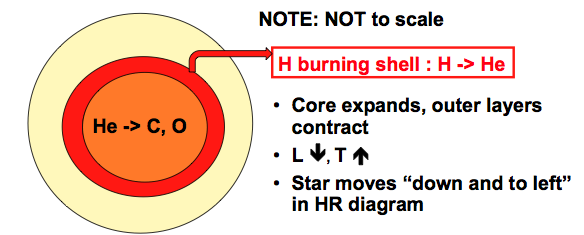
Following helium ignition, the star achieves stable core helium fusion () alongside a hydrogen-burning shell ().
Core expansion reduces gravitational pull on the hydrogen shell, reducing shell luminosity. The envelope contracts and warms (, ), moving down and to the left on the H-R diagram.
The Asymptotic Giant Branch (AGB):
When core helium is depleted, an inert carbon-oxygen core () contracts under gravity.
The star establishes double shell burning: an inert C-O core, surrounded by a helium-burning shell, surrounded by a hydrogen-burning shell, enclosed within an expanded convective envelope.
The star ascends the H-R diagram a second time along the Asymptotic Giant Branch.
Comparative Internal Stellar Structures:
Property | Red Giant Branch (RGB) | Horizontal Branch (HB) | Asymptotic Giant Branch (AGB) |
|---|---|---|---|
Core Composition | Inert Helium () | Helium, Carbon, Oxygen () | Inert Carbon and Oxygen () |
Core Fusion | None | Helium () | None |
Hydrogen Shell Fusion | Yes () | Yes () | Yes () |
Helium Shell Fusion | No | No | Yes () |
Core at Transition | Contracts and heats | Expands and cools | Contracts and heats |
Envelope Behaviour | Expands and cools | Contracts and warms | Expands and cools |

Death of Low-Mass Stars: Planetary Nebulae and White Dwarfs
Planetary Nebula Ejection:
On the late AGB, the distended envelope is weakly bound gravitationally.
The mechanisms driving outer-envelope ejection are not fully understood, but proposed mechanisms include radial shock waves, radiation pressure on condensed dust grains, and thermal pulses from periodic helium shell flashes.
Mass Loss Distinction: While a solar-mass star sheds an envelope of order (roughly of its mass) during the planetary nebula event itself, a Sun-like star loses considerably more than of its initial mass across its entire evolutionary lifespan through cumulative stellar winds. An ZAMS star can lose enough mass to be reduced to within .
Lifetimes: The oldest observed planetary nebulae are approximately old; expanding envelopes dissipate into the ISM within .
Nomenclature: Historical naming reflects their visual planet-like disk appearance through small telescopes; they share zero physical connection with planets. Examples include the Ring Nebula (M57), Dumbbell Nebula (M27), and Cat's Eye Nebula (NGC 6543).
White Dwarf Remnants:
Core Physics: Stars with initial masses below the approximate boundary of generally do not reach the temperatures () required for core carbon ignition, leaving carbon-oxygen remnants (though some stars near the upper end of the intermediate-mass range can form oxygen-neon white dwarfs). Core collapse halts when electron degeneracy pressure balances gravity.
Sirius B was the first white dwarf discovered; billions of white dwarfs exist in the Milky Way.
Dimensions and Density: Typical masses range between compressed into an Earth-sized radius (), yielding extreme central densities of:
Mass-Radius Relationship: In non-relativistic degenerate matter, adding mass forces electrons into higher momentum states, causing an inverse mass-radius relation:

Cooling: White dwarfs generate no internal nuclear energy. Initial surface temperatures can reach approximately , but small surface areas limit total luminosity. As they radiate thermal energy at approximately constant radius, luminosity and temperature decrease over timescales exceeding .
The Chandrasekhar Limit and Type Ia Supernovae:
Electron degeneracy pressure cannot support a cold, non-rotating white dwarf above the Chandrasekhar limit:
Accreting carbon-oxygen white dwarfs in binary systems approaching or reaching this threshold can undergo runaway thermonuclear disruption as Type Ia supernovae (distinct from core-collapse events).
Post-Main-Sequence Evolution of High-Mass Stars (, Approximate)
Advanced Nuclear Burning Stages:
In massive stars, core contraction generates extreme temperatures and pressures, igniting advanced burning stages without entering electron degeneracy during intermediate stages.
Successive nuclear burning stages become progressively shorter because later fuels release less usable nuclear energy per unit mass, while increasingly severe neutrino losses drain energy from the core.
The star develops an onion-skin internal architecture of concentric fusion shells surrounding an inert iron core.
Successive Nuclear Burning Stages ( Star):


Fuel and Reaction | Central Core Temperature () | Timescale | Percentage of Lifetime |
|---|---|---|---|
* (lecture slide value; CNO fusion operates at ) | |||
The Iron Dead End:
Iron-group nuclei lie near the maximum nuclear binding energy per nucleon (peaking near nickel-62 and iron-56).
Neither ordinary fusion into heavier nuclei nor fission into lighter nuclei provides a significant energy source capable of sustaining the stellar core.

Core Collapse, Supernovae, and Compact Remnants
Mechanics of Core Collapse:
Silicon shell burning continually deposits iron ash onto the core until the degenerate iron core mass exceeds the Chandrasekhar mass ().
At the onset of collapse, the core radius is . The core collapses in less than a second ().
Photodisintegration: Extremely high core temperatures () produce gamma-ray photons that dissociate iron nuclei into helium, protons, and neutrons: This endothermic dissociation removes thermal kinetic energy and accelerates gravitational collapse.
Electron Capture (Neutronization): As densities rise, electrons are captured by protons, producing neutrons and neutrinos: Electron capture reduces the number of free electrons, decreasing electron degeneracy pressure and further accelerating collapse.

The Core Bounce and Type II Supernova:
Dynamic collapse halts when the core reaches nuclear density:
At nuclear density, the core strongly resists further compression due to neutron degeneracy pressure and short-range repulsive nuclear forces.
Infalling outer layers rebound off the compressed core; neutrino heating can revive the stalled shock wave, driving dynamic envelope expulsion.
The resulting Type II Supernova may eject over of the star's mass into the ISM.
Typical Core-Collapse Supernova Energy Scales:
Neutrino emission:
Ejecta kinetic energy:
Electromagnetic radiation:
(Illustrative orders of magnitude on a logarithmic scale; the lecture syllabus quotes for the kinetic and electromagnetic burst scale).
Notable remnants: Supernova 1987A (LMC) and the Crab Nebula (remnant of SN 1054 containing a central pulsar).
Compact Remnant Determinations:
Remnant identity depends on both initial ZAMS mass and cumulative mass loss prior to core collapse, characterized by approximate simplified thresholds:
Neutron Stars (, Approximate Threshold):
Remnant core mass remains below the maximum supportable limit (, an approximate simplified model threshold).
Typical mass , radius .
Mean density matches the nuclear density regime:
Supported primarily by neutron degeneracy pressure alongside nuclear forces.
Black Holes (, Approximate Threshold):
Remnant core mass exceeds the neutron degeneracy limit (, approximate simplified threshold).
Gravity overwhelms all repulsive forces, collapsing the core to a gravitational singularity enclosed by an event horizon from which no light can escape.
Systematic Evolutionary Summary
H-R Diagram Evolutionary Directions (Sun-like Star):
Evolutionary Stage | Luminosity () | Effective Surface Temperature () |
|---|---|---|
Hayashi Track | Decreases | Nearly constant |
Henyey Track | Approximately constant | Increases |
Red Giant Branch (RGB) | Increases | Decreases |
Horizontal Branch (HB) Transition | Decreases | Increases |
Asymptotic Giant Branch (AGB) | Increases | Generally decreases |
White Dwarf Cooling | Decreases | Decreases |
Comparative End States by Stellar Mass:
Initial Mass Regime | Post-Main-Sequence Stages | Envelope Fate | Final Remnant | Principal Support Mechanism |
|---|---|---|---|---|
Low to Intermediate Mass (, approximate) | RGB Helium ignition (flash in stars ) HB AGB | Envelope driven off as Planetary Nebula ( in PN phase; substantial mass lost over lifetime) | Carbon-Oxygen White Dwarf (, ) | Electron degeneracy pressure |
High Mass (, approximate) | Successive non-degenerate core/shell burning () to iron core | May eject over of stellar mass in Type II Supernova | Neutron Star (, ) | Neutron degeneracy pressure and nuclear forces |
Very High Mass (, approximate) | Successive core and shell burning produces an iron core, followed by core collapse. A black hole forms if the remnant exceeds the approximate support limit. () | Type II Supernova / direct collapse | Black Hole | None (gravity overcomes all forces; singularity) |
