20.4 The pH of weak acids
For monobasic acid, HA in aqueous solution
a strong acid HA completely dissociates

a weak acid HA partially dissociates

 [H+(aq)] depends on
the concentration of the acid [HA(aq)]
the acid dissociation constant Ka.
When HA molecules dissociate, H+(aq) and A-(aq) ions are formed in equal quantities.

 Approximation 1
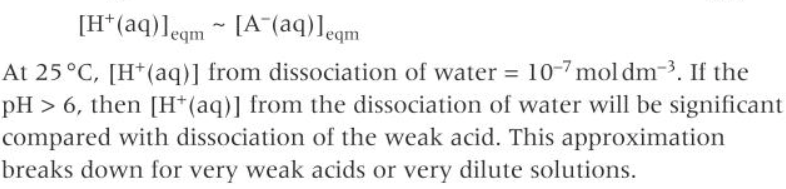
HA dissociates to product equilibrium concentrations of H+(aq) and A-(aq) that are equal. there will also be a very small concentration of H+ (aq) from the dissociation of water but this will be extremely small and can be neglected compared with the H+ concentration from the acid.

Approximation 2
The equilibrium concentration of HA is smaller than the undissociated concentration.
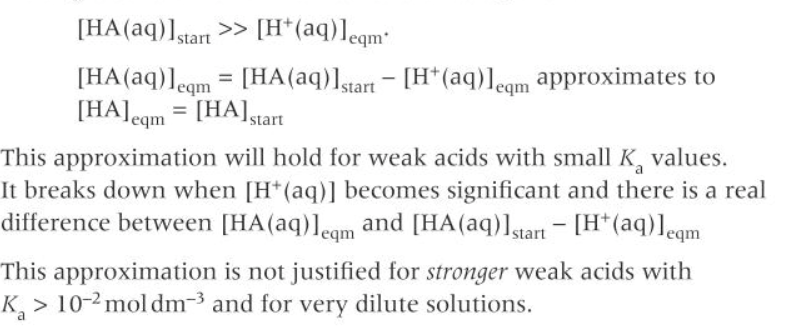
 As the dissociation of weak acids is small, you can assume that [HA(aq)] start » [H+(aq)] and you can neglect any decrease in the concentration of HA from dissociation.
[HA(aq) eqm = [HA(aq) start
Simplifying the Ka expression
By applying the two approximations, the Ka expression can be greatly simplified.
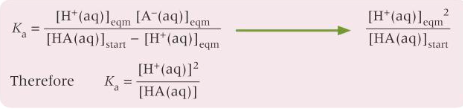 Provided that two of [H+(aq)] (or pH), Ka and [HA(aq] are known, you can always calculate the third quantity.
 Calculating pH
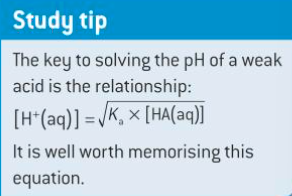
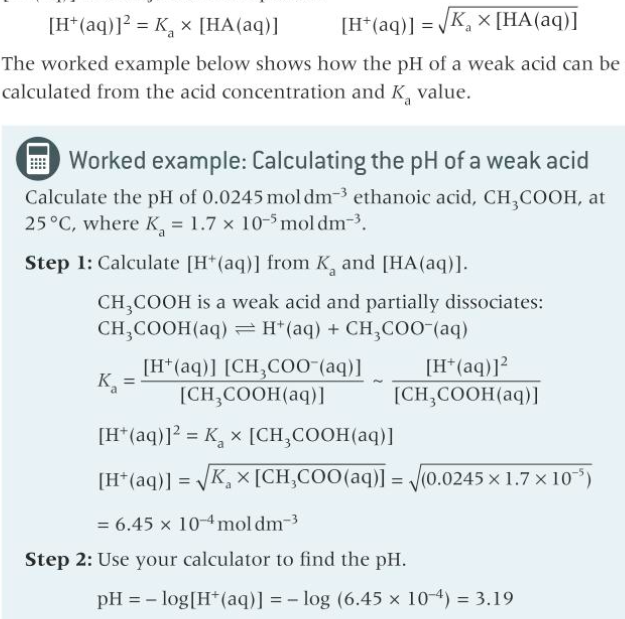
To calculate pH using the Ka expression above, you first need to make [H+(aq)] the subject of the equation.
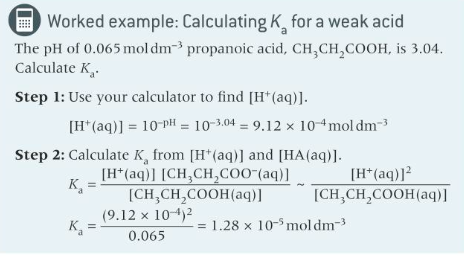
 Determination of Ka
Experimentally the Ka for a weak acid can be determined by
preparing a standard solution of the weak acid of known concentration
measuring the pH of the standard solution using a pH meter.
Approximations in calculations involving weak acids
Approximation 1
The first approximation assumes that the dissociation of water is negligible.
 Approximation 2
The second approximation assumes that the concentration of acid is much greater than the H+ concentration at equilibrium.