RSM LECTURE 3 Strategic Human Resource Management Notes
Strategic Human Resource Management (SHRM) and Personal Development
Topic: Strategic Human Resource Management (SHRM) and Personal Development
Focus areas:
SHRM aims to align human resource activities with the overall goals of the organization.
Personal development as a key component of SHRM: reflect on what you have done since the first class for your own development.
Case example referenced:
Google Case: Introduction to SHRM; Work environment and practices at Google used as a practical illustration of SHRM concepts.
Questions to consider (implied from the slide):
What can personal development look like in the context of SHRM?
How do organizational practices at a company like Google illustrate SHRM principles?
Google's SHRM and Work Environment
Visit to Google HQ (Toronto) and the Google Work Environment:
Prompt questions:
Is Google’s working environment a key contributor to their success?
Covers basic needs: prepared meals free employees’ mental space → focus on important tasks.
Incentives to stay longer: free breakfast, lunch, other perks encourage extended office time.
Recreational areas (billiards, games) → encourage breaks, creativity, and community-building.
Supports collaboration, innovation, and employee retention.
What potential drawbacks might accompany their approach?
High costs: providing meals and amenities is expensive.
Distractions: stimulating environment can reduce focus; discipline harder to enforce.
COVID reduced in-person interaction → less effective collaboration.
Hard to measure cause and effect: performance may be due to talented hires rather than environment.
Autonomy makes monitoring productivity and mistakes difficult.
Unclear if rewards focus on input (effort/time) or output (results).
Budget cuts can make differences in perks noticeable → impact morale. (spam v. filet mignon)
Notable perks at Google:
Free food and lunches
Billiards and games
Google Help Center
SHRM Explained: The Pattern of Planned Human Resource Deployments and Activities
Definition:
Planned HR activities to achieve organizational goals.
Align HR strategy with overall business strategy.

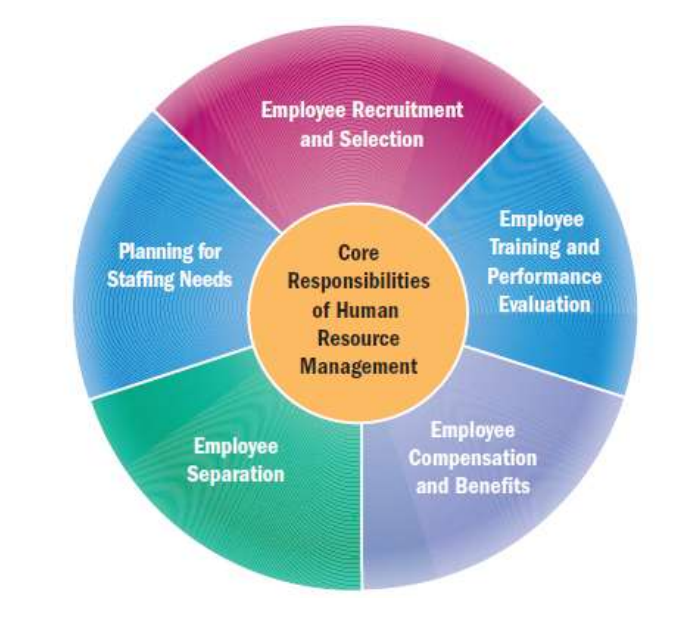
HRM Responsibilities: PEIA
Planning: anticipate talent needs, define roles.
Implementation: recruit, train, deploy effectively.
Evaluation: monitor performance, assess outcomes.
Alignment: ensure HR supports organizational objectives.
Disney Example:
Employees trained to be happy → brand image.
Training refines desired traits; hire for innate qualities (patience, friendliness, empathy).
Emotional intelligence: respond to kids appropriately.
Traits you can’t teach: bad attitude, lack of patience/friendliness.
Example: Shepherd hired for patience → good guest care.
Key Skills / Takeaways:
Delegation: hire right people, keep right people.
MGT100 Case Example:
Managing TAs → emails, test prep, admin, research/case prep.
Assign tasks efficiently (e.g., Case Competition to one person).
Effective delegation + right hires = smoother operations & alignment with goals.
HR Practices: Recruitment, Appraisal, Compensation
Recruitment and Selection
Recruiting techniques evolve with technology; internet recruitment is quick, efficient, and inexpensive.
Large pool of candidates via online platforms (e.g., monster.ca).
Use of social networking sites for reaching candidates.
Legal requirements in recruitment and selection; noncompliance risks: litigation, bad publicity, poor morale.
Cost considerations: recruiting and hiring is costly for employers.
Some employers use employment tests (e.g., mechanical, computer, language skills).
Canada Human Rights Commission considerations in hiring processes.
Performance Appraisal
Definition: Evaluation of and feedback on an employee’s job performance.
Effective performance reviews:
Conducted several times a year.
Linked to organizational goals.
Based on objective measures.
Conducted as a two-way conversation.
Peer reviews: some firms assess performance of co-workers.
360-degree performance review: feedback from a panel including co-workers, supervisors, team members, subordinates, and sometimes customers.
Performance Appraisals and Balanced Scorecard (as a framework):
Dimensions include Financial, Customer, Internal Process, Learning and Growth.
Metrics may cover: efficiency improvements, cycle time, training provided, conferences attended, new customers, customer satisfaction, profitability, sales.
Compensation
Five factors influencing compensation decisions:
What competing companies are paying ()
Government regulation
The cost of living
Company profits
Employee productivity
Definitions:
Salary: pay on a periodic basis (e.g., weekly, monthly).
Wage: pay based on hourly rate or the amount of work accomplished.
Compensation: the total amount employees are paid in money and benefits.
Flexible Work, Employee Separation & Downsizing
Flexible Benefits
Many companies offer flexible time-off policies instead of fixed holidays, vacation, and sick days.
Employees can use paid time off (PTO) as they wish.
Flexible benefits are expensive for employers but provide options (medical, dental, vision, life, disability insurance).
Flexible Work Arrangements
Flextime: employees set their own hours within firm constraints.
Compressed workweek: same total hours in fewer days.
Job sharing: two or more employees share the duties of one job.
Home-based work: telecommuting from home.
Implication: 70% of Generation Y professionals value work-life balance (as a proxy for flexibility).
Monitoring Work From Home Activity
Performance Appraisal: Evaluation of and feedback on an employee’s job performance
Effective performance reviews:
Take place several times a year
Are linked to organizational goals
Are based on objective measures
Take place in the form of a two-way conversation
Some firms conduct peer reviews (assess performance of coworkers)
May conduct a 360-degree performance review, a process that gathers feedback from a review panel that includes co-workers, supervisors, team members, subordinates, and sometimes customers
Balanced Scorecard: Looks beyond financial achievements of an employee

Why do we look at all aspects instead of only financial?
If you focus on financial - you’re only looking at short-term
If you focus on other things - you’re seeing how it will affect you in the longer term
Employee Separation
Voluntary turnover: employees leave to start their own business, join other firms, or retire.
Exit interviews to understand reasons for leaving.
Importance of retaining top performers for organizational success.
Is our good talent going to leave because the others left?
Involuntary turnover: terminations due to poor performance, unethical behavior, or downsizing.
Legal considerations require careful documentation of termination reasons.
Team Dynamics affected
Downsizing and Outsourcing
Downsizing: reducing headcount by eliminating jobs.
Negative effects: heightened anxiety, health problems, lost productivity among remaining staff; expensive severance; potential negative domino effects on the local economy.
Outsourcing: using external vendors to produce goods or deliver services previously handled in-house.
Rationale: save costs and remain flexible by outsourcing non-core functions.
Reality vs. theory: outsourcing might not always deliver expected benefits.
Motivating Employees (next section builds on motivation foundations)
Should there be a Cap/Ceiling on Executive Compensation?
Yes – Arguments for a Cap:
Ethical concerns: fairness compared to other employees (employment/pay equity).
Encourages responsible use of company funds.
Promotes long-term thinking and sustainable growth.
Builds societal trust in the business; avoids negative public perception (“doesn’t look good”).
No – Arguments Against a Cap:
Capitalist principle: reward based on value contributed.
Limits talent pool: top talent may go elsewhere if pay is capped.
Could restrict company growth and profile.
Brain drain: skilled executives may migrate to companies offering higher compensation.
Talent Pool in this context:
The range of qualified, experienced executives available for hire.
High executive pay helps attract and retain top talent; capping pay may shrink this pool.
Employee Motivation Theories
Core idea: Motivation and Morale
Motivation starts with good employee morale (positive attitude toward employer and job).
High morale occurs when employees feel valued, heard, and empowered to contribute their best work.
Poor morale manifests as absenteeism, voluntary turnover, and lack of motivation.
Maslow’s Hierarchy of Needs (5 levels)
Needs arranged in a hierarchy; satisfying one need leads to a higher-order need emerging. (cannot move up in hierarchy until every need below it is met)
Hierarchy levels (from bottom to top):
Physiological needs
Safety needs
Social (belongingness) needs
Esteem needs
Self-actualization needs
Key principle: lower-order needs must be satisfied before higher-order needs influence behaviour.
Maslow vs. Herzberg
Maslow’s hierarchy forms the basis for understanding needs-driven motivation.
Hygiene factors (Herzberg): factors that can cause dissatisfaction if missing but do not motivate if present alone. Examples: salary, job security, working conditions, status, interpersonal relations, supervision, company policies.
Motivator factors (Herzberg): factors that can lead to higher motivation and job satisfaction if present: job responsibilities, achievement, recognition, growth opportunities.
Expectancy Theory and Equity Theory
Expectancy theory: individuals evaluate the likelihood that their efforts will lead to desired results and the value they place on those results. (you can get a promotion if you come INTO work!)\
Equity theory: perception of fair and equitable treatment relative to others. - perform in line to how well you are treated or compensated as an employee, example:
(COVID live lectures based on time zone, want to give students a good experience - not lectures at 2am)
Management Attitudes & Workforce Trends
Managers’ Attitudes and Motivation (Douglas McGregor, Theory X and Theory Y; Theory Z by Ouchi)
Theory X: assumes employees dislike work; need coercion, need to be managed; money and job security are primary motivators (Maslow’s lower-order needs).
Theory Y: assumes people like work and seek greater responsibility; self-control and self-direction are motivators (Maslow’s higher-order needs).
Theory Z: emphasizes worker involvement as the key to higher productivity and improved quality of work life.
Self-Determination Theory
Relatedness: feeling connected to others; sense of belonging.
Autonomy: having a choice; being able to be yourself.
Competence: feeling effective at one’s activities.
Current Trends in a Changing Workforce: Millennials and Generation Z
Autonomy: 63% would switch to a job with flextime
Relatedness: 65% prefer face-to-face meetings with managers
Competence: feeling effective at activities
Growth: 80% view emphasis on personal growth as the most important quality of company culture
The Future of Remote Work: The Hybrid Model
Questions to consider:
Case Study: The Future of Remote Work
Q: What advantages and disadvantages do businesses face with a hybrid work model compared to fully remote or fully in-office setups?
Advantages:Cost-effective: less office space → reduced rent.
Supports older workers with child/parent care → improves satisfaction, attracts talent.
Environmental benefits: less commuting.
Higher employee satisfaction → higher productivity.
Some employees work better from home.
Disadvantages:
“Out of sight, out of mind”: employees may be overlooked for promotions.
Communication delays; company culture may suffer.
Productivity can be inconsistent.
Q: How might remote work affect employees' mental health and relationship building with coworkers?
Risks: loneliness, isolation, poor mental health, decreased motivation.
Younger employees: need mentorship, social interaction, and career growth opportunities.
Q: What strategies could companies implement to mitigate feelings of isolation in primarily remote teams?
Virtual social events, icebreakers, team-building activities.
Encourage occasional in-person collaboration.
Difficult to fully replicate informal social interactions remotely.
Q: Why might remote workers be less likely to be promoted?
Limited visibility to leadership → fewer networking opportunities.
Perception of lower engagement (Zoom vs. in-person).
In-person presence signals ambition and active participation.
Some discussions/decisions happen face-to-face, missed remotely.
Q: Why do younger workers in their 20s tend to prefer in-person work while those in their 30s-40s prefer to work from home?
Younger workers (20s):
Value mentorship, career growth, and social interaction.
Fewer personal responsibilities → prefer in-person work.
Older workers (30s-40s):
More personal responsibilities → prefer flexibility of home.
Experienced → need less guidance, value convenience.
Health considerations may favor remote work.
Q: What might be the long-term outlook of employees working from home?
Continued adoption of hybrid models likely.
Flexibility will remain highly valued, especially for older employees.
Companies need strategies to maintain engagement, culture, and career development.
HR Objectives, Training & Development
Questions for Self-Study on the Future of Work
Human resource management: attracting, developing, and retaining employees to meet organizational objectives.
Three main objectives:
Job Search: providing qualified, well-trained employees for the organization.
Work Performance: maximizing employee effectiveness in the organization.
Employee Needs: satisfying individual needs through monetary compensation, benefits, advancement opportunities, and job satisfaction.
HR: The People Behind the People
SHRM and Strategic Management perspective: aligning people strategy with competitive strategy.
Strategic Management Process (for analyzing competition, setting goals, action plans, resource allocation)
Orientation, Training, and Evaluation
Newly-hired employees typically complete an orientation program.
Communications during orientation: inform about policies, employee manuals, describe benefits/programs.
Training approaches:
Classroom and computer-based training.
On-the-job training.
Management development.
Employee Benefits & Job Design
Employee Benefits
Additional compensation beyond salary: vacation, retirement plans, profit-sharing, health insurance, gym memberships, child/elder care, tuition reimbursement.
Can comprise up to roughly 30% of total compensation.
Some benefits are legally required:
Canada Pension Plan
Unemployment insurance
Workers’ compensation programs
Job Design and Motivation
Job enlargement: expanding responsibilities by increasing tasks and variety.
Job enrichment: expanding duties to empower decision-making and skill development for career growth.
Job rotation: moving employees between different jobs to broaden activity range.
Four Forms of Incentive Compensation
(Details may include performance-based pay, bonuses, profit sharing, stock options, etc. – not explicitly enumerated in the transcript but typically covered under incentive compensation.)
Goal-Setting Theory
A goal is a target or objective to achieve.
Core idea: people are motivated to the extent they accept specific, challenging goals and receive feedback on progress toward those goals.
Management by Objectives (MBO)
A structured approach to focus on achievable goals and optimize results based on available resources.
MBO principals:
A series of related organizational goals and objectives.
Specific objectives for each person.
Participative decision-making.
A set time period to accomplish goals.
Performance evaluation and feedback.
Labour-Management Relations & Remote Work
Labour-Management Relations
Labour union: workers organize to pursue goals in wages, hours, and working conditions.
Union presence at local, national, and international levels; in Canada, around 600{,}000 employees are represented by the Canadian Union of Public Employees (CUPE).
The Collective Bargaining Process
Collective bargaining: negotiations between management and union representatives.
Common issues: wages, work hours, benefits, union activities, grievance handling/arbitration, layoffs, employee rights and seniority.
Settling Labour-Management Disputes
Most negotiations end with a signed agreement without a work stoppage.
Mediation: settlement via an impartial third party.
Arbitration: a third party renders a legally binding decision.
Steps in the Grievance Procedure
(Not all steps are detailed in the transcript, but typically include filing, investigation, hearing, and arbitration as applicable.)
Competitive Tactics of Unions and Management
Union Tactics: strike, picketing, boycott.
Management Tactics: lockout.
The Future of Labour Unions
Membership and influence are declining due to a shift to information and service industries.
Public sector unions account for more than 70% of all employees today.
Unions may need greater flexibility to adapt to a global economy and diverse workforce.
Potential for prosperity for both management and union workers when collaboration improves.
Is Working from Home the New Normal? (Assigned readings)
Reading list includes articles from The Globe and Mail and Forbes discussing shifts in office footprints and productivity in work-at-home contexts.
The Future of the Office: Video & Reflection
The Economist video: What Will Happen To The Office?
Reflection prompts (from the slide):
Consider implications for office space, productivity, and employee well-being in a post-pandemic hybrid/remote workplace.
Overarching Themes & Key Insights
SHRM as a strategic function: HR practices are not isolated; they support organizational strategy through recruitment, development, retention, and performance management.
The role of technology: Internet recruiting, social media, online training, and remote work technology reshape HR processes and costs.
Balancing costs and value: Flexible benefits, telecommuting, and downsizing/outsourcing decisions impact morale, loyalty, and productivity.
Theoretical foundations of motivation:
Maslow, Herzberg, Expectancy, and Equity theories provide lenses to understand what motivates employees and how to design policies accordingly.
Self-Determination Theory adds social-contextual factors (relatedness, autonomy, competence).
Contemporary workforce considerations:
Generational differences (Millennials, Gen Z) influence preferences for autonomy, growth, and feedback.
The future of work increasingly blends remote and in-person work (hybrid models) with concerns about visibility, promotions, and social connection.
Labor relations landscape:
Unions and collective bargaining remain relevant, but the balance of power and the structure of workplaces are evolving in a global economy.
Ethical and practical implications:
Compliance with laws, fair treatment, transparency in performance evaluation, and equitable access to opportunities are central to SHRM success.
The impact of downsizing and outsourcing on local economies and employee morale requires careful management and communication.
Key formulas and numbers mentioned (for quick reference):
>70% of Generation Y professionals value work-life balance (Current trend data).
600{,}000 Canadian employees represented by CUPE (Labour context).
Growth emphasis in company culture: >80$$% prioritize personal growth (Growth metric in Gen Z/Millennial context).
Legal and regulatory references: Canada Pension Plan, Unemployment Insurance, Workers’ Compensation (mandatory programs).