Schaechter: Chapter 1 Establishment of Infectious Disease
{{Chapter 1: Establishment of Infectious Diseases{{
- Events that take place in all infectious diseases
* Encounter: the agent meets the host
* Entry: the agent enters the host
* Spread: the agent spreads from the site of the entry
* Multiplication: the agent multiplies in the host
* Damage: the agent or the host response, or both, causes tissue damage.
* Outcome: the agent or the host wins out, or they learn to coexist. - All events require that the parasite breaches the host's defense system, and how it does this is specific to the parasite type.
{{Encounter{{
- first encounter with microorganisms is at birth
* mother’s womb is protected by fetal membranes in uterine environment, and mother’s blood only carries infectious agents sporadically and in small numbers
* Measles and syphilis are congenital infections via the placenta - Protection after birth
* mothers’ antibodies in circulation remain in babys body
* ==for how long!!?==?
* Maternal antibodies provided by mothers milk (colostrum)
{{Endogenous Versus Exogenous Encounters{{
- @@Exogenously acquired diseases@@: from encounters with agents in the environment
* ways microorganisms enter body
* ingestion
* inhalation s
* sexual contact
* wound
* insect bite - @@Endogenously acquired diseases:@@ caused by misbalanced agents already present in or on the body
* for example, when microflora breach the barrier between sterile and nonsterile tissue, causing inflammation
{{{{
Two types of entry:
- @@Ingress:@@ entry without crossing Epithelial barries
* via swallowing( contaminated food) , inhalation( aerosol droplets or dust particles) - @@Penetration@@: entry by crossing(penetrating) an epithelial layers
* via single-cell mucus layers
* penetrate the skin… insect bites; hookworms
* penetration from cuts or wounds
* organ transplant and blood transfusion
* active transport through a membrane with macrophages via phagocytosis - Inoculum size: the number of invading organisms
* key factor in the development of infection potential
{{{{
- the original site of entry to contiguous tissues
- contiguous tissue to distant sites(organs)
- Host-parasite interaction:
The host, in turn, adapts to these new challenges, eliciting yet different responses from the agents. This intricate counterpoint is played out, sometimes over extended periods.
- One of three things happen:
* the host wins
* the parasite overcomes the host
* both learn to coexist - Spreading of microorganisms is influenced by fluid dynamics
- Active participation by microbes: microbes move, wiggle, swim, or secrete products to contribute the spreading
{{Multiplication{{
- the number of microorganisms in a patient must exceed a threshold to cause disease and visible symptoms
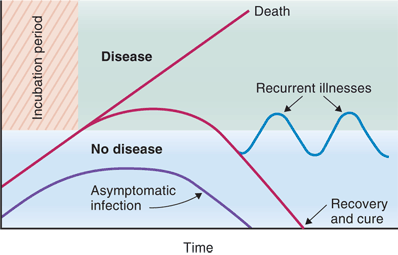
- @@Incubation period@@: the time needed for infectious agents to overcome early defense and grow to a certain population size
- environmental factors that influence multiplication
* Temperature
* temperature optimum
* osmotic pressure
* pH - two strategies of defense system
* @@complement and phagocytosis@@
* The complement system functions to kill microbes via lysis or phagocytosis, to clear immune complexes and apoptotic debris from the circulation, to promote inflammation, and to stimulate humoral immunity (Chapter 37. Humoral Immunity and Complement)
* @@humoral and cellular immunity@@
* Humoral immunity, mediated by antibodies produced by B lymphocytes, is a form of specific immunity directed primarily toward extracellular antigens (Chapter 37. Humoral Immunity and Complement) - microbial ways to avoid defense system
* microbes produce extracellular capsules that block recognition - altering surface antigens
{{Damage{{
- damaged is both caused by activities of invading agent and consequences of host response( apoptosis)
- different immune responses:
* innate: first line of immune responses which are always present and available for action
* does not require previous exposure to microbe
* adaptive: an alternative immune response that targets specific infected cells due to production of specific antibodies
* requires previous encounter with microbe
* causes antigen-antibody complexes
* complement system: antibodies-antigen complexes trigger the complement system to activate proteolytic reactions (hydrolysis of peptide bonds) via the classical pathway
* alternative pathway can also be activated by the microorganisms alone called the alternative pathway - @@Cell-mediated immunity(CMI)@@: a response that leads to activation and mobilization of macrophages