Appendicular Skeleton
A. Thoracic Limb
The bones of the thoracic limb include the scapula, humerus, radius and ulna, carpals, metacarpals, and bones of the digits.
Joints present in the thoracic limb:
Shoulder joint between the glenoid cavity of the scapula and the head of the humerus
Elbow joint is formed by the articulation between the humeral condyles and the radius with the olecranon process of the ulna
Carpal joint is formed by numerous articulations between the distal end of the radius and ulna with the bones of the proximal row of the carpal bones and the articulations between the carpal bones via the intercarpal joints
Fetlock joint or metacarpophalangeal joint is found between the metacarpal and the proximal phalanx
Pastern joint or proximal interphalangeal joint is the proximal interphalangeal articulation
Coffin joint or distal interphalangeal joint is the distal interphalangeal articulation
Scapula
Dogs- the scapular spine divides the lateral surface into two equal fossae, has a distinct acromion but lacks the trapezius tubercle
Pig and horse- the trapezius tubercle is present at the scapular spine
Pig- the spine fades distally and there is no acromion
Horse- the spine divides the lateral surface into two unequal fossae and there is no acromion
Ruminants- the goat's scapula is distinctly triangular in shape, there is also an unequal fossa with the infraspinous being broader and there is also an acromion but not as distinct as in the dog
Cattle's scapula is also distinctly triangular like in the goat but bigger in size, there is also an unequal size of the fossae and acromion is present at the distal end of the scapular spine
Large and small ruminants have trapezius tubercle but not prominent
Cat- the scapula is also triangular with the scapular spine dividing the fossae equally like in the dogs, there is an acromion and a suprahamate process
Birds- scapula is elongated and blade-like, relatively immobile and firmly held to the ribs by the muscles and ligaments
Clavicle
The clavicle is absent or rudimentary since most domestic animals are quadrupeds
Cats- still present
Birds- complete set of pectoral girdle composed of the scapula, the coracoid and the clavicle/furcula
Humerus
Dogs- has a supratrochlear foramen
Cats- has a supracondylar foramen at the medial epicondyle; prominent greater tubercle
Pigs- the greater tubercle almost converts the bicipital groove into a foramen
Horse- has an intermediate tubercle at the bicipital groove
Cattle- has a massive greater tubercle overhanging the bicipital groove; the greater tubercle is divided into a cranial and a caudal part
Birds- thin and the medullary cavity contains network of trabeculae which increases the strength of the bone; has a pectoral crest for the attachment of the pectoral muscle; pneumatized; pneumatic foramen is present
Bones of the forearm- the medially located radius and the laterally located ulna
Dogs and cats- the ulna is not fused with the radius and has a distinct interosseous space in the entire antebrachial length; articular circumference is present
Ruminants- the ulna is fused with the radius and has a proximal and a distal interosseous space
Pigs- the ulna is not necessarily fused with the radius and has a small interosseous space
Horse- the ulna is shorter than the radius and is fused with around proximal two-thirds of the radius, only a proximal interosseous space is present
Birds- the ulna is more massive and longer than the radius, the two bones are not fused and there is a relatively wide interosseous space
Carpus- two rows of carpal bones, the proximal and distal rows
Pigs- all eight carpal bones are present
Carnivores- the radial carpal bone and the intermediate carpal bones are fused so they only have seven carpal bones
Horse- the first carpal bone is either present or absent so they can have either seven or eight carpal bones
Ruminants- the first carpal bone is missing, the second and the third carpal bone are fused and the fourth carpal bone is present so they have a total of six carpal bones
Birds- consists of only two, the ulnar carpal bone and the radial carpal bone; the distal row of the carpal bones fused with the metacarpal bone forming the carpometacarpal bone
Metacarpal and digital bones
Dogs- five metacarpal bones; the first metacarpal bone has only two digital bones, the rest have three digital bones
Pigs- four metacarpal bones; the first metacarpal bone is missing, the third and the fourth metacarpal bones are well developed while the second and the fifth were reduced, all the present metacarpal bones bear three digital bones
Cattle- the third and the fourth metacarpal bones are united on the proximal and the middle part to form the large metacarpal bone, the fifth metacarpal bone is reduced to become the small metacarpal bone, the first and the second metacarpal bones are lacking, the functional metacarpal bones (III and IV) bear three digital bones each
Horse- only the third metacarpal bone is fully developed called the cannon bone, the second and the fourth metacarpal bones were reduced and fused with the cannon bone as the splint bones, the first and the fifth metacarpal bones are missing, only the canon bone bears the digital bones
Birds- have only three digits, the first digit is called the alula and bears two phalanges, the major digit bears two phalanges and the minor digit bears only one phalanx
B. Pelvic Limb
The pelvic limb includes the hip bone (os coxae), femur (thigh bone), tibia and fibula (leg bones), tarsals, metatarsals, and digital bones.
A true joint connects the pelvic limb to the trunk via the sacroiliac joint, located between the sacrum and the ilium of the pelvic bone.
Other joints include the coxofemoral joint (acetabulum of the os coxae and the head of the femur), the knee (femur and tibia, femur and patella), and the stifle (leg bones and tarsal bones).
The metatarsophalangeal joint is the fetlock, the proximal interphalangeal joint is the pastern, and the distal interphalangeal joint is the coffin joint.
Hip Bone (Os coxae):
Composed of the ilium, ischium, and pubis.
Identification is based on the size, shape, orientation of the gluteal surface, and the number of gluteal lines.
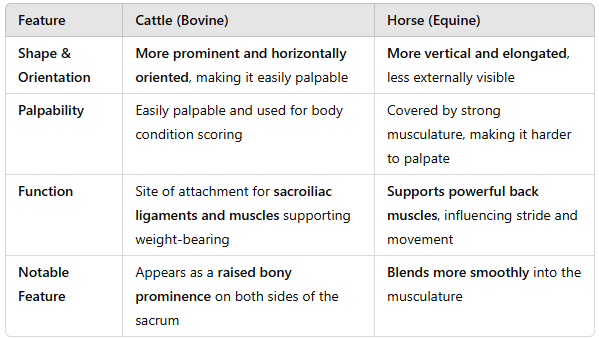
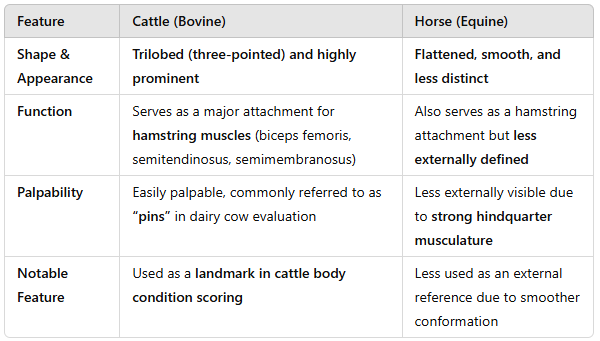
In cattle and horses, the gluteal surface faces dorsally.
Sacral Tuber
Ischiatic Tuberosity
In pigs and dogs, gluteal surface faces laterally.
Carnivores have three gluteal lines, while other domestic animals have one.
In birds, the ilium is divided into pre-acetabular and post-acetabular parts, based on the acetabulum's location.
Birds have two openings: the obturator foramen (smaller, like in mammals) and the ischiatic foramen (larger, between the ilium and ischium) which transmits the sciatic nerve.
The pubis is long and separated from the ischium by the ischiopubic fenestra.
Femur (Thigh Bone):
In dogs and cats, the femur is cylindrical, and the femoral head is level with the greater trochanter.
In pigs, the greater trochanter is level with the head, and the shaft is quadrilateral.
In cattle and horses, the greater trochanter is higher than the head of the femur.
Horses have a third trochanter, which is absent in cattle.
The femur in birds is similar to that in mammals and also has a patella at the distal end.
Tibia and Fibula (Leg Bones):
Comparison is based on the degree of fusion.
In dogs and cats, the fibula is not fused and is as long as the tibia.
In ruminants, the fibula is vestigial with no interosseous space. The lateral malleolus articulates separately, and a malleolar bone is present.
In horses, only the proximal half of the fibula remains, and the lateral malleolus is fused with the tibia.
In pigs, the tibia and fibula are not fused.
In birds, the fibula is thin and splint-like, while the tibia is fused with the proximal row of tarsal bones, forming the tibiotarsus, which features a proximal bony projection called the cranial crest.
Tarsal Bones:
Arranged in proximal, distal, and center rows.
The proximal row has the tibial tarsal bone (talus) and fibular tarsal bone (calcaneus).
The distal row has the first, second, third, and fourth tarsal bones.
The center row has the central tarsal bone.
This pattern is present in pigs and dogs.
Modifications occur in larger animals:
In horses, the first and second tarsal bones are fused, resulting in six tarsal bones.
In ruminants, the central tarsal bone fuses with the fourth tarsal bone (centroquartal bone), and the second and third tarsal bones are fused, resulting in five tarsal bones.
In birds, the central and distal tarsal bones fuse with metatarsals 2, 3, and 4, forming the tarsometatarsal bone.
Metatarsals and Digital Bones:
The pattern is similar to that of the thoracic limb in horses and pigs.
In carnivores, the first metatarsal bone is reduced, and the first digit may be absent.
In ruminants, the fifth metatarsal bone is absent, and a metatarsal sesamoid bone (small metatarsal or metatarsal two bone) is present.
In birds, the tarsometatarsus articulates with the phalanges:
Digit 1 has two phalanges.
Digit 2 has three phalanges.
Digit 3 has four phalanges.
Digit 4 has five phalanges.
Splanchnic Skeleton
Develops in soft organs
Remote from other skeleton
Examples: os penis, os clitoridis, os cordis