Comprehensive Study Notes on Lenses and Optics
What is a Lens?
A lens is a transparent optical device that refracts light rays in a way that produces an image. Lenses can be classified into two main categories based on their shape: converging lenses and diverging lenses.
Converging and Diverging Lenses
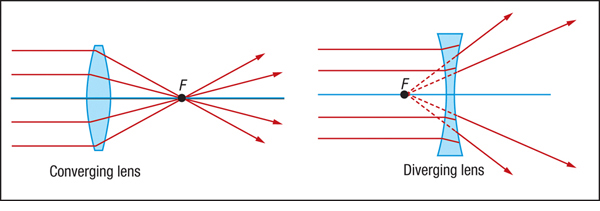
The converging lens is typically a double convex lens, which focuses incoming parallel rays of light to a single point known as the focal point, thus producing a real image. Conversely, the diverging lens, which is usually a double concave lens, spreads out light rays that are incident on it and forms a virtual image that can never be projected onto a screen.
Anatomy of a Lens
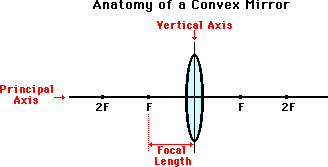
Understanding the anatomy of a lens is essential for studying optics. Each lens has two focal points (F), one on each side. The distance from the lens to the focal point is referred to as the focal length (f). It is important to note that the principal axis is an imaginary line that runs centrally through the lens, and there is also a center of curvature (C) that relates to the curvature of the lens.
Constructing Ray Diagrams
Ray diagrams are a vital tool for visualizing how lenses form images. For a converging lens, the principal focus is where light rays converge after having passed through the lens, while for a diverging lens, the focus is where the refracted rays appear to diverge from before the lens.
Drawing Ray Diagrams for Convex Lenses


Image Characteristics
The type of image formed depends on the position of the object relative to the focal points:
Beyond 2F: Image is smaller, inverted, real, and located between 2F and the focal point.
At 2F: Image is the same size, inverted, and real.
Between F and 2F: Image is larger, inverted, and real, located beyond 2F.
At F: No image is formed.
Between F and lens: Image is larger, upright, virtual, and located further from the lens.


Concave Lenses
For diverging lenses, principal ray diagrams follow similar principles but with different results:
Draw a ray from the object straight through the pole of the lens; it will continue undeflected.
Draw another ray from the top of the object parallel to the principal axis, which will diverge as if it is coming from the focal point prior to the lens.
The characteristics of the images formed by diverging lenses are:
Size: Smaller
Attitude: Upright
Location: Closer to the lens
Type: Virtual
Lens Thickness and Focal Length
The thickness of a lens influences how sharply it bends light. A thicker lens has a shorter focal length, as light rays bend more sharply, while a thinner lens has a longer focal length due to light bending less.


Using Formulae to Solve Lens Problems
The equations associated with lenses are analogous to those used with mirrors:
Focal Length:
Where:
= focal length
= distance from the lens to the object
= distance from the lens to the image
Magnification:
Where:
= height of the image
= height of the object
The magnification indicates whether the image is enlarged, diminished, or of the same size as the object and shows whether the image is upright or inverted based on the sign of the distances.

Correcting Eye Defects
Short-sightedness (myopia) and long-sightedness (hyperopia) can both be addressed using lenses.
Myopia: Caused by the eyeball being elongated or the lens being too curved. Corrected with concave lenses that spread light rays.
Hyperopia: Caused by the eyeball being too short or loss of lens elasticity. Corrected with convex lenses that converge light rays.