Business Management
Operations management involves coordinating and organising the activities involved in producing the goods or services that a business sells to customers.
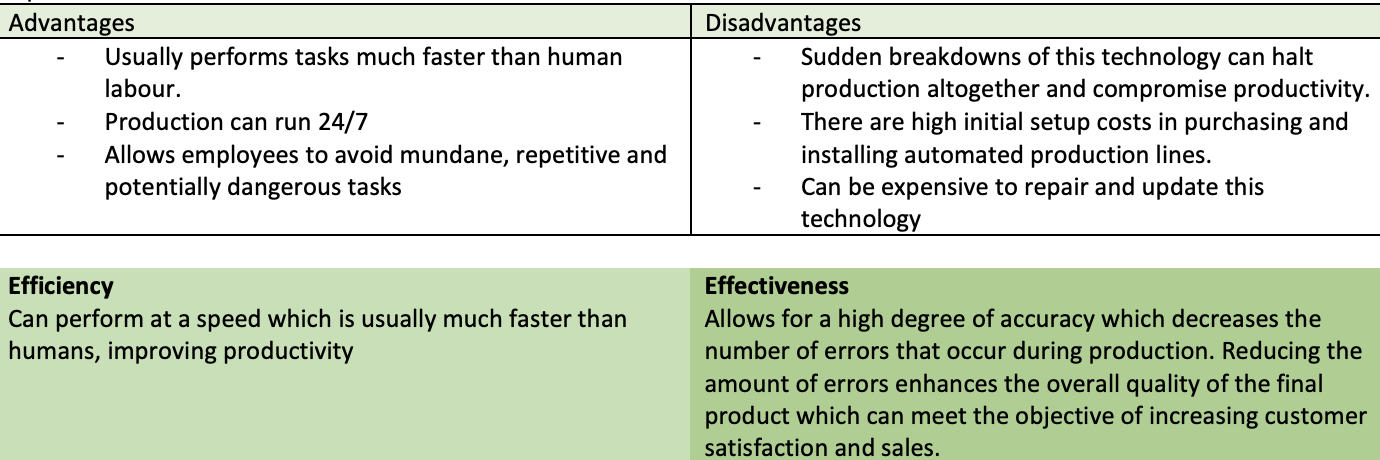
Efficiency is how productively a business uses its resources when producing a good or service.
Effectiveness is the extent to which a business achieves its stated objectives.
Characteristics of a service or manufacturing business
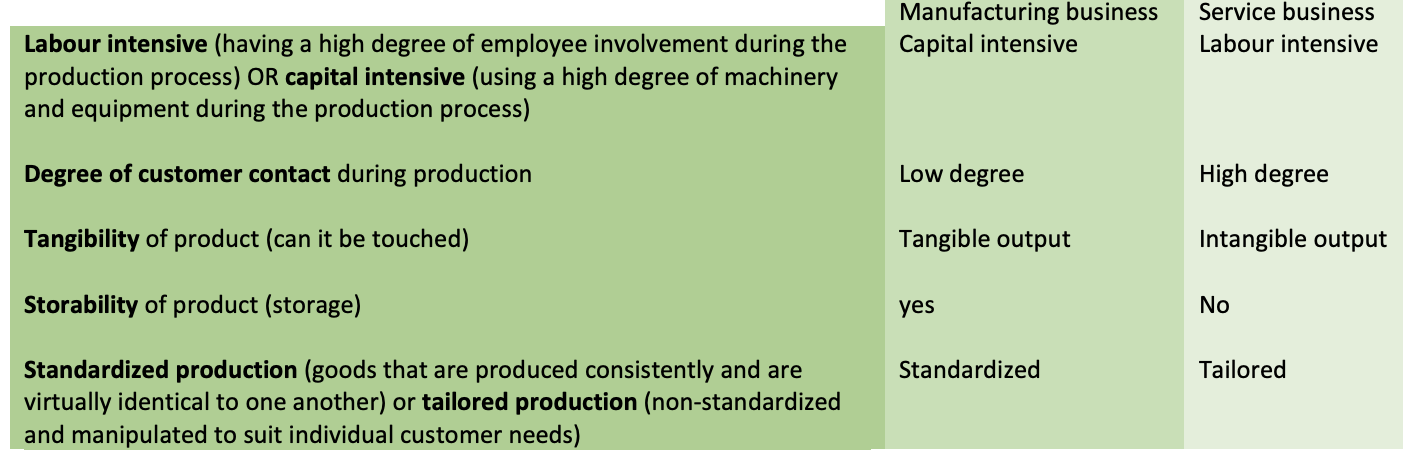
Manufacturing business: use raw materials and resources to produce a finished physical good
Service business: provide intangible products, usually with the use of specialized expertise
Similarities include:
- both have to deal with suppliers during the process of managing operations
- both aim to optimize efficiency and effectiveness in their operations
- both can utilize technology in their operations systems
CSR in an operations system CSR considerations for inputs One consideration a manager should have when sourcing inputs is identifying how the business can improve the environmental sustainability of its natural resources. Strategies that a manager can implement to respond to this CSR consideration include:
- sourcing from local suppliers instead of overseas suppliers to reduce transport emissions.
- sourcing from suppliers that use environmentally sustainable methods with regards to natural resources.
- Implementing forecasting and just in time to reduce the risk of over ordering inputs that may later be discarded.
- Purchasing energy efficient machinery to be used in production.
- Installing reusable and clean energy sources.
CSR considerations for processes When performing operations processes, a business will aim to be as efficient and effective as possible. However, many processes may use a large amount of energy or excess inputs that are discarded freely. Strategies that can lower the amount of waste created by operations processes include:
- Using technology that performs processes in a precise and consistent manner to reduce waste generated from errors.
- Developing methods to capture and recycle excess input materials to be reused in production and place them back into the input element of the operations system.
- Implement just in time and lean management strategies to reduce unnecessary materials waste. - Removing harmful chemicals from waste products.
- Disposing of any harmful waste that cannot be treated safely.
CSR considerations for outputs While the output of a business is meant to create value to the customer, it is socially responsible to ensure that goods and services produced does not cause harm to the wider community. Therefore, one of the most important CSR consideration is that any output produced creates minimal waste and environmental damage. Strategies that a business can implement to demonstrate CSR in the output phase of the operations system include:
- Developing an alternative product that is environmentally friendly - Creating products that have recyclable elements at the end of their lifecycle.
- Eliminating as much plastic as possible in the packaging and creation of the final product.
- Delivering products in bulk to retailers to reduce the businesses carbon emissions from transportation
Automated production lines involve machinery and equipment that are arranged in a sequence, and the product is developed as it proceeds through each step.