CFE Lec | Lesson 1: Introduction to Chemistry
Importance of Chemistry for Engineering
Engineers must understand chemistry to select and utilize materials effectively in design and manufacturing.
Proposed reasons for engineers to understand chemistry include material selection for durability, conductivity, or specialized applications like energy storage.
Critical Materials
Unique to modern technologies and vitally important to industry
Possess unique physical and chemical properties essential for technological roles
Availability is prone to disruption
Lithium
near-critical material
used in lithium batteries
Chemists and engineers actively seek ways to replace critical materials with alternative elements less prone to supply disruption.
The Three Perspectives in Chemistry
Macroscopic: Observing substances and reactions as they appear to the naked eye.
Particulate: Understanding matter at the level of atoms and molecules.
Symbolic: Using symbols and formulas to provide concise descriptions of compounds and reactions.
The Macroscopic Perspective
Matter is anything that has mass and can be observed
Observations are made through physical and chemical changes.
Natural occurrences, such as Cobalt appearing in cobaltite ore (), require refining steps to yield the pure metal for applications like blue pigments in Delft blue jars
Physical properties are variables of matter measured without changing the identity of the substance (e.g., mass, density, color, hardness, and temperature)
Density is the ratio of an object's mass to its volume.
Example: aluminum has a density of approximately .
Chemical properties are determined by observing how a substance changes its identity during a reaction.
Examples: pure aluminum reacting with acid to form aluminum salt and hydrogen gas, combustion (reaction with oxygen to yield and ), and corrosion (metal reaction with air and moisture)
Phases of Matter:
Solids: Hard substances that do not change shape easily at ordinary temperatures.
Liquids: Substances that assume the shape of their container.
Gases: Substances that expand to occupy the entire volume of their container.
Knowledge Check: Lithium and Aluminum in Batteries
Question: Explain the chemical and physical properties of lithium and aluminum that facilitate their use in lithium-ion batteries.
Lithium Properties:
Chemical: High electrochemical potential and the ability to form compounds integral to battery chemistry (reactivity).
Physical: Low density () contributing to a high energy-to-weight ratio, good ionic conductivity for ion movement, and a low melting point suitable for operational temperatures.
Aluminum Properties:
Chemical: Resistance to corrosion and adequate electrical conductivity for current collectors.
Physical: Lightweight, malleability, and ductility for shaping components, and good thermal conductivity to dissipate heat.
The Particulate Perspective
Matter consists of a limited number of elements that cannot be broken down by ordinary chemical or physical means.
Elements consist of atoms with identical physical and chemical properties.
Molecules are groups of atoms held together by attractive forces, possessing properties distinct from the individual elements.
Phase behavior at the particulate level:
Solid: Particles maintain a regular, ordered structure with fixed size and shape.
Liquid: Particles remain close but are disordered, taking the shape of the container.
Gas: Particles are disordered and move independently, filling the available volume.
Physical vs. Chemical changes:
In a physical change (e.g., liquid water turning to steam at the boiling point), chemical composition remains unchanged.
In a chemical change (e.g., electrolysis), chemical composition is transformed as reactions occur, such as splitting water into oxygen and hydrogen molecules.
Example Activity: Testing Gas Composition with Limewater
Scenario: Testing the hypothesis of gas composition released from boiling limewater ().
Observations for Water Vapor: Limewater remains clear; no reaction occurs with liquid or flame.
Observations for Oxygen: Limewater remains clear; the flame burns more intensely and brightly.
Observations for Hydrogen: Limewater remains clear; the flame may burn with a pale blue hue, or a small explosion may occur if mixed with air.
Symbolic Representation
Concise symbols describe atoms, molecules, and reactions.
Examples include Pure Aluminum () and Aluminum Oxide ().
Representations also apply to complex materials like neodymium oxide () and neodymium magnets ().
Observations, Models, and Systems
Chemistry is an empirical science involving the measurement of physical properties and the observation of reactions.
Scientists create models to explain observations and organize data.
Accuracy: How close an observed value is to the "true" value.
Precision: The spread in values obtained; how close measurements are to each other.
Measurement Errors:
Random Error: Makes measurements randomly too high or low due to equipment limitations.
Systematic Error: Makes measurements consistently too high or low, often due to impurities.
Interpreting Observations and Reasoning
Inductive Reasoning: Starting with specific observations to reach a universal conclusion.
Deductive Reasoning: Combining two or more assertions to make an irrefutable conclusion.
Systems Thinking: An approach to solving problems in complex systems by identifying components, their interactions, and the ultimate function of the system.
Scientific Frameworks
Scientific Model: A largely empirical description (e.g., gas pressure is proportional to temperature).
Scientific Theory: An explanation grounded in fundamental principles or assumptions (e.g., the relationship between gas pressure and temperature explained by kinetic energy).
Scientific Laws: Sufficiently refined, well-tested, and widely accepted theories.
Numbers and Measurements
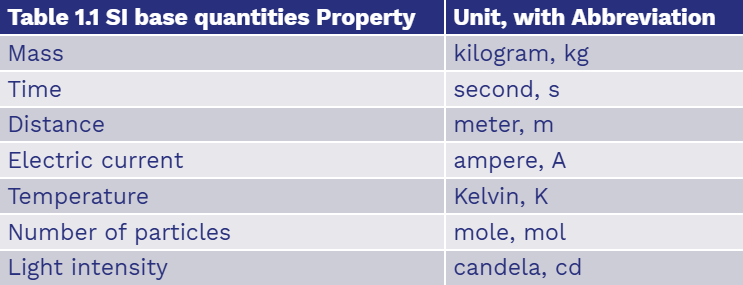
Units: Designate the type of measured quantity.
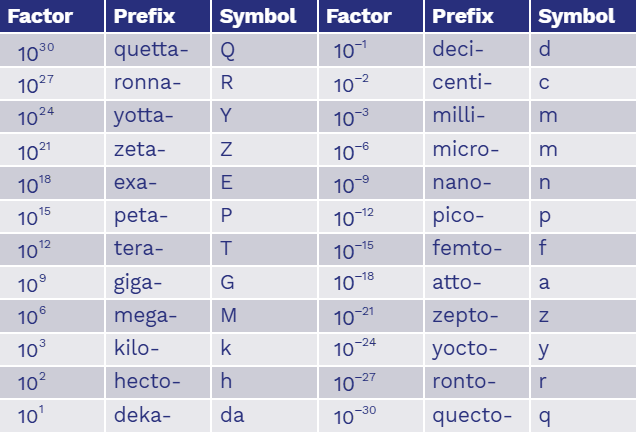
Prefixes: Provide scale to base units.
Significant Figures: Indicate the amount of reliable information in a measurement.
SI Base Units and Prefixes
Temperature Scales and Conversions
Conversions:
Significant Figures (SFs) and Scientific Notation
Scientific Notation: Simplifies writing large or small numbers by factoring out powers of .
Example:
Example:
Determining Significance:
Zeros establishing decimal places are not significant (e.g., has SFs; has SFs).
Zeros are significant when they follow a decimal or occur between significant figures (e.g., has SFs; has SFs).
Correct scientific notation identifies all significant digits.
Rules for Calculations with Significant Figures
Rule 1 (Multiplication/Division): The result must have the same number of SFs as the factor with the fewest SFs.
Example: ( SFs).
Rule 2 (Addition/Subtraction): The result's SFs are determined by the position of the first uncertain digit (round off to match the less precise value).
Example:
Rule 3 (Exact Numbers): Counting discrete objects or using defined terms (like metric prefixes) results in infinite significant figures (e.g., pennies is exactly ).
Dimensional Analysis and Ratios
Ratios represent the relationship between two quantities and are used for unit conversion.
Dimensional Analysis (Factor-Label Method): Using units to ensure appropriate ratios are written by "canceling" out units.
Example (Shrimp Cost):
Price: ; Count: .
Cost per shrimp: \frac{\6.19}{1\,lb} \times \frac{1\,lb}{20\,shrimp} = \.
Twelve shrimp: .
Example (Pool Mass):
; .
.
.
Touchscreen Technology
Indium Tin Oxide (ITO): A doped semiconductor providing position-dependent sensitivity to touch. It is optically transparent, allowing light to generate visible images.
Gorilla Glass: A ruggedized alumina silicate glass surface essential for durability.
Historical Development: Evaluation of touchscreen evolution from mechanical interfaces in the to modern capacitive screens in tablets and smartphones.
Questions & Discussion
Question 1: Which property refers to the tendency of a metal to change shape under load?
Answer: Malleability.
Question 2: When a reaction is represented by a chemical equation, what representation is being used?
Answer: Symbolic.
Question 3: Which representation is suited to differentiating between chemical and physical changes?
Answer: Particulate.
Question 4: If you conduct an experiment prone to random error, what is the most likely result?
Answer: Poor precision with decent accuracy.
Question 5: Which is the longest distance: , , , or ?
Answer: .
Question 6: Calculate the density of a cube with sides and mass of .
Calculation: . .
Answer: .
Question 7: Which step in aluminum refining is NOT a chemical change?
Answer: Slurry mixing.
Question 8: Which material makes a bicycle frame feel stiffest?
Answer: Aluminum.
Discussion Prompt: What are the advantages and disadvantages of ITO? Two properties of ITO allowing function? How does Gorilla Glass differ from common glass?
Advantages of ITO (Indium Tin Oxide)
Transparency and Conductivity: ITO offers a unique combination of optical transparency and electrical conductivity. This makes it highly effective for use in touchscreen technology, allowing light to pass through while enabling the transmission of electrical signals.
Position-Dependent Sensitivity: ITO films are designed to sense touch inputs accurately across the surface of the device, providing a responsive and effective user interface.
Stability: ITO is stable under various environmental conditions, ensuring consistent performance over time.
Disadvantages of ITO
Cost: ITO is relatively expensive due to the limited availability of indium, which is not as abundant as other materials. This can increase the overall cost of devices that use ITO for touchscreens.
Brittleness: ITO layers can be fragile, making them susceptible to cracking under stress or impact, which can limit their long-term durability.
Environmental Concerns: Mining indium can have negative environmental impacts, raising questions about the sustainability of its use in high-technology applications.
Two Properties of ITO Allowing Function
High Optical Transparency: ITO typically has a light transmittance greater than 85%, allowing screens to maintain high visibility and brightness levels.
Good Electrical Conductivity: This property enables ITO to effectively carry electrical currents essential for touch detection and control.
Differences Between Gorilla Glass and Common Glass
Material Composition: Gorilla Glass is chemically strengthened alumina silicate glass, which undergoes a specific ion-exchange process to enhance its durability. In contrast, common glass is typically less robust and lacks the same level of chemical strengthening.
Strength and Durability: Gorilla Glass is designed to withstand drops and impacts significantly better than regular glass, featuring a lower likelihood of shattering. This is crucial for portable devices that experience frequent handling and potential falls.
Scratch Resistance: Gorilla Glass provides superior scratch resistance compared to standard glass, making it ideal for touchscreens and other surfaces that are prone to scratches from daily use. This feature helps maintain visual clarity and usability over time.
Answer Insight: ITO is transparent and conductive; Gorilla Glass is reinforced via chemical processes to be more rugged than standard alumina silicate glass.