Attitude and Speed
Understanding airplane motion is fundamental in flight mechanics, requiring a clear vocabulary and concepts:
Key Descriptions:
Attitude: Describes the airplane's orientation, i.e., where the nose and wings point. This is defined using Euler angles.
Ground Speed Vector: Shows the direction and speed of the aircraft relative to the ground (assumed identical to the Earth's surface speed in this context).
Airflow Direction: Determines the aerodynamic forces based on how the air impacts the wings in body coordinates.
Trajectory and Speed Vector:
The speed vector is tangent to the trajectory and controls it.
The longitudinal axis of the airplane (nose direction) often differs from the speed vector's direction.
Euler Angles (Aircraft Attitude):
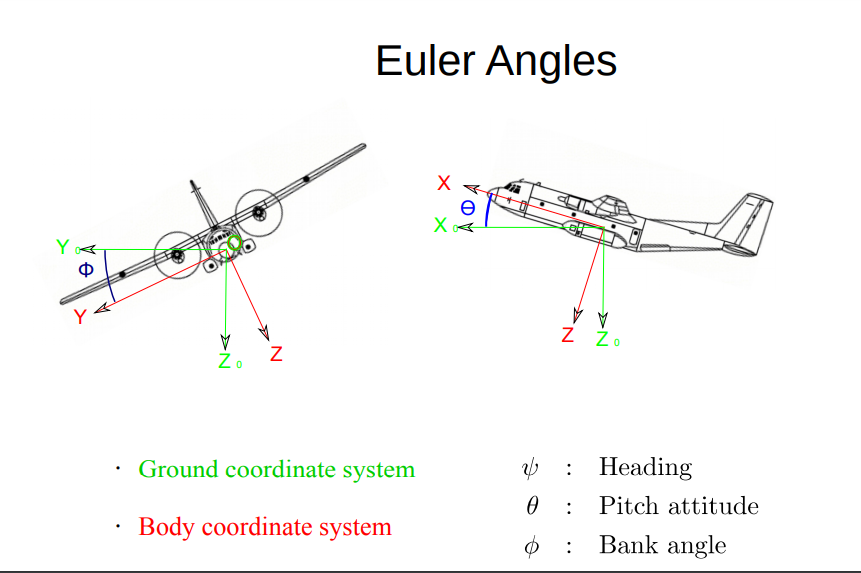
Heading (ΨΨ): Rotation around the vertical axis, showing the direction the nose points relative to the north.
Pitch (ΘΘ): Rotation around the lateral axis, indicating nose-up or nose-down orientation (positive when the nose is raised).
Bank (ΦΦ): Rotation around the longitudinal axis, indicating the tilt of the wings (positive when the right wing dips).
Ground Speed Vector (Direction):
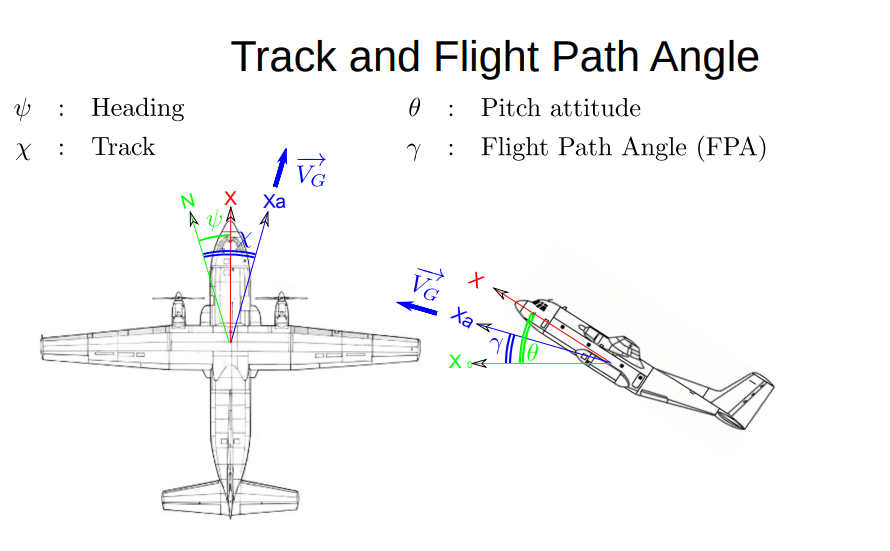
Defined with two rotations:
Track: Rotation around a vertical axis (not heavily emphasized in this context).
Flight Path Angle (ΓΓ): Angle between the speed vector and the horizontal plane, indicating climb or descent.
Airflow Relative to the Body:
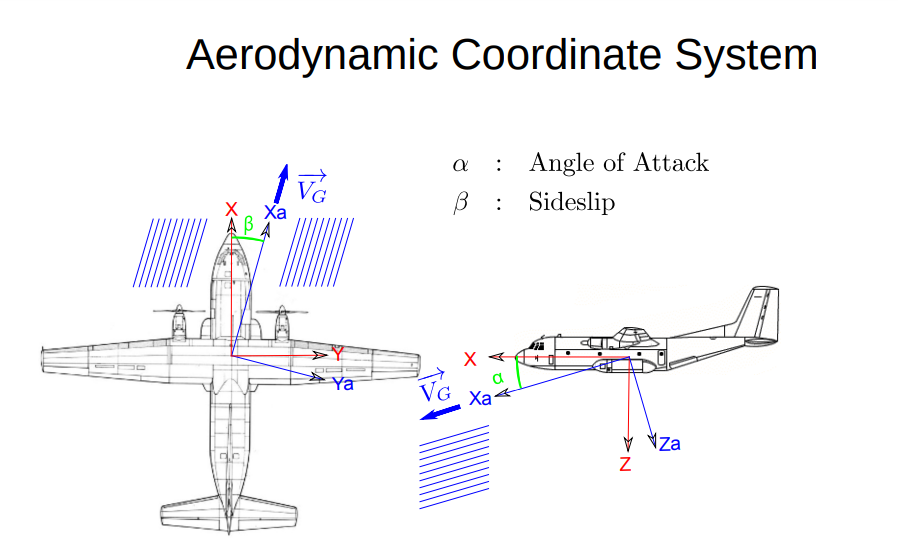
Sideslip Angle (ββ): Angle between the speed vector and the aircraft's plane of symmetry. Normally zero in stable flight.
Angle of Attack (αα): Angle between the speed vector projection in the plane of symmetry and the longitudinal axis. A critical parameter for determining lift.
Special Case:
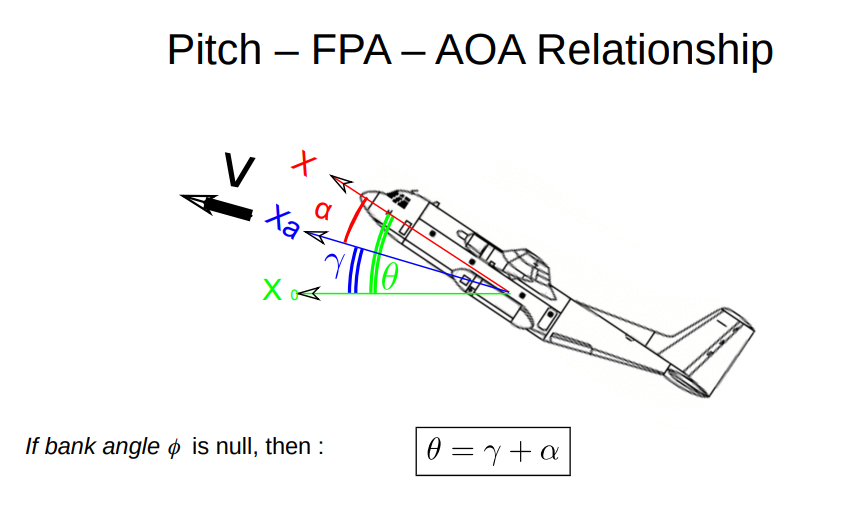
When the bank angle is zero, the relationship Θ=Γ+αΘ=Γ+α holds. However, this is invalid during turns where the angles are in different planes.
Example in Takeoff:
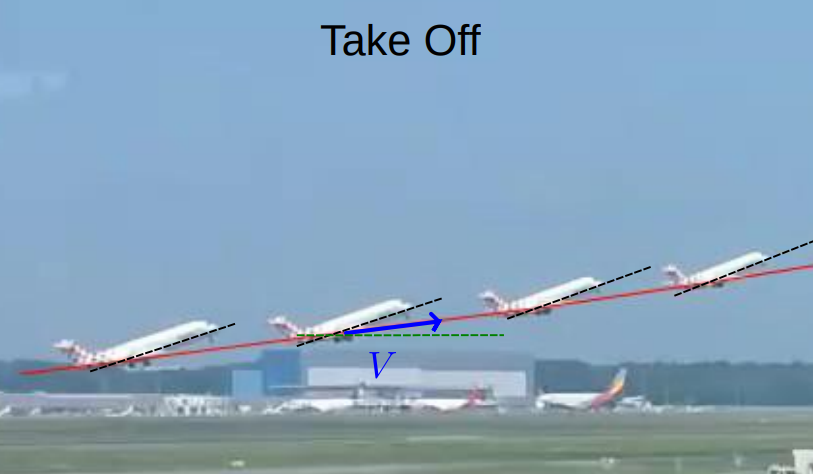
During takeoff, the flight path angle (ΓΓ) is the angle between the speed vector and the horizontal. The angle of attack (αα) is between the speed vector and the aircraft's longitudinal axis, while the pitch (ΘΘ) is between the horizontal plane and the longitudinal axis.