Lecture 19 - Pyruvate Dehydrogenase
Lecture 19 - Pyruvate Dehydrogenase
The pyruvate dehydrogenase complex catalyzes a central reaction in cellular metabolism.
Transfer of two carbons from pyruvate onto acetyl-CoA links glycolysis (and other pyruvate-generating pathways) to the citric acid cycle
Reaction is major route of entry into aerobic respiration
Pyruvate dehydrogenase complex rxns also representative of common reaction in metabolism and thus merit detailed study
Differing fates of pyruvate: cytosolic fermentation or entry into the mitochondrion for aerobic respiration
In hypoxic conditions (low levels of O2, such as exercising muscle), cells without mitochondria (e.g., RBCs), or anaerobic organisms, pyruvate is reduced in the cytoplasm to regenerate NAD+ for glycolysis
When oxygen and mitochondria are present, pyruvate is (often) transported into the mitochondria for aerobic respiration
★Pyruvate oxidation (pyruvate dehydrogenase) and citric acid cycle located in matrix of mitochondrion
The mitochondrion is a specialized organelle dedicated to aerobic respiration
Not all cells have mitochondria - even in animals:
Cells in the lens of the eye lack mitochondria, which would scatter light
Red blood cells lack mitochondria, which would consume the O2 they transport
The pyruvate dehydrogenase complex catalyzes the oxidative decarboxylation (redox, O2 comes off) of pyruvate and its conversion of acetyl-CoAOverall rxn of pyruvate:
Overall rxn of pyruvate:
Highly regulated rxn
Three enzymes:
E1: Pyruvate dehydrogenase
E2: Dihydrolipoamide transacetylase
E3: Dihydrolipoamide dehydrogenase
Five cofactors:
Thiamine pyrophosphate (vitamin B1)
Lipoic acid/lipoamide
Coenzyme A (vitamin B5)
Flavin adenine dinucleotide (vitamin B2)
NAD+ (vitamin B3)
Overview of the five reactions of the pyruvate dehydrogenase complex:
(E1) Decarboxylation of pyruvate; formation of hydroxyethyl-TPP
(E1 & E2) Oxidation to acetyl group bound to lipoamide cofactor
(E2) Transfer of acetyl group to CoA to form acetyl-CoA
(E2 & E3) Re-oxidation of dihydrolipoamide
(E3) Transfer of electrons to NAD+
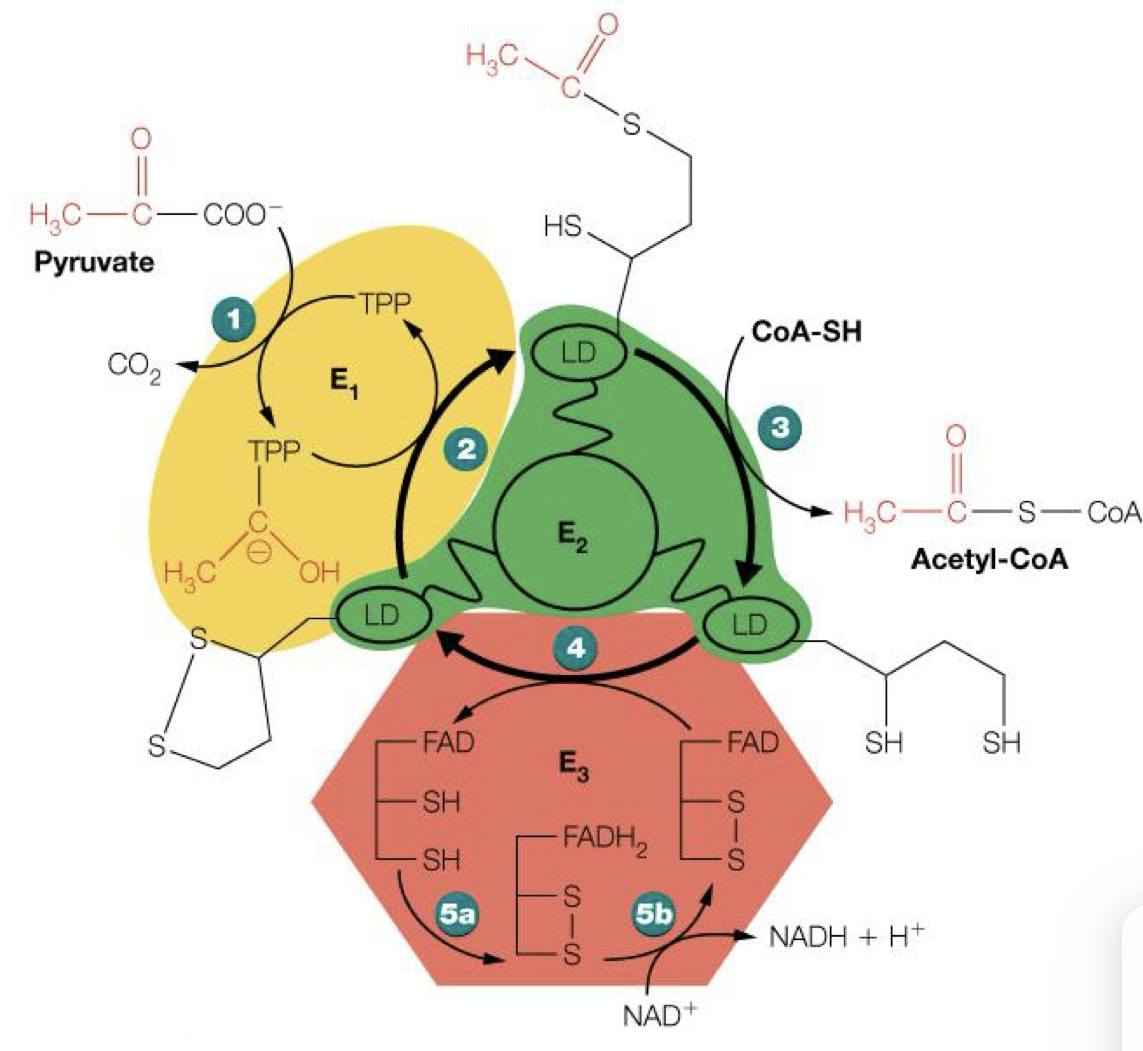
The net outcome of the reaction is two-fold:
2e- from pyruvate C-C bond are transferred to NADH
Acetyl group is stored in acetyl-CoA via a high-energy thioester bond
1. E1 (pyruvate dehydrogenase), using TPP as a cofactor decarboxylates pyruvate
Ripping the 2e- out of an -keto acid is harder than a -keto acid because the intermediate can’t easily accommodate the extra 2e-
Thiamine pyrophosphate (TPP), tightly but non-covalently bound by E1, solves this problem
Non-covalently = no chemical bond between TPP and protein, but bound tightly in active site
Thiamine pyrophosphate:
Tightly, but not covalently, bound to E1
Thiazolin ring acts as an electron sink to stabilize both TPP carbanion and hydroxyethyl-TPP
2. E2 (dihydrolipoamide transacetylase) transfers 2C from pyruvate onto the lipamide cofactor as an acetyl group
Lipoic acid: Flexible “swinging arm” with redox-active disulfide
Lipoamide (lipoyllysine): Lipoid acid attached covalently to a lysine side chain in E2 via an amide bond
Acetyl-dihydrolipoamide: Product of reaction 2, with 2C acetyl group from pyruvate attached via a thioester bond
E1 hands off the 2C from pyruvate directly to E2 thanks to the architecture of the complex and the lipoamide cofactor
The E2 subunit comprises multiple domains:
las-LD1 – las-LD2 – las-LD3 – PSBD – Catalytic
Key:
las = Lipoic Acid Site
LD3 = Lipoyl domains interact with E1/E3 active sites
PSBD = Peripheral Subunit Binding Domain (binds E1 or E3)
Catalytic = assembles into Octahedral/Icosahedral Core
3. E2 transfers the acetyl group from acetyl dihydrolipoamide to coenzyme A (CoA)
*Nucleophilic acyl substitution exchanges one thioester for another
Acetyl-CoA is a high-energy molecule; this energy will be used in the first step of the citric acid cycle
The 2e- we pulled off pyruvate remain on dihydrolipoamide
Don't go into acetyl-CoA
4./5. FAD is a tightly bound (cofactor) sequential 2e- acceptor (2e- + 2H+), whereas NAD+ is a mobile 2e- acceptor (H-)
FAD (riboflavin/Vitamin B2) 2H+ 2e- FADH2
Insoluble
2 protons and 2 electrons placed on different atoms on FAD molecule, sequentially
NAD+ (Niacin/Vitamin B3) H- NADH
Dissociable
Accepts two electrons @ same time in a single hydride transfer
4./5. E3 reoxidizes dihydrolipoamide to regenerate E2 and then transfers the 2e- to the mobile e- carrier NAD+
Lipoamide underwent 2e- reduction to dihydrolipoamide and must be regenerated
E3 has a redox-active disulfide bond immediately adjacent to a tightly bound FAD that accepts the 2e-
The reduced FADH2 then transfers the 2e- to NAD+ to produce NADH
★Pyruvate → hydroxyethyl-TPP → acetyl-dihydrolipoamide → dihydrolipoamide → E3 disulfide → E3 FADH2 → NADH
The pyruvate dehydrogenase complex is an extreme example of a concept known as “substrate channeling”
Efficient movement of metabolic intermediates between successive active sites prevents loss of substrates and protects the cell against toxic intermediates
Increases in “effective” or “local” concentrations can cause huge increases in catalytic rates
Covalent tethering increases the effect concentration
The PDH complex is regulated allosterically, by phosphorylation, and transcriptionally
Allosterically: Regulation by feedback inhibition. The products of the pyruvate dehydrogenase reaction, acetyl-CoA and NADH, inhibit pyruvate oxidation if allowed to accumulate
Phosphorylation: Regulation by covalent modification of E1. A kinase and a phosphate inactivate and activate the first components (E1) of the PDH complex by phosphorylating and dephosphorylating, respectively, three specific serine residues
Transcriptionally: In absence of O2, turn off flux into citric acid cycle and oxidative phosphorylation → since not enough O2 to act as a terminal electron acceptor