Reactivity 2.3
Reversible reactions - chemical reactions that can proceed both forward and backward
represented by 2 arrows pointing in opposite directions on top of each other
also means equilibrium
extent of reaction - how far a reaction proceeds in the forward/reverse direction
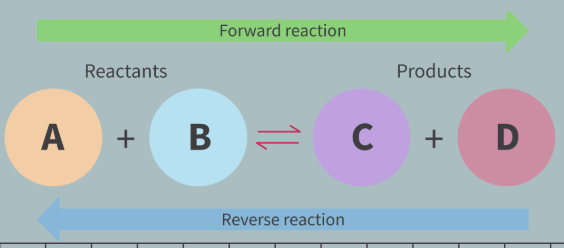
physical equilibrium - physical change ocurring at equal rates in both forward + reverse directions
changes of state/dissolution of solute
REQUIRES CLOSED SYSTEM
no matter can escape
Chemical equilibrium - chemical change occurring at equal rates in both forward + reverse directions
involves chemical change
rate of forward = rate of reverse
concentrations of reactants/products remain constant
rates are equal
concentrations are constant
not equal usually
can be achieved from either direction
reaction vessel - sealed container where a chem reaction occurs
closed system
Equilibrium Constant Kc - ratio providing info about composition of a reaction mixture at equilibrium
quantifies extent of reaction
NO UNITS
K - equilibrium constant
c - terms of concentration
provides info about
extent of reaction
position of equilibrium
Lies to right (products) → greater concentration of products at equilibrium
Kc > 1
If exponent of 10^(4) is more than 4 → almost exclusively products
Lies to left (reactants) → greater concentration of reactants at equilibrium
Kc < 1
If exponent of 10^(-4) is less than -4 → almost exclusively reactants
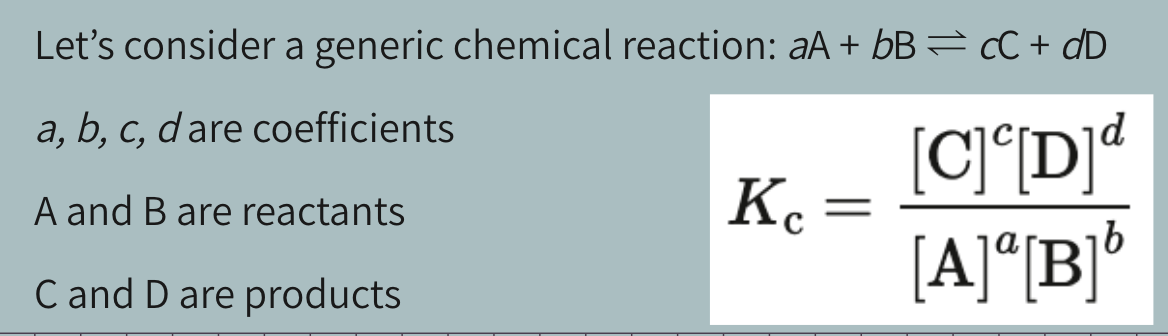
raised to the power of the molar ratio
products on top + reactants on bottom
does not include state symbols in equation
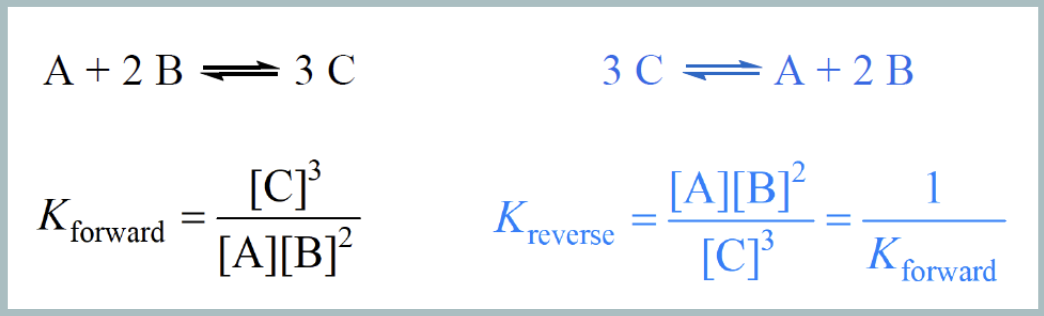
Kc of reverse reaction = reciprocal of Kc of forward reaction
Reaction quotient Q - measure of relative amounts of reactants/products for a reaction not at equilibrium
determines which direction reaction proceeds to reach equilibrium
compare to Kc to see if system reached equilibrium
Equation for Q is same as Kc
Kc used AT equilibrium
Q used NOT AT equilibrium
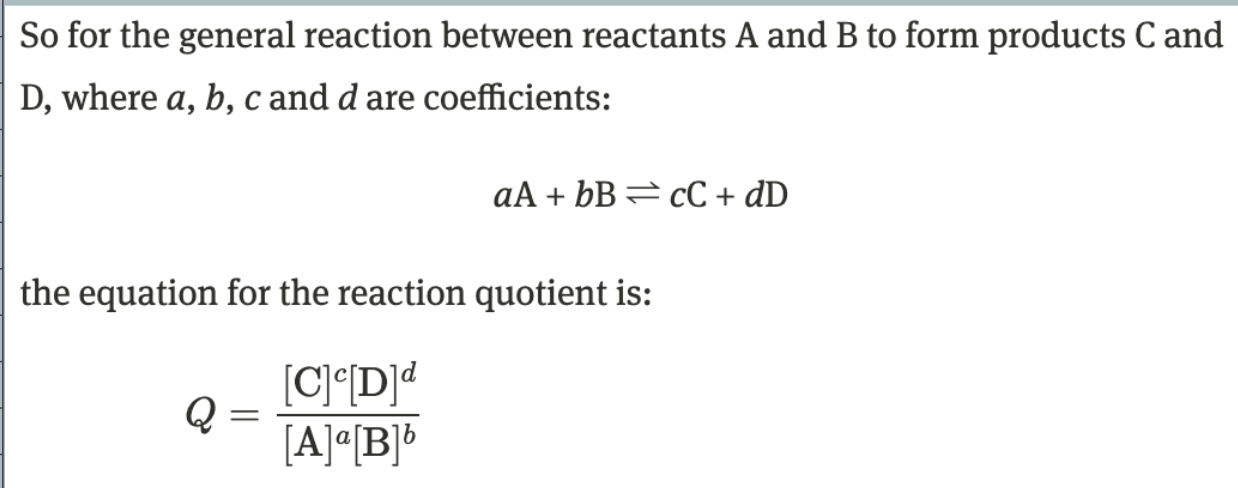
Relationship btwn Q and Kc
Q < K
greater concentration of reactants
forward reaction favored
reaction proceeds right
Q = K
equilibrium
rate forward = rate reverse
Q > K
greater concentration of products
reverse reaction favored
reaction proceeds left
Le Chatelier’s Principle - a system at equilibrium is subjected to a change → system responds to minimize effect of change
system tries to counteract change made
changes that can be made
concentration
increase concentration → shift right (away)
extra needs to be used
decrease concentration → shift left (towards)
need more substance
Kc NO CHANGE
pressure
increase pressure → shifts to side with fewer moles of gas species
high pressure → more collisions → faster rate
decrease pressure → shifts to side with more moles of gas species
low pressure → fewer collisions → slower rate
Kc NO CHANGE
Volume
temperature
increase temp → away from heat/energy (favors endothermic)
increase heat (reactant) → right
increase heat (product) → left
decrease temp → towards heat/energy (favors exothermic)
decrease heat (reactant) → left
decrease heat (product) → right
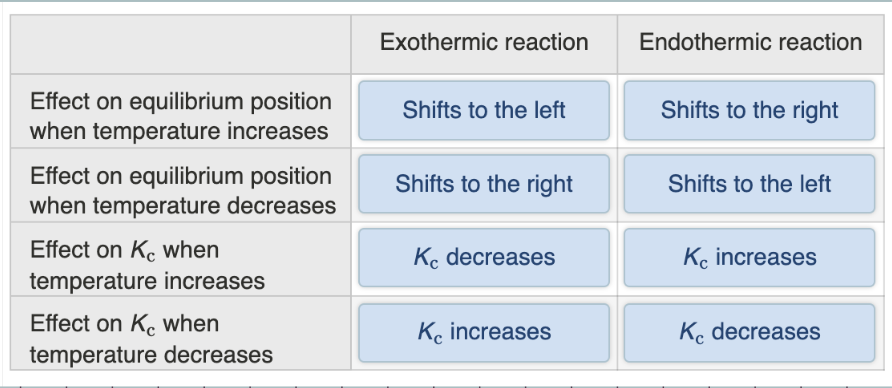
Kc DOES CHANGE
shifting right → more products + bigger Kc
shifting left → more reactants + smaller Kc
catalysts
no shift
the rates are increased by the same amount for both forward and reverse reactions
only provides alternative pathway to lower Ea
Kc NO CHANGE
ICE Table - calculates Kc when not at equilibrium
I - initial
C - change
based on coefficients from balanced chemical equations
reactants subtract, products add
If Kc is very small (less than 10^(-4))
reaction barely proceeds
concentration of products very small
assume reactant initial = reactant equilibrium
x is negligible
E - equilibrium
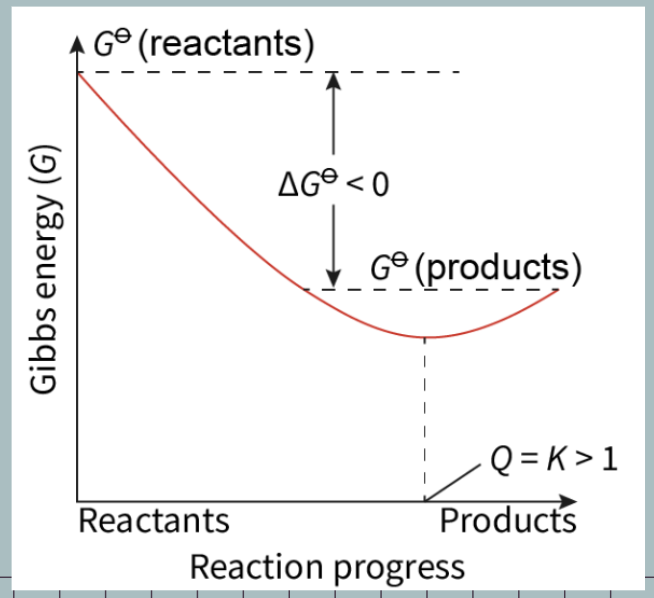
Gibbs free energy (J or kJ) is negative (G < 0) → reactions are spontaneous
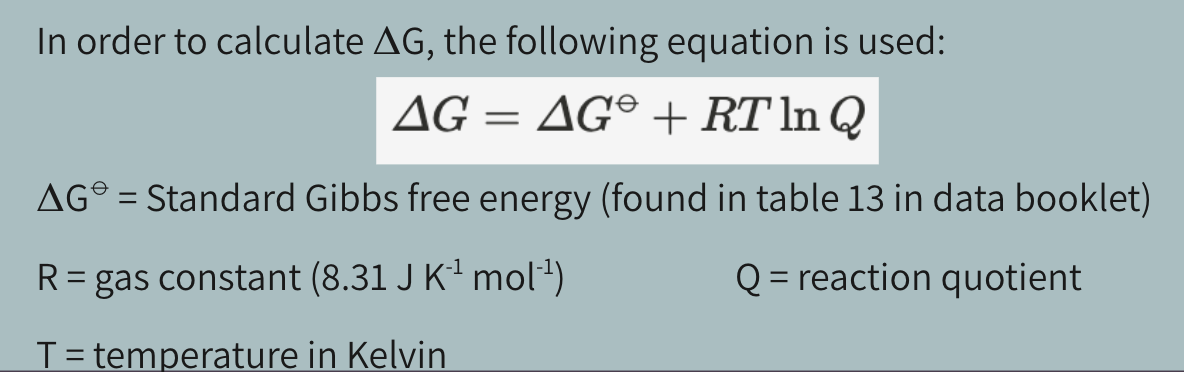
R has to be in kJ (8.31/1000)
Standard Gibbs free energy units: J mol^(-1)
If at equilibrium
ΔG = 0
Q = K
ΔG⦵ = -RTlnK
cannot leave K as e^x
Relationship btwn Gibbs and Kc
chemical reaction will always move to achieve the most stable state possible under a given set of conditions
thermodynamically at equilibrium
entropy = max value
system in its most disordered state
more disorder = more favorable
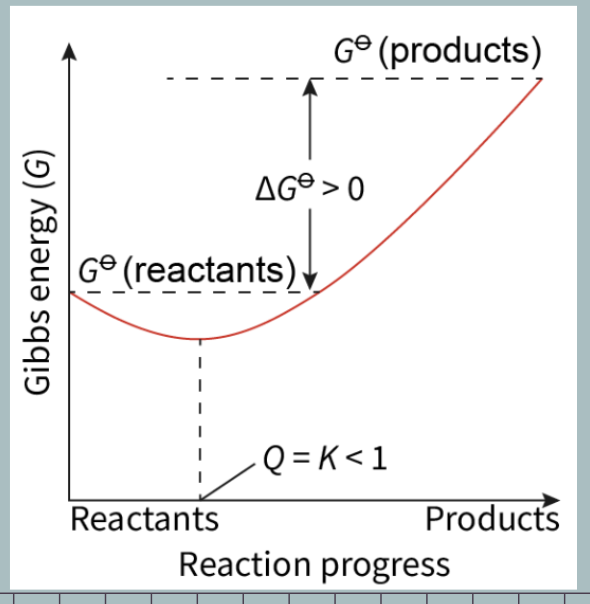
Gibbs free energy = min value
system in lowest possible energy state
lowest energy = most stable
G < 0, Kc > 1
high concentration of products
G > 0, Kc < 1
high concentration of reactants
G = 0, Kc = 1
neither favored
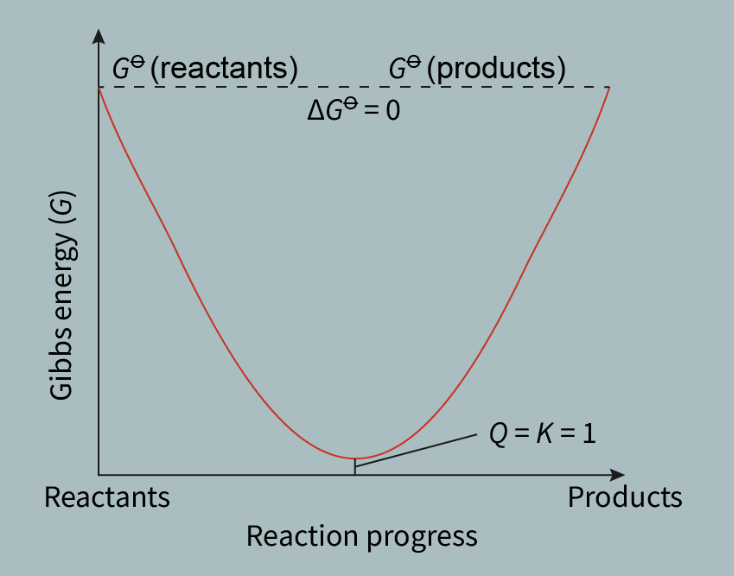
Spontaneous reactions
equilibrium favors product side
products > reactants
min value of Gibbs lies more to product side
Nonspontaneous reactions
equilibrium favors reactants side
products < reactants
min value of Gibbs lies more to reactants side