AP English Midterm I
The Rhetorical Situation Worksheet
A rhetorical situation arises whenever a speaker or a writer sees a need to communicate in order to accomplish a goal. The term “rhetorical situation” refers to the context of a rhetorical event, which consists of the Text, the Reader or the audience, the Author, the Constraints, and the Exigence or cause. You can remember these elements by the acronym TRACE.
Text
The text is the argument. Whether it be written, visual, or spoken, the text will have characteristics you can analyze. Some possible characteristics to analyze in a text include: the type of text, the format, the organisation, the argumentation strategies, the language and the style.
Reader
The reader, also known as the audience, are people who are interested in the topic and who can change their perceptions as a result and, possibly, mediate change or act in a new way. Most authors have a targeted or intended reading audience in mind. You may identify with the targeted audience of a text, or you may not, particularly if you belong to a different culture or live in a different time.
Analyzing the audience
As you are reading and writing, keep in mind the expectations that your audience will have about your topic and how they might react to you paper. Consider the following questions when analyzing the audience:
What range of people might read the discourse?
What does the audience care about or value?
Why might the audience read the writing?
What does the audience already know about the issue?
How is the audience supposed to react to the discourse?
Author
The author writes or develops an argument to convince a particular audience. You can analyze the author’s position, motives, values, and degree or expertise. If you do not have direct information about the author you reading, you will need to infer or guess at much of this information as you consider the text.
Constraints
Constraints include the people, events, circumstances, and traditions that are part of the situation that constrain or limit a targeted audience and cause them to analyze and react to the situation in a particular way. Constraints also include beliefs, attitudes, prejudices, interests, and habits that influence the audience’s perceptions of the situation.
The author of a text brings another set of constraints to the situation. These include the author’s character, background, available resources, and style. The limits inherent in the type of text being produced, whether written, spoken, or visual, can also provide constraints.
Constraints may draw the author and audience together or drive them apart. They influence the amount of common ground that will be established between an author and an audience.
A constraint can include a specific attitude or assumption on the part of the author or the audience. Constraints also include external factors - from formal rules to laws to informal social norms.
Exigence
Exigence is part of the situation that signals that something controversial has occurred or is present and that a problem needs to be resolved by some response from an audience. Exigence is the answer to questions like “So what?” or “Why should we care about this subject?” Exigence refers to the reason why you are writing, the purpose of your writing. The exigence is a problem existing in the world that can be changed by rhetorical discourse.
Finding the Exigence
Why is the writing needed?
Why is now the right time for it?
What factors (e.g., event, occasion, assignment, other discourse) has prompted it?
Why do the problems, questions, or conflicts that the discourse/writing will address matter?
What deeper issues are represented by the subject matter?
What problems, questions, or conflicts, need to be resolved?
Rhetorical Analysis Cheat Sheet Worksheet
Rhetoric: persuasive words/images such as news, articles, essays, or political cartoons.
Rhetorical Analysis: investigation of an author’s argument that assesses the use of rhetorical devices to convey a message.
Rhetorical Choices: decisions an author makes to express their message or achieve their purpose.
Rhetorical Situation:
Writer: the person who made the rhetoric usually be found in the prologue of a text.
Audience: the person(s) intended to receive the rhetoric.
Context: the surrounding events/location of the rhetoric’s creation
The author’s background is…
The author wrote this during…
The author write this in the year…
Exigence: the problem/issue the author is addressing
The author wrote this because…
Purpose: the author’s solution to the problem/intention in writing
The author’s purpose is to…
Message: the idea the author is conveying
The author is saying…
Author’s Voice:
Imagery: verbal representation of a sensory experience
Tone: author’s attitude/mood
Diction: author’s word choices
Syntax: word arrangement in a sentence and punctuation
Detail: reasons, facts, and examples that develop a text
Aristotle’s Three Appeals:
Ethos: an appeal to ethics e.g. Trust me, I am a surgeon.
Pathos: an appeal to emotions e.g. Sad cat commercials
Logos: an appeals to logic e.g. facts and statistics
Rhetorical Devices
Alliteration: the repetition of the same consonant sound at the beginning of words in proximity to each other.
Example: Betty bought some butter but the butter was bitter, so Betty bought some more butter to make the bitter butter better.
Function: to capture the reader’s attention | to create memorable phrases | adds rhythm
Antithesis: a device in which an opposition or contrast of ideas is expressed; juxtaposes two contrasting ideas, usually within parallel grammatical structures.
Example: Go big or go home | It was the best of times, it was the worst of times | Hope for the best; prepare for the worst.
Function: to use contrasting ideas, words, or concepts placed side-by-side in a balanced structure to create emphasis, clarity, impact.
Allusion: an expression designed to call something to mind without mentioning it explicitly.
Example: Don’t be such a Romeo! | I need to find my kryptonite.
Function: To add layers and enrich a deeper meaning through shared language.
Anaphora: the repetition of a word or phrase at the beginning of successive clauses.
Example: I have a dream that one day this nation will rise…. I have a dream that one day on the red hills of Georgia… I have a dream that one day even the state of Mississippi…
Function: to draw the audience in to the message being delivered.
Chiasmus: device in which the structure of a phrase or sentence is reversed in the second part, creating a mirror-like pattern (AB → BA).
Example: Ask not what your country can do for you - ask what you can do for your country — J.F.K.
Function: It makes the sentence more memorable and balance by showing contrasting or connection between ideas.
Climax: a three-step increase in words or phrases.
Example: My brother, my captain, my king.
Function: Dramatization | to enhance the importance.
Hyperbole: device that uses extreme exaggeration.
Example: I heard Lana’s laugh from a mile away.
Function: To create strong emphasis or to indicate anger or humor.
Irony: when the reality is opposite to what is expected or said.
Example: A police officer gets arrested for breaking the law.
Function: to create humor | emphasize a point | show contrasting between appearance and reality.
Satire: way of using funny or clever writing to show that something is wrong, silly, or unfair in people, society.
Example: After years of research, scientists have finally proven that procrastination is a highly effective strategy for getting things done - just not today.
Function: to criticize or mock societal norms, behaviors, or institutions | to provoke thought and encourage change.
Metaphor: figure of speech that directly compares two unlike things by stating that one is the other.
Example: Miss Ghadeer is a compass providing guidance to her students in the fog of confusion.
Function: create vivid imagery | make complex ideas easier by transferring qualities.
Simile: figure of speech involving the comparison of two tings use ‘like’ or ‘as’.
Example: Miss Ghadeer is as graceful as a swan.
Function: to provide vivid imagery and emphasize a specific quality using ‘like’ or ‘as’.
Persona: when an author uses someone else’s voice to deliver a pov or persuade the audience.
Example: Name: Percy Jackson Age: 29 Occupation: Marine Biologist Location: NYC
Function: helps understand user’s goals, behaviours
Personification: figure of speech where human qualities are given to non-human things, such as animals, objects, or ideas.
Example: Time runs in Ms Ghadeer’s class.
Function: makes the description more vivid and imaginative | helpers the reader connect emotionally to non-human elements
Imagery: visual symbolism, or figurative language that evokes a mental image or other kinds of sense impression
Example: The stars shimmer in the sky
Function: to create sensory experiences and mental pictures for the readers or observers
Analogy: comparison between two things, typically for the purpose of explanation or clarification
Example: Life is like a box of chocolates, you never know what you’re going to get.
Function: to clarify | creating vivid imagery | promoting deeper understanding for an audience
Repetition: device that involves the repeated use of a word, phrase, or structure to add emphasis, create rhythm, or evoke a strong emotional effect
Example: Time after time
Function: to emphasize key ideas | make a message memorable | build emotional impact
Rhetorical Question: question asking in order to create a dramatic effect or to make a point rather than to get an answer
Example: Do you think money grows on trees?
Function: to influence how an audience understands | engages with the material
Anecdote: short amusing or interesting story about a real incident or person
Example: telling the story of how you once got lost on vacation in a foreign country because you didn’t check the train schedule, which then led to you arriving an hour late for your important event.
Function: make a topic relatable | persuade an audience | evoke an emotional response like empathy or humor
Flashcard for examples: https://knowt.com/flashcards/577c4cff-424e-47f6-a22b-270fe3d318fa
Vocabulary
Segregation: the separation or isolation of a race, class, or ethnic group by enforced or voluntary residence in a restricted area by barriers to social intercourse, by separate educational facilities, or by other discriminatory means.
Archaic: very old or old-fashioned.
Espousing: to adopt, support, or advocate for a particular idea, belief, or cause.
Predominately: mainly, for the most part, mostly.
Desegregation: the process of ending separation of people based on race, especially in schools and public spaces.
Dismay: concern and distress caused by something unexpected | to cause or lose courage or resolution (because of alarm or fear).
Exasperates: intensely irritated and frustrated.
Ostracized: excluded from a group, deliberately left out.
Scrutiny: critical observation or examination | a close look at or over someone.
Superficial: only comprehending what is on the surface or obvious, without a deeper meaning | existing or occurring at or on the surface.
Integration: to form, coordinate, or blend into a functioning or unified whole.
Umpire: an official who watches a game closely to enforce the rules.
Controversy: prolonged public disagreement or a heated discussion.
Stellar: featuring or having the quality or a star performer | relating to stars.
Sexism: prejudice, stereotyping, or discrimination on the basis of sex.
Latitude: scope for freedom of action or thought.
Impenetrable: impossible to pass through or enter | impossible to understand.
Adversely: doing something in a harmful or problem-causing way | in a way that prevents success or development.
Absurdity: the quality or state of being ridiculous or wildly unreasonable.
Penalties: a punishment given for breaking a rule or law or contract.
Unsatisfactory: not good enough.
Injustice: lack of fairness or justice | an unjust act.
Champion: a person who has surpassed all rivals in a competition | a person who vigorously supports or defends a person or cause.
Hysterical: affected by or deriving from wildly uncontrolled emotion.
Literary Skills
Things that you should be able to understand and identify:
Themes: they are the central ideas or underlying messages in a text.
How to identify: look for recurring topics or symbolisms and ask yourself what the text is primarily about and what message is the author trying to convey.
Claim: it is the assertion or statement made by the author that requires support or evidence.
How to identify: look for statements that convey a belief or opinion. These are often the main points the authors is trying to prove.
Thesis: it is the main argument or position of the author (usually found in the introduction).
How to identify: look for a clear statement that summarizes the main point or argument of the piece. It often appears at the end of the introduction.
Counterargument: it is an opposing viewpoint or argument that challenges the main claim.
How to identify: look for sections of the passage where the author acknowledges other perspectives or arguments that contradict their own.
Rebuttal: it is a response to the counterargument that defends the original claim.
How to identify: look for evidence or reasoning provided by the author that addresses and counters the opposing viewpoint.
Refute: it is to disprove or argue against a claim or counterargument.
How to identify: identify strong evidence or reasoning that undermines the validity and credibility of a counterargument.
Concession: (elements of argument) is the acknowledgment of valid points in the opposing argument.
How to identify: pay attention to statements where the author admits that the counterargument has merit (is write to some extent/has good quality), which can help strengthen their own position.
Differences of rebuttal, refute, and concessions:
Rebuttal: directly responds to and defends against a counterargument.
Refute: aims to prove the counterargument is incorrect or flawed.
Concessions: acknowledges the opposing argument’s valid points to enhance credibility of the author themselves.
Vocabulary Quiz AP L1 from Edulastic
Lina was upset when the coach criticized the team so harshly that it almost seemed unfair. This constant criticism ____ her motivation.
A) Stellar
B) Exasperates
C) Espousing
D) Integration
During the debate, Jamal argued passionately for equal rights in education, supporting the idea of racial ____ in schools.
A) Segregation
B) Desegregation
C) Controversy
The referee warned the players about the upcoming rules and possible ____ for breaking them.
A) Penalties
B) Latitude
C) Absurdity
D) Hysterical
The old library had books so dusty and rare that they seemed almost ____ to any ordinary reader.
A) Archaic
B) Superficial
C) Champion
It seemed ridiculous to suggest that students could finish a 50-page project in one night, highlighting the sheer ____ of the claim.
A) Dismay
B) Absurdity
C) Hysterical
D) Controversy
“The town council faced intense controversy from residents after proposing new rules for the park. Some believed the rules were absurd and unnecessary. The committee was praised for its stellar decision-making, even though some argued the regulations would affect the community adversely. Those who supported equality were ostracized as they pushed for school integration and against lingering segregation practices in the district.”
Synonyms / Antonyms
Stellar - Outstanding Synonym
Archaic - Modern Antonym
Superficial - Shallow Synonym
Champion - Opponent Antonym
Ostracized - Accepted Antonym
Correct Usage
She was hysterical with joy when she heard she had won the scholarship.
= Correctly
Espousing kindness and honesty, he often ignored his responsibilities at work.
= Incorrectly
Formative Assessment: Analysis Writing
Match each AP-style example with the correct device from the word bank below:
Anaphora - Antithesis - Chiasmus - Hyperbole - Rhetorical Question - Analogy - Allusion - Alliteration
“We shall fight on the beaches; we shall fight on the landing grounds.”
= Anaphora
“Ask not what your country can do for you—ask what you can do for you country.”
= Chiasmus
“It’s so hot I could melt into the pavement!”
= Hyperbole
Who wouldn’t want to be a millionaire?
= Rhetorical Question
“Finding that lost dog will be like finding a needle in a haystack.”
= Analogy
“To err is human; to forgive is divine.” - Alexander Pope
= Antithesis
I felt like Caesar getting stabbed in the back.
= Allusion
Clary closed her cluttered clothes closet.
= Alliteration
The device of anaphora is most often used to:
A) Compare unrelated ideas.
B) Emphasize a concept through deliberate repetition at the start of phrases of clauses.
C) Contrast two opposing ideas for effect.
D) Soften the tone of criticism.
Which sentence demonstrates antithesis?
A) “To err is human; to forgive is divine.”
B) “She sells seashells by the seashore.”
C) “The clock ticked angrily as the test dragged on.”
D) “The classroom was as cold as ice.”
A writer uses satire when they:
A) Compare two different ideas using “like” or “as”.
B) Use humor and irony to criticize or expose flaws in society.
C) Repeat sounds for musical quality.
D) Replace one word with another closely associated with it.
Chiasmus occurs when:
A) Two phrases are reversed to mirror each other for emphasis.
B) The same word appears at both the beginning and end of a clause.
C) Two ideas are contrasted in adjacent phrases.
D) A story beings in the middle of events.
Parallelism functions primarily to:
A) Provide humor through exaggeration.
B) Develop imagery through comparisons.
C) Appeal to emotion through storytelling.
D) Create rhythm and balance to reinforce meaning.
Formative Assessment
Read the passage, and then answer the questions below.
(The following passage is from Jonathan Swift’s 1729 essay “A Modest Proposal.”)
This passage is from Jonathan Swift’s essay A Modest Proposal (1729), where he satirically suggests a shocking solution to poverty in Ireland. Swift proposes, in an exaggerated way, that poor children could be used as food to help the economy. The essay uses irony and satire to criticize how the wealthy ignore the suffering of the poor.
1) There are about 120,000 children born every year to poor families. The question is: how can these children be raised and provided for? Right now, it is almost impossible by the methods people have suggested. We cannot easily put them to work in crafts or farming, we do not build houses in the countryside or grow much land. Children can rarely support themselves by stealing until they are six years old, except in rare cases where they are clever, although I admit they learn the basics earlier. During this time, they can only be seen as learners. A man in County Cavan told me he never knew more than one or two children under six who could manage on their own, even in a place famous for quick learners.
2) Merchants tell me that a boy or girl under twelve is not worth selling, and even when they reach twelve, they would not bring more than three pounds, or at most three pounds and sixpence. This does not cover the cost of feeding and clothing them, which is at least four times that amount.
3) Therefore, I humbly propose my own idea, which I hope will not objected to. A very knowledgeable American friend in London told me that a healthy, well-fed child, at one year old, is a very delicious, nutritious, and wholesome food, whether stewed, roasted, baked, or boiled. I believe it would also work in a fricassee or ragout. I suggest that out of the 120,000 children, 20,000 should be kept for breeding, with only one-fourth males. This is more than we allow for sheep, cows, or pigs, but one male is enough for four females because these children are rarely from married parents.
4) The remaining 100,000 children could, at one year old, be sold to rich people across the country. Mothers should let them nurse well in the last month to make them plump and fat for the table. A child will make two dishes for a large dinner, and a smaller portion will do for a family meal. With a little salt or pepper, the fourth-day boiled meat will taste very good, especially in winter. I estimate that a newborn weighs 12 pounds and will grow to 28 pounds in a year if properly fed.
5) I admit this food will be somewhat expensive, and therefore it is suitable for landlords, who, having already “devoured” the parents, seem to have the best claim to the children.
This text can best be described as
A) Scientific
B) Satirical
C) Forthright
D) Humanitarian
The narrator’s tone in the passage is best described as
A) Sincere and sympathetic
B) Detached and analytical
C) Outraged and passionate
D) Melancholic and reflective
Jonathan Swift’s suggestion to eat children is an example of
A) Literal advice
B) Hyperbole
C) Historical fact
D) Metaphor
Who is the primary audience Swift is addressing?
A) Poor Irish families
B) Wealthy landlords and politicians
C) American merchants
D) Children
Which rhetorical device is used when Swift says landlords have “devoured most of the parents”?
A) Irony
B) Personification
C) Simile
D) Metaphor
(Both can be correct)
What is Swift really criticizing through this shocking suggestion?
A) That children should be sold
B) That poor families are lazy
C) That wealthy people ignore the suffering of the poor
D) That farming is too hard
When Swift uses numbers (120,000 children, 12 pounds, 28 pounds), he appealing to
A) Logos (logic and reasoning)
B) Pathos (emotions)
C) Ethos (credibility)
Which rhetorical device is shown when Swift calls a child “delicious, nutritious, and wholesome food”?
A) Irony
B) Simile
C) Repetition
D) Personification
How does Swift use exaggeration in this essay?
A) By giving small, practical advice for helping the poor
B) By proposing eating children as a way to solve poverty
C) By explaining farming methods
D) By calculating the exact population
Why is this essay considered satire?
A) It teaches proper nutrition
B) It uses shocking ideas to criticize society
C) It is a serious policy proposal
D) It is meant to entertain children
Decide the following based on the passage:
Dominant Appeal: Pathos
Secondary Appeal: Logos
Minor Appeal: Ethos
Rhetorical Situation:
Speaker: Jonathan Swift who is a writer and social critic.
Exigence: The ignorance of the wealthy upon the suffering poor people.
Purpose: To criticize the injustices of the poor in a satirical approach.
Context: Poverty in 1729, Ireland.
Choices: Irony, sarcasm, hyperbole, satire.
Formative Assessment: Analysis Writing
Example of what the analysis should be:
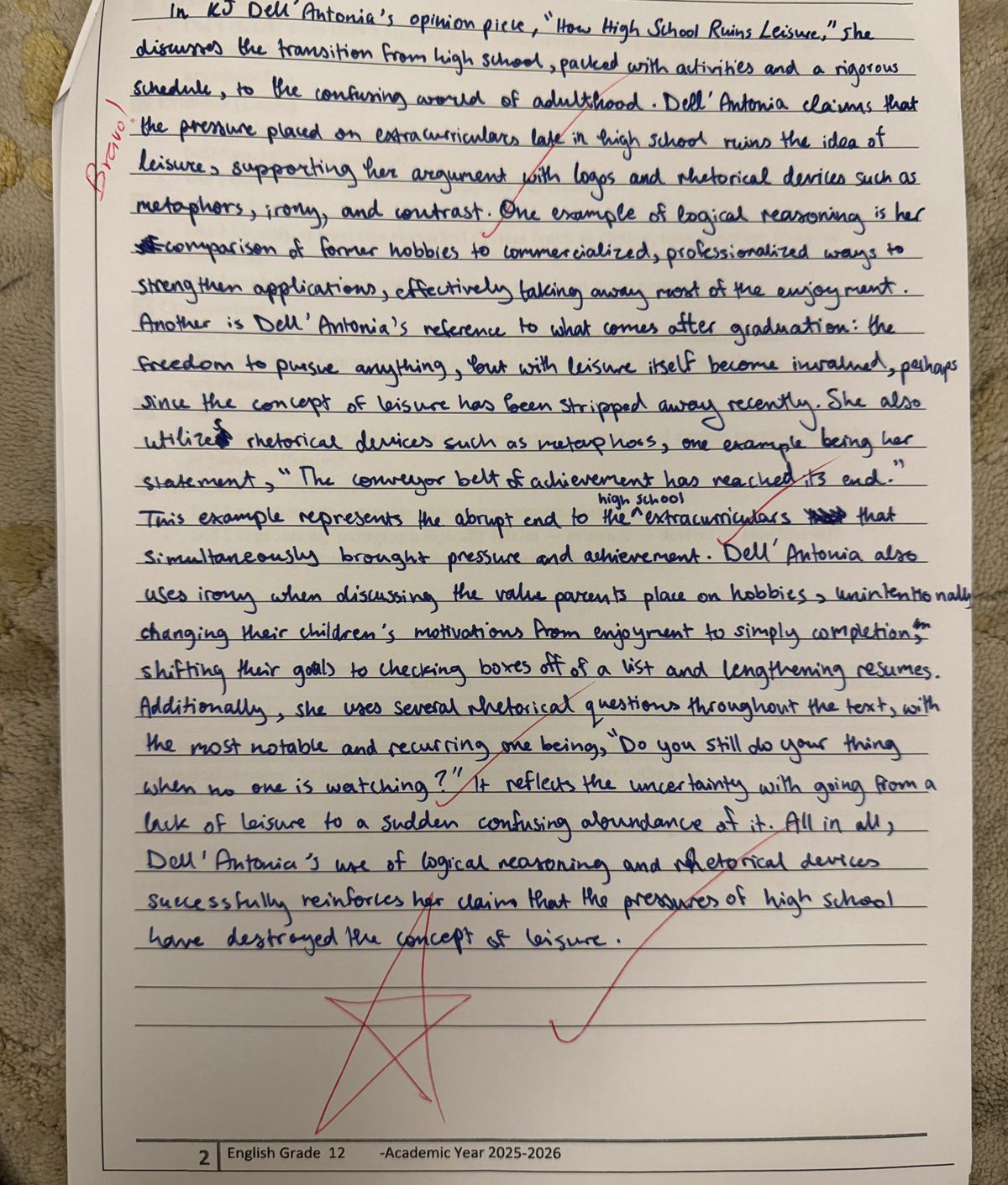
Serena is Still Treated Differently than Male Athletes Answer Key
Author / Speaker: Billie Jean King — tennis legend, longtime advocate for gender equality, former world no.1. Her credibility (ethos) is high because of her experience in sports and activism.
Audience: Broad public readers of The Washington Post and (others who follow sports, gender politics, equality issues). Also particularly women and girls.
Context: After the 2018 U.S. Open Women’s Final between Serena Williams and Naomi Osaka. Serena received warnings and penalties. The match was controversial because many observed that male players often act similarly but are treated more leniently. This triggered more public debate about gender bias in sports officiating.
Exigence: King writes to respond to what she sees as a clear instance of sexist double standards, abuse of power, and inconsistency in rules / enforcement. She wants to challenge norms and prompt change - in how players are treated, how rules are enforced, and how women are perceived. Also to encourage women to speak up when unfairly treated.
Purpose:
To persuade the public that Serena Williams was treated differently than male athletes in similar situations.
To expose sexism and racial aspects in sports, and more broadly in “arenas of life”.
To empower women and girls to stand up against unfair treatment.
Claim: Serena Williams, despite her status and achievements, is still subjected to different standards of behaviour and fairness than male athletes, especially in terms of how rules are applied, how emotions are judged, and how much latitude is allowed. The piece argues that such double standards are unjust, sexist, and hurtful, and they reflect a broader pattern of discrimination.
Tone: assertive, reasoned, and passionate. King uses logical reasoning, personal experiences, and emotional appeals.
Appeals:
Ethos: King’s credibility; her experience’ she refers to her own past when she’s been in similar situations.
Pathos: emotional appeal to fairness, empathy for Serena, for women and women of color; invoking feelings of injustice, frustration, the desire for respect.
Logos: cause/effect (inconsistent rule enforcement → abuse of power), comparisons between how male and female athletes are treated, refuting counter arguments (e.g., “the rules are what they are”), questions (“why not just allow coaching on every point?”) to prompt reflection.
Constraints: established rules of tennis, the power dynamics between players and umpires, media scrutiny, and societal biases.
Additional Notes:
King uses comparisons: “Did Ramos treat Williams differently than male players have been treated? I think he did.” This invites readers to compare and see double standards.
She uses personal anecdote to her own experiences-strengthens ethos and helps readers see she’s not just speaking theoretically.
There is a rhetorical question (“why not just allow it?) which challenges norms and invites the reader to imagine a fairer system.
Repetition of certain ideas: “women are taught to be perfect … we have a voice … emotions …” reinforces her message.
She frames elements as more than just about Serena: about women, women of colour, fairness in public life. This expands the appeal.
She makes allusions to historical examples to evoke a sense of familiarity. She refers to the case of Bobby Riggs and her own match in 1973.
The Black Table is Still There Answer Key
What exactly is the “black table”?
A designated lunch table in Graham’s junior high school where all the Black students sat together. It symbolizes both voluntary self-segregation and the lingering social separation in an “integrated” school.
Why was the sight of the all-black lunch table a surprise to him?
Graham did not expect that even years after integration, black students would still sit together. Shows that legal integration doesn’t automatically erase social division; it challenged his expectations of a fully mixed student body.
In Graham’s junior high school, what factors determined where students sat?
Race, social groups, extracurricular activities, and personal friendships. Seating reflected social identity and comfort zones; students gravitated towards those like themselves.
Why didn’t Graham sit at the “black table” when he was in junior high?
He felt torn between wanting to assimilate with white students and fearing judgement from Black peers. Illustrates internal conflicts and the social pressures of fitting into multiple worlds.
Whom did Graham blame for the existence of the black table as a student? Whom or what does he now see as the cause?
As a student, he blamed the black students and social pressures. As an adult, he sees it as a natural tendency of humans to seek comfort among those with similar backgrounds. Shows a shift from a simplistic blame perspective to a nuanced understanding of human social behaviour.
Speaker: Lawrence Otis Graham, an African American man who attended a predominately white junior high school. He writes from the perspective of a successful adult reflecting on a painful and confusing adolescent experience.
Purpose: his main purpose is to persuade readers that despite decades of legal integration, social segregation persists, often voluntarily, in institutions like schools. He aims to challenge the common perception that racial segregation is a relic of the past and to force readers to confront uncomfortable truths about prejudice.
Audience: the particular audience is aimed at mainstream American readership that may be complacent or unaware of nuances of ongoing racial divisions.
Context: the essay’s intended audience was originally published in 1991, long after the major civil rights legislation of the 1960s. Graham’s revisit to his old school 14 years later, around the 1980s.
Exigence: the specific catalyst for the essay is Graham’s visit to his old junior high school cafeteria and his dismay at finding the “black table” still in existence.
Choices:
Anecdotal Evidence: Graham uses his own personal story as the primary evidence. He recounts his feelings of discomfort, his desire to assimilate, and the negative reactions he received.
Rhetorical Questions: the use of “Why do all those black kids sit together?” to force the reader to consider the different ways of segregation is perceived.
Symbolism: the “black table” is a powerful symbol throughout the essay, it represents no just the physical location but the lasting, systemic nature of racial divisions.
Appeals:
Pathos: he relies heavily on emotion appeals by recounting his personal anecdotes of feeling isolated and targeted.
Logos: he builds a logical argument by moving from his specific experience to a broader commentary on society. His conclusion that people seek comfort among those with similar backgrounds extends his critique from a single racial issue to a more general human tendency toward self-segregation.
Tone: reflective, disappointed, and critical. Graham reflects on his past with a sense of regret for his youthful perspective, but also expresses disappointment that the social problem he observed has not disappeared. His tone is critical of a society that allows such divisions to persist, despite outward gestures of integration.