CiCC - Memory - Amnesia
CiCC – Memory – Amnesia
What is Amnesia?
Intelligence is intact
Attention span is intact
Personality unaffected
BUT
Ability to take in new information is severely impaired and permanently affected
HM underwent surgery to treat his severe epilepsy, which removed parts of his medial temporal lobes (including the hippocampus) and completely lost his memory of events after the surgery. He could not recall ever having met specialists he had been talking to even a few minutes after they left.
Amnesia is caused by damage to the medial temporal lobe.
Anterograde = after brain injury
HM had anterograde amnesia and had severely impaired memory (regardless of test)
How to test?
Recall/recognition format using both verbal and visual tests consisting of a large number of items. Usually the test will occur after a delay (of a few minutes). Patients with anterograde amnesia will be impaired on all types of test.
What systems are not impaired?
Procedural memory – Amnesiacs can learn new skills
Verbal and visual short term memory
Digit Span (repeating back numbers)
Spatial Span (choose the same blocks as me in the same order)
Priming
Declarative memory theory
LTM is Split into Declarative and Implicit memory (conscious and unconscious). Declarative is split into episodic and semantic memory. Implicit contains procedural memory. Declarative is affected by amnesia. Implicit is not .
Tulving proposed episodic and semantic memory is different. Squire proposed amnesia is the loss in ability to make new declarative memories.
Can Amnesiacs acquire new semantic memories?
NO – Bayley tested vocabulary in 2 amnesiacs – who performed very poorly
YES - Vargha-Khadem - 3 Amnesiacs still completed normal schooling and had good knowledge of the world despite having impaired episodic memory. Counters Squires point of view.
Retrograde = Before brain injury
Retrograde memory loss is almost always present in amnesia.
Standard theory of Memory consolidation
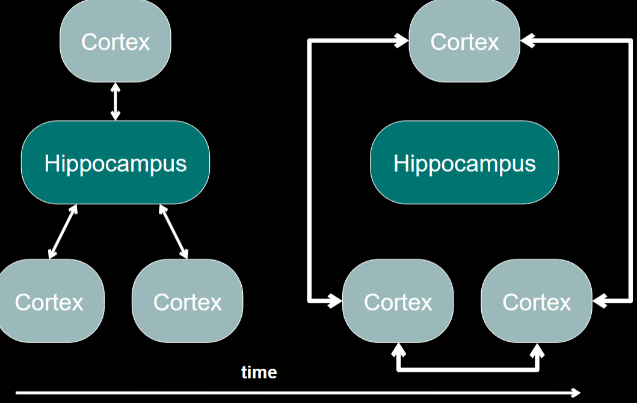
Old Memories (retrograde amnesia)
Warrington tested amnesiacs memory of highly familiar people and matched for how famous they were at the time (60s, 50s, 40s). It was found Amnesiacs were impaired at all retention levels (all periods of time)
Multiple Trace Theory
 Every time a memory is retrieved it is encoded and a new set of connections (traces) between the hippocampus and cortex form.
Standard Theory of Consolidation vs Multiple Trace Theory
Not one theory is “right” as there is Evidence to support BOTH. (from fMRIs)
Therefore perhaps memories are transformed over time
Semantic Memory and Semantic Dementia
Semantic Memory = Knowledge about the world
Semantic Dementia = Difficulty remembering words or concepts often involving “naming errors” (e.g calling a zebra a horse)
Semantic knowledge is associated with the lateral temporal cortex (on the left side)
Memory and Executive function
Frontal lobes play a role in the strategic aspects of memory (e.g searching for the right memory and making sure it is correct)
Confabulation
Amnesiacs may also have confabulation (delusions)
Spontaneous confabulation results as a result from damage to the frontal lobe and is caused by a breakdown in memory executive processes.