Ethics Chapter Test Review
- Morality: standards that an individual or group has about what is right and wrong or good and evil.
- Ethics: branch of philosophy that tries to determine the good and right thing to do.
- Ethical relativism: view that denies the existence of a single universally applicable moral standard. In other words, morality is “relative” from person to person and group to group.
- Ethical absolutism: view that affirms the existence of a single, correct and universally applicable moral standard.
- Normative ethics: branch of ethics that makes judgments about obligation and value.
- Cultural relativism:
- Consequentialist theory: position that the morality of an action is determined by its non-moral consequences. If the consequences are good, the action is right.
- Teleology: the theory of end results. All things have a purpose and reason.
- Egoism: treats self interest as the foundation of morality.
- Hedonism: view that pleasure is intrinsically worthwhile. Pleasure is the only thing that has intrinsic value.
NOT ALL EGOISTS ARE HEDONISTS
- Act Utilitarianism: normative ethics, position that an action is moral if it produces the greatest happiness for the most people.
- Non-consequentialist: the rightness or wrongness of an act is dependent on more than its consequences.
- Scriptural divine command: doing the will of God on the basis of what is written in a religion’s Holy Scriptures
- Divine command: a nonconsequential theory that suggests that we should always do the will of God.
- Natural Law: the non consequential theory that holds that humans should live according to nature. Our natural inclination is to do and be good.
- Categorical Imperative: ethical formula suggesting that the main by which you act could become a universal rule; I am not to act unless I would expect everyone else to act this way
- Kant’s first categorical imperative: what if my maxim were to become a universal law? Practice what you preach.
- Kant’s second categorical imperative: others are an end, not a means to an end. Don’t use people.
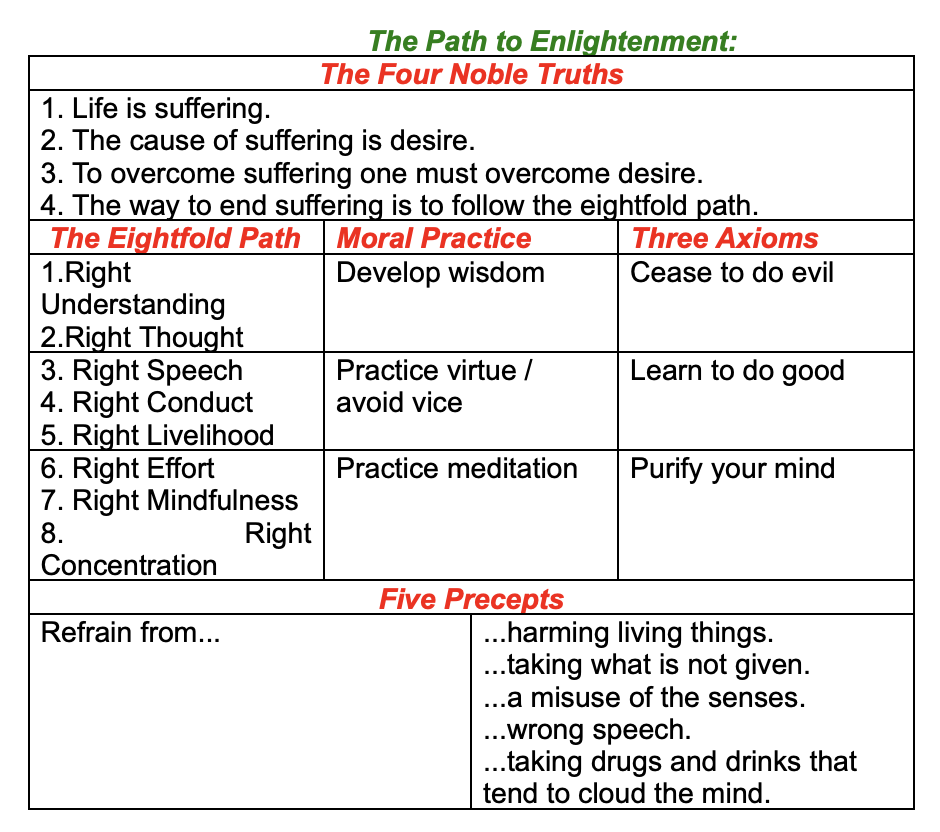
- Buddhist Ethics: ethical behaviour both leads to and slows from an enlightened mind. An enlightened person acts ethically.
- cultivation of wisdom: discipline of the mind through ethical action and quieting of the mind until the point of enlightenment.
- morality and wisdom: 2 factors that go together in buddhist ethics
- karma: great law of cause and effect
- volitional action: voluntary effort to follow a conduct
- Virtue: the ability to be reasonable in our actions, desires and emotions.
- Virtue: a morally good character trait, such as honesty, courage or integrity.
- Virtue Ethics : position that the moral life should be concerned with cultivating a virtuous character rather than rules of action.
- Utilitarianism: theory that we should act in such a way that our actions produce the greatest happiness or pleasure for all concerned.
- Rule Utilitarianism: normative ethics, position that we should act so that the rule governing our actions produces the greatest happiness for the most people.
- Jeremy Bentham:
- Aquinas: because God created the universe, the laws that govern it are laws that God imposed on it.
- John Stuart Mill: founder of utilitarianism.
- Kant: founder of the “good will” theory.
- Buddha: Sidhartha Gautama, found the 8 fold path.
- Aristotle: because humans can reason, they must act upon their ability to reason. Result is happiness.
- Happiness: what is the end we seek.
- Mean: how can virtue be achieved?
- Aristotle: who said “"…the ultimate good for man is carrying out those activities of his soul (which involve reason) and doing so with proper virtue and excellence.”
- Character development: what do virtue ethics depend on?
- Morally right: if an action tends to produce a virtous character it is?
- Virtous character: develop virtous traits, recognize the important of community, develop personal ideals.