Rights and Freedoms
The United Nations and Rights
What are human rights?
- <<Human rights are a set of fundamental rights and freedoms that are inherent to all human beings, regardless of their race, gender, nationality, religion, or any other status. These rights include the right to life, liberty, and security of person, freedom of thought, and religion, and the right to education, work, and an adequate standard of living.<<
- {{Human rights are something that everyone is entitled to and apply to everyone to ensure equality{{
- }}They are about being treated fairly, treating others fairly and having the ability to make genuine choices in our daily lives and are the basic standards by which we can identify inequality, discrimination, and the fairness of our nation.}}
The instruments that are declared under the Australian Human Rights Commission (AHRC) Act.
- International Covenant on Civil and Political Rights
- Convention on the Rights of Persons with Disabilities
- Convention on the Rights of the Child
- Declaration of the Rights of the Child
- Declaration on the Rights of Disabled Persons
- Declaration on the Rights of Mentally Retarded Persons
- Declaration on the Elimination of All Forms of Intolerance and Discrimination Based on Religion or Belief.
| Political | Cultural and Personal Beliefs | Legal | Economic | Freedom |
|---|---|---|---|---|
| Freedom from Slavery | Freedom from Discrimination | Freedom from Slavery | Freedom from Discrimination | Equality |
| Take Part in Government | Nationality | Freedom from Torture | Right to Own Property | Freedom from Discrimination |
| Social Security | Freedom of Belief | Recognition as a Person before Law | Social Security | Life, Liberty, and Security |
| Freedom from State or Personal Interference | Marriage and Family | Equality Before the Law | Work | Freedom from Slavery |
| Freedom from Slavery | Right to Own Property | Remedy by Tribunal | Adequate Living Standard | Freedom from Torture |
| Remedy by Tribunal | Participate in Cultural Life | Freedom from Arbitrary Arrest | Education | Privacy |
| Freedom from Arbitrary Arrest | Social Order | Fair Public Hearing | Freedom of Movement | |
| Asylum | Work | Innocent until Proven Guilty | Asylum | |
| Social Security | Marriage and Family | |||
| Property | ||||
| Freedom of Belief | ||||
| Right to Own Property | ||||
| Freedom of Opinion | ||||
| Freedom of Assembly | ||||
| Work | ||||
| Rest and Leisure | ||||
| Education | ||||
| Mutual Responsibility |
The Methods/Processes in Place to Protect Human Rights and Monitor Their Implementation.
- The International Declaration of Human Rights is not legally binding. However, the rights contained in the document act as a scaffold and a base from which important legislation can be passed in governments around the world in order to abide by these human rights.
- There are several methods and processes in place to protect human rights and monitor their implementation. One such method is the establishment of international human rights treaties and conventions, which outline the basic rights and freedoms that all individuals are entitled to. These treaties are monitored by international bodies such as the United Nations Human Rights Council, which reviews reports submitted by member states and conducts investigations into alleged human rights violations. Additionally, many countries have established national human rights institutions to monitor and promote human rights within their borders. These institutions may conduct investigations, provide education and training, and advocate for policy changes to protect human rights. Finally, civil society organizations and human rights defenders play a critical role in monitoring and advocating for human rights, often working in partnership with governments and international organizations to promote and protect human rights around the world.
- As well as the United Nations Human Rights Council, some other bodies that monitor these treaties are:
- International Convention on the Elimination of All Forms of Racial Discrimination
- International Covenant on Civil and Political Rights
- International Covenant on Economic, Social and Cultural Rights
- Convention on the Elimination of All Forms of Discrimination against Women
- Convention on the Rights of Persons with Disabilities
- And others, please refer to this link for more
- The UN has two types of human rights monitoring mechanisms: treaty-based bodies and charter-based bodies. The ten Treaty Bodies are made up of independent experts who oversee the implementation of international human rights treaties. The charter-based bodies consist of the Human Rights Council, Special Procedures, Universal Periodic Review, and Independent Investigations. UN Human Rights offers assistance and knowledge to all of these mechanisms.
Australia and the UN
- Australia was one of the 51 founding members of the UN and a member of the 18-nation commission that participated in drafting its Universal Declaration of Human Rights (UDHR)
- This document sought to record a ‘common understanding’ of the human rights and freedoms that people and nations should recognise, observe and protect. Australia’s Dr Herbert Vere (‘Doc’) Evatt (1894–1965) made an important contribution to this process.
- Doc Evatt served in many important roles in Australian law and politics: as a High Court judge, Attorney-General, Minister for External Affairs and leader of the Labor Party. From April to June 1945, he led Australia’s delegation to the meetings at the San Francisco Conference formed to establish the UN’s mandate and draw up the Charter, signed on 26 June 1945, that created the UN’s six key organs.
First Nations People
- First Nations people were discriminated against through the process of assimilation, during which their children were taken from them under the guise of ‘protection’, when in reality the circumstances they were exposed to harsh, abusive conditions and had their cultures taken away from them in an attempt to ‘educate’ and ‘civilize’ them
- This led to the stolen generation of children of Aborigines
WebQuest
- Flora and fauna: What was the impact of Aborigines who were not even counted as flora or fauna?
- They felt as though they didn’t exist at all, as though there was no acknowledgement of them as people
- Out of bounds: What was the Brisbane City Act? What measures were used to exclude Indigenous Australians from Europeans?
- the Brisbane City Act was an exclusion zone to keep Aboriginal people separate from the area that was frequented by European arrivals.
- Violence was used to keep Aboriginal people separate from Europeans
- No consorting: What brought European and Indigenous Australians together?
- Music brought them together
- Police: A law unto themselves: What brutality was experienced by Aboriginal children?
- Aboriginal children were assumed to be criminals, and they were attacked by police. Bones were broken and police brutality was a common experience for Aboriginal children
- Colour coding: What testing were children subjected to, to find out their ‘whiteness’? Why do you think they were completing these tests?
- They were sorted from the blackest to the whitest, noses and lips were measured, and the colour of their eyes was taken down
- Schooling: Why was Ernabella school different to the rest of its time? What successes did the school achieve?
- Ernabella school taught the Indigenous language, and supported Indigenous culture in it’s school. It was praised for its high level of education
- Hidden Away: What impact do you think denying an indigenous heritage had on individuals and families?
- Someone in the past decided they were white enough to get away with it, so they hid. Who can blame them? Seventy years ago that was the safest way, but today things are different. Not a lot different but today you can survive in Australia with a black past."
- Wards of the State: What kinds of places were stolen children taken to? What happened to them there?
- Aboriginal and Torres Strait Islander children could be removed from their families at any time under government protection acts. Generations of kids were sent to missions, stations, government settlements, industrial schools, reform schools and children's homes. They were prevented from practising culture and, almost always, from speaking the language. Most girls were trained to become domestic servants and boys to become agricultural or industrial workers.
- Dog licence: What was a ‘dog licence’? What did it allow? How would an Indigenous person get one? What did the application report on and include? How did the licences get removed?
- The 'dog licence' was another name for Certificates of Exemption. It was a licence to live in a white man's world. It allowed Aboriginal people to enter a town, vote, and send their children to the local school.
- Certificates of Exemption were seen by authorities as a key to 'assimilation', but could be withdrawn at any time. To get one, you were forced to renounce your culture, language and family who were still living on missions and reserves.
- Lack of health: What kinds of positions were Aboriginal men and women employed
to do? Name the person and their job.
- Alec Bilson
- Worked for white settlers as a police tracker, then a station hand
- Only received a disability pension just before he died
- Angel Sangka
- A station hand, when there is no work in the station for him, assists woodcutters
- Jacob Bilson
- A master tracker station hand
- Was unable to work for 2 years due to heart disease, and never received a disability pension
- Jim Brown
- Always worked as a station hand until his horse fell on top of him and rendered him unable to do the heavy lifting
- Joe Mason (Malkathanu)
- Prospector; has found gold and was a first-rate axeman
- \
ClickView Video
- The purpose of the reserves were to ‘protect’ the Aboriginal people, isolate them from the rest of society, and assimilate them into white society (‘civilise’ them and teach them Christianity)
- The removal of Aboriginal people onto reserves caused conflict. Different groups of Indigenous people were forced to live together on land belonging to other groups, which caused conflict. Education was only to the third-grade level, they were highly restricted when it came to food rations, healthcare, and visiting family. There was a severe lack of hygiene and people had to basically forget about their Aboriginal heritage. Half-Caste children and children deemed ‘white’ enough were taken away from their families, and while both boys and girls were educated and then sent to work, the girls were also expected to marry a white man.
Tasks
- The term ‘Stolen Generation’ refers to the Aboriginal people forcibly removed from their families as children between the 1900s and the 1960s, to be brought up by white foster families or in institutions.
- The Cootamundra Domestic Training Home for Girls, 1912–74
- This home was an institution for Aboriginal girls aged about 7-14 who were forcibly taken away from their Aboriginal families
- They were forbidden from any type of contact with their families
- They were punished for speaking their language and were forbidden from learning about their culture
- They were taught that they were white, and that Indigenous girls were inferior to white girls
- Once the girls were sent to work in domestic service, they were paid rarely (if at all), worked long hours with little freedom, and were at risk of sexual abuse
- On Document
%%STUDY FOR EXAM%%
The Stolen Generations refer to Aboriginal and Torres Strait Islander children who were forcibly removed from their families by the Australian government and church missions between 1910 and 1970. The reasons for removal included the belief that Indigenous peoples were inferior and needed to be assimilated into white Australian society, or that they were not fit to raise their own children due to poverty, alcoholism, or neglect.
The experiences of those who were removed varied widely, depending on their age, gender, location, and the circumstances of their removal. Many children were taken from their families at a very young age and placed in missions or homes run by religious organisations, where they were often subjected to physical, emotional, and sexual abuse by staff members and other residents. They were also deprived of their cultural identity, language, and connection to their communities, and were forced to adopt white Australian ways of life.
Some children were sent to foster families or adopted by non-Indigenous families, where they were often subjected to racism and discrimination. Others were placed in institutions, including juvenile detention, mental health hospitals, and prisons, where they endured further trauma and isolation.
The negative outcomes of the Stolen Generations are still being felt today by Indigenous communities across Australia. Many survivors suffer from ongoing trauma, depression, anxiety, and substance abuse, and struggle to reconnect with their culture and families. Their children and grandchildren have also been impacted by the loss of their family history and connections.
The Stolen Generations have also had a devastating impact on Aboriginal and Torres Strait Islander communities as a whole. The forced removal of children has disrupted traditional family structures and weakened cultural practices, leading to a loss of language, knowledge, and traditions. This has contributed to a breakdown in intergenerational relationships and has made it difficult for Indigenous communities to maintain their cultural heritage.
In conclusion, the Stolen Generations represent a dark chapter in Australian history that has had lasting effects on Indigenous peoples and their communities. The experiences of those who were removed were marked by abuse, trauma, and cultural loss, and the negative outcomes of the policies are still being felt today. It is important to acknowledge the suffering of the Stolen Generations and work towards healing, reconciliation, and justice for Indigenous peoples.
Day of Mourning
- What is significant about the date of “The Day of Mourning”?
- “The Day of Mourning” was in 1939, the 150-year anniversary of the arrival of the first fleet. It was also Australia Day.
- What was the aim? How did they attempt to achieve this? (methods) What was the outcome?
- The aim of “The Day of Mourning” was to bring rights to Indigenous Australians - recognition, unity, and equal access.
- Why is this a significant event in the struggle for Indigenous civil rights in Australia?
- Who were Jack Patten and William Cooper? Why are they associated with this event and how did they contribute to the Indigenous civil rights movement? (APA and AAL should be mentioned)
Rosa Parks
Rosa Parks is widely regarded as a key figure in the American civil rights movement. On December 1st, 1955, Ms. Parks refused to give up her seat on a Montgomery, Alabama bus for a white passenger. This act of civil disobedience led to her arrest, but also sparked a widespread boycott of Montgomery's buses by the African American community. This boycott, which lasted over a year, was a turning point in the civil rights movement and brought national attention to issues of segregation and inequality. Rosa Parks' bravery and the success of the boycott ultimately led to the desegregation of Montgomery's public transit system. Her role in the civil rights movement cannot be overstated, as her willingness to take a stand rallied the African American community and paved the way for future progress in the fight for equality and justice.
1967 Referendum
- The 1967 referendum proposed to include Aboriginal people in the census.
- The 1967 referendum proposed to allow the Commonwealth government to make laws for Aboriginal people.
- The referendum did not give Aboriginal people the right to vote - this was already given to them in 1962.
- It also did not give Aboriginal people citizenship, as most of these federal and state laws had been repealed.
- The referendum itself also was not about equal rights for Aboriginal people. The Constitutional change would not impact at all on laws governing Aboriginal people. However, campaigners hoped that a 'yes' vote would require the Commonwealth government to enact reforms that would eventually achieve better rights for Aboriginal people.
- On 27 May 1967, Australians voted to change the Constitution so that like all other Australians, Aboriginal and Torres Strait Islander peoples would be counted as part of the population and the Commonwealth would be able to make laws for them.
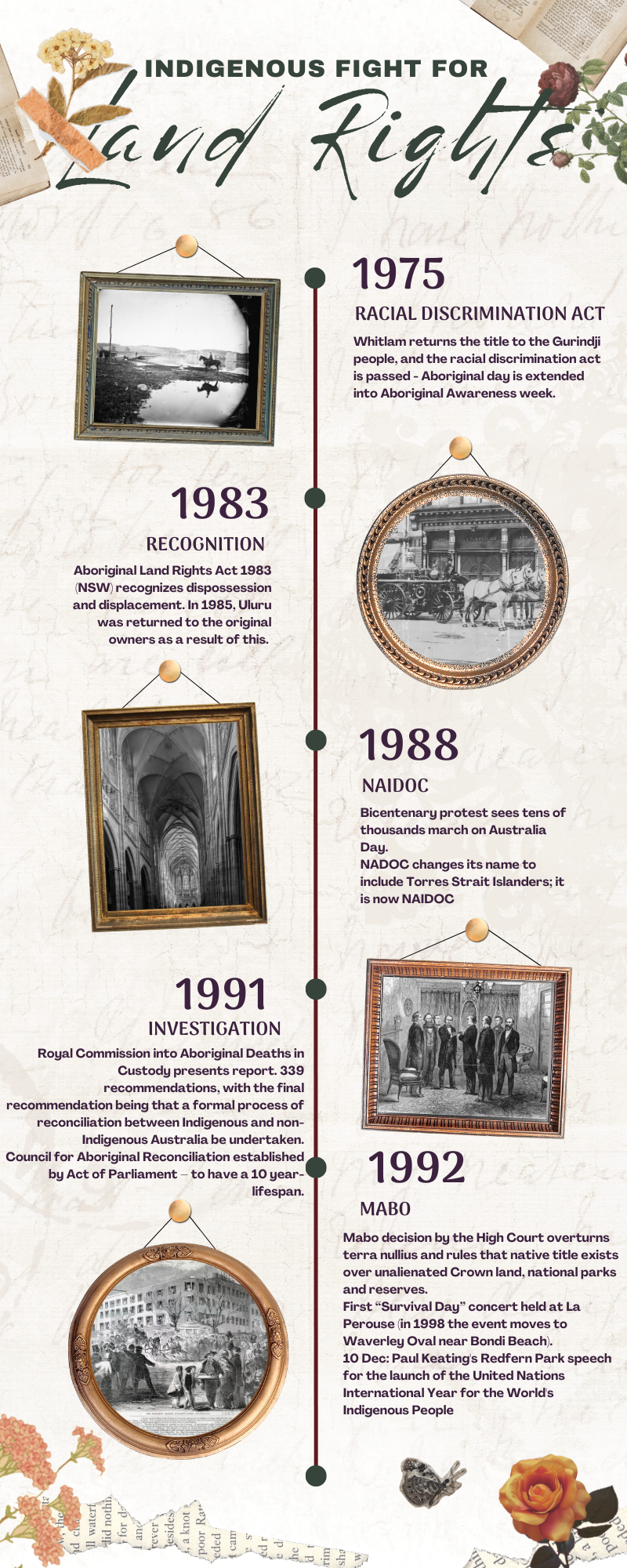
- The Aboriginal Land Rights (Northern Territory) Act 1976 has resulted in almost 50 per cent of the Northern Territory being returned to Aboriginal peoples. Some state governments followed the lead of the Australian Government and introduced their own land rights legislation.
Timeline