Community Pharmacy Dispensing
Retail Pharmacy Facilities
- community pharmacies are divided into 2 sections
- retail
- “back” secured off limits to the public
- the pharmacy may run at full capacity when the pharmacist is present
- patient convenience is put first
- having drive through windows
- off hours
- free delivery
Roles of a Retail Technician
- a certified tech can spend time directly with customers, entering new and refill prescriptions into the computer, filling and labeling prescription orders, reconciling insurance claims, stocking drugs, or checking inventory levels and drug expiration dates.
- may also do nonsterile compounding
- nonsterile compounding: non-injectable, noncommercially available medication for an immediate need
- expected to maintain a clean atmosphere
- dusting, vacuuming, garbage control
Dispensing Duties in the Community Pharmacy
- Greet customers at the pharmacy counter or drive-through window, and receive written new or refill prescriptions
- Answer the telephone and refer call-in new or refill prescriptions or transfers to the pharmacist • Update patient profiles, including patient demographics, drug use, allergies, and health conditions
- Clarify and resolve questions about a prescription (name, directions, and so on) with the prescriber's office
- Scan and/or enter new prescriptions (or refill requests) into the patient profile • Enter and/or update billing information for third-party reimbursements • Submit prescription claims online for medication reconciliation and insurance adjudication (see Chapter 8)
- Refer to a pharmacist any medication contraindications, and drug and allergy interactions
- Resolve eligibility or prescription processing issues
- Calculate prescription quantity and days' supply for accurate billing
- Retrieve and count drug products from restricted storage for prescription filling
- Reconstitute, package, and/or repackage products as needed for prescriptions
- Prepare extemporaneous, nonsterile compounds when necessary
- Select medication containers and affix labels
- Seek final verification by the pharmacist
- Store completed prescriptions for future patient pickup
- Return stock bottles to their proper storage locations
- Retrieve medications for patient pickup
- Offer a medication counseling opportunity with the pharmacist to the patient
- Distribute labeled medications with reminders of label directions
- Accept and process payments and copayments for the prescription(s) and in some cases for OTC drugs, supplements, and retail items Handle cash register, change, and credit processing responsibilities Resolve refused insurance payments
- Stock shelves
- Assist in inventory management
- Assist in technology management
- Assist in business functions
- Help keep the prescription filling area clean, organized, and tidy
Overview of the Prescription Process
- prescription: a patients medication order issued by a legally authorized physician or license practitioner for a valid medical condition by members of the pharmacy team
- they may be identifiable by the “Rx” symbol meaning it can only be sold with a prescription
- prior authorization is needed for expensive drugs and ones not covered by a patients health plan
- highly addictive drugs are other ones that need special precautions
The Prescription Components
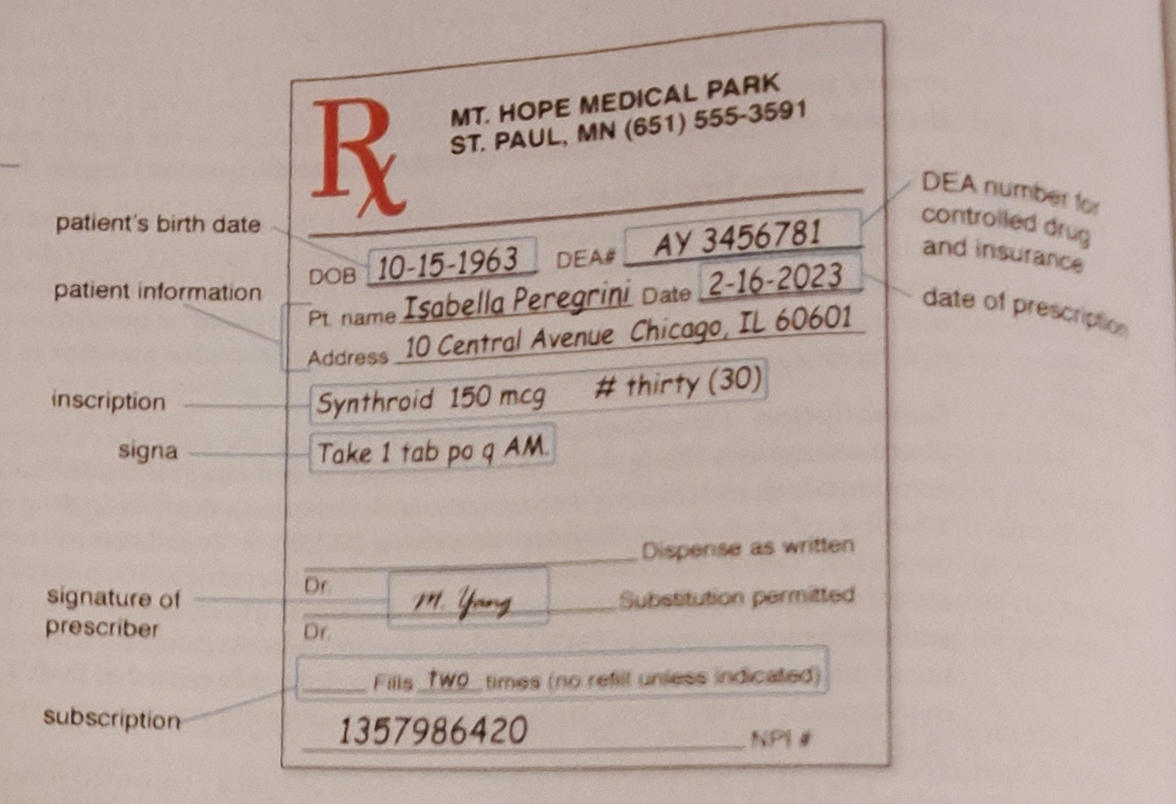
- must include the same information
- Rx symbol
- prescribers information- name address, phone number, identification of the prescriber, NPI
- Date-when the prescription was written
- Patients information- name, address, phone number, DOB
- Inscription- meds prescribed, generic and brand name, strength, amount
- subscription- instructions to the pharmacist
- signa- directions for the patient to follow
- additional instructions- anything else deemed necessary by the prescriber
- signature- by the prescriber
- Prescribers Information
- Prescribers Contact Information: the name, address, telephone number, fax numbers
- National Provider Identifier Number: necessary for each healthcare provider ti get reimbursed for services provides
Patients Information
- name: given in full and is legible
- date of birth and sex: additional identification
- helps to minimize medication errors
- Address and Phone Number: address is important for billing information
- reduces dispensing errors
Medication Information
- Date the prescription was written
- must be present to have prescription filled
- Inscription
- the medications name, strength, and amount
- generic is automatically substituted by the computer
- both knowing both names is important
- Signa
- directions how how it is used
- transferred and printed on the medication bottle
- Subscription
- lists the prescribers instructions to the pharmacist
- it may be noted “Dispense as Written “ or brand medically necessary
- Prescribers Signature
- must appear at the bottom of the paper
- stamps and another office personnel are not allowed
Processing Time Expectations
- ideally takes 5-10 minutes
- typically take 15-20 minutes with distractions
- insurance issue will take longer
Computer Communications and Efficiencies
- database management systems help process orders
- it is a computerized information system that integrates and interfaces with other software programs
Pharmacy Software Interoperability
Interoperability is the ability to exchange and process information between databases, software, and technology.
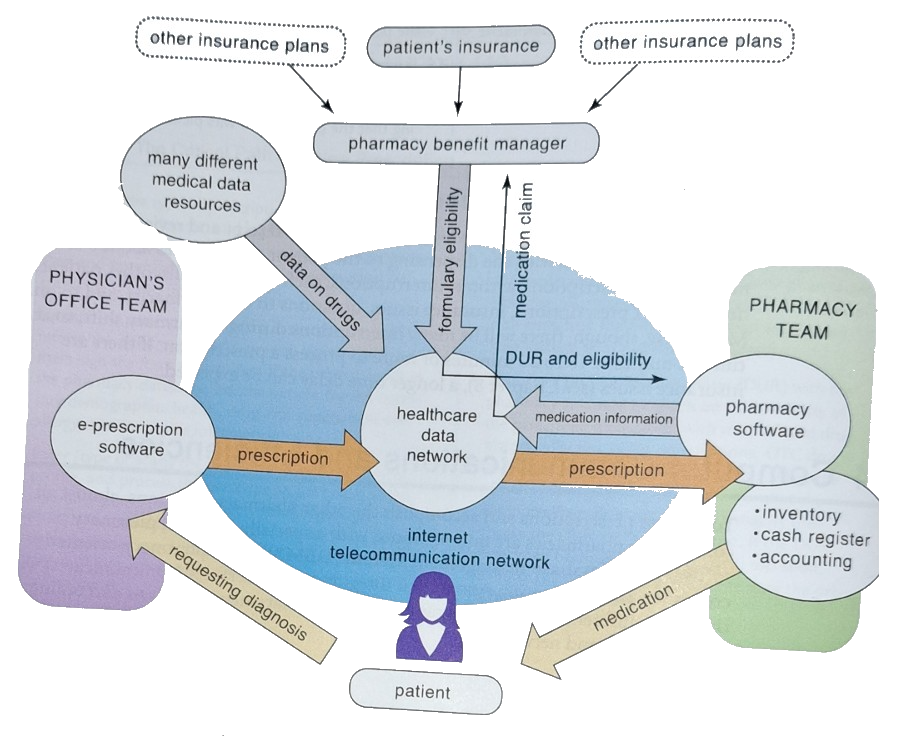
- Typically the software is menu driven or window-based
- the database usually has the patient profile. physician database, drug inventory, and a directory of prescribers and insurance plans
- can all be sorted through
- patient's name, address, phone number, date of birth
- the prescription's number, drug name, National Drug Code (NDC) number, dosage and quantity of the drug, and number of refills
- prescriber's name, address, phone number, and DEA number
- they typically track the financial aspect as well
- to alleviate some of the technician’s workload there are two types of computers
- smart terminals- contain their own storage and processing capabilities
- dumb terminals- contain a monitor and a keyboard
- they are hooked up to a remote computer that sends the information to a central location to be stored and processed