Plant Responses
Organisms respond to the environment and receptors observe changes in the environment
Plants can look very different based on their environment
Signal Transduction Pathway:
Reception:
Receptors- proteins that undergo changes in shape in response to specific stimuli→chemical, mechanical, light
lock and key mechanism
Etiolation = morphological adaptations for growing in darkness
Transduction:
conversion of an external signal from receptor into a signal that organisms can process in a response center
Secondary messengers- small molecules in the cell than can amplify the signal and transfer it from the receptor to other proteins that carry out the response
like a relay race
Response
Transcriptional Regulation: turning genes on or off
increasing/decreasing the synthesis of of mRNA coding a specific enzyme
Post translational Modification: changing enzymes already there
activates pre-existing enzymes
De-etiolation: the process of “greening”, w/ morphological and biochemical changes of photosynthesis
Chemical Communication:
Plants tune responses w/ hormones
signaling molecules produced by one part of an organism’s body and transported to other parts where it binds to specific
Tropism- growth response toward/away from a stimulus
Phototropism- growth toward/away from light
differential growth of cells on light+dark sides
cells elongate faster on dark side as bending occurs below the growing tip of plant (opp side), which goes toward the light
Ratio of auxin and cytokinin controls cell differentiation
Thigmotropism- response to touch
Gravitropism- sensing of gravity
Moving Hormones
move through circulatory system (plasmodesmata, xylem, phloem)
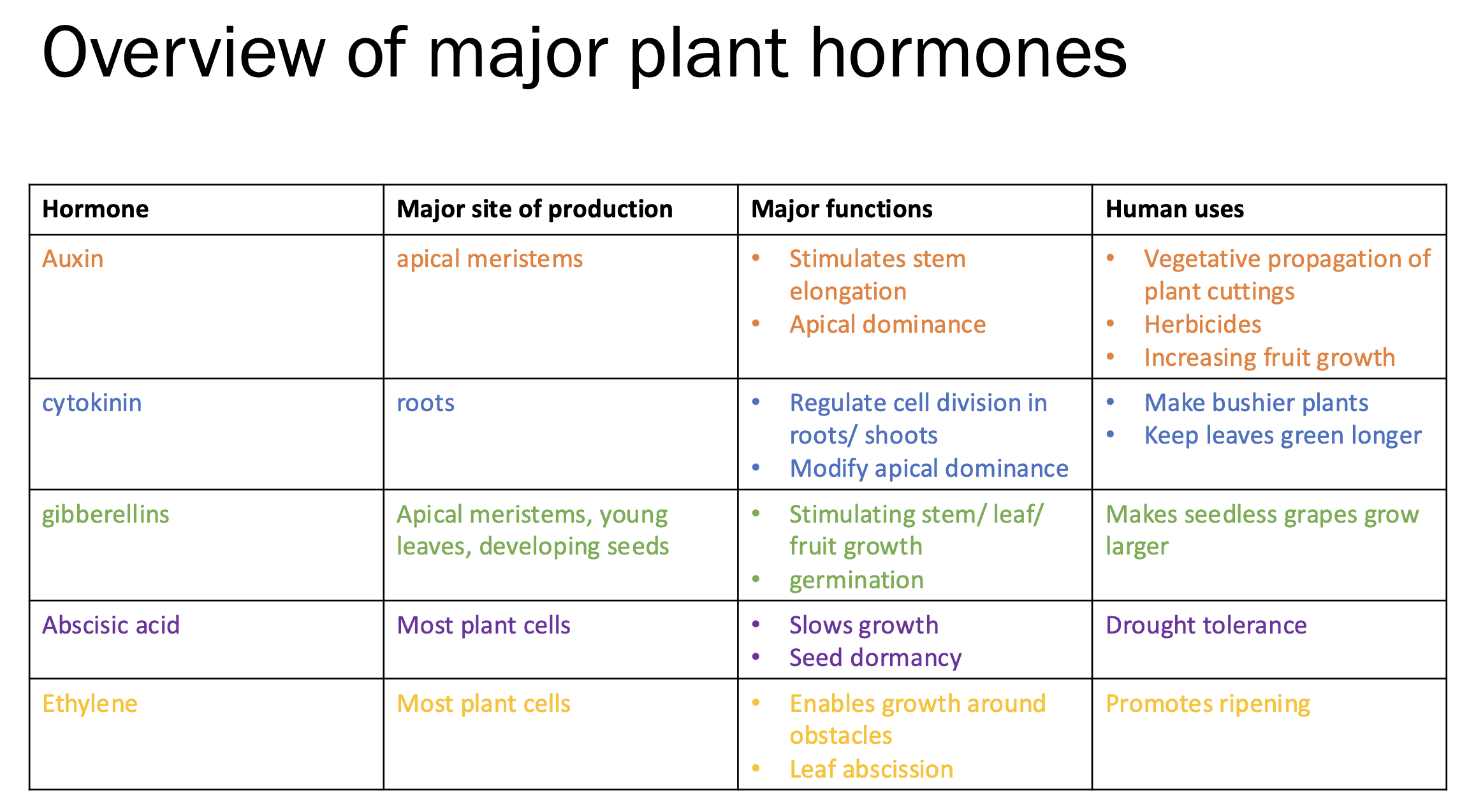
Auxin: promotes elongation
produced mainly in apical meristems
moves only from tip to base in phloem→Polar transport (unidirectional)
inhibits growth of lateral axiliary buds when apicad bud present→removal stimulates cytokinin→lateral axilliary bud growth
Used as a herbicide (preserves monocots but overdoses eudicot weeds)
promote fruit development (esp in greenhouses)
in agent orange
Cytokinin: stimulates cytokinesis (cell direction)
produced mainly in plant roots
transported in xylem sap- opposite direction of auxin
bushier plants
anti-aging effects on plants
Gibberellins
expressed in apical buds, young leaves, and developing seeds
promotes stem elongation and leaf growth
bolting= rapid growth of the floral stalk
Promotes pollen development, fruit growth w/ auxin, and seed germination
used to make bigger seedless grapes
Abscisic Acid (ABA)
synthesized in most plant cells
inhibits growth and maintains seed dormancy
antagonizes growth hormones
promotes leaf senescence (aging→death)
drought tolerance→ closes stomata, used in agriculture, including synthetics
Ethylene:
gas produced by nearly all parts of plant in response to stressful conditions
promotes fruit ripening→fruits look great on outside but don’t taste good
speeds rate of senescence in deciduous trees→leaf abscission (leaves drop prematurely (esp close to gas leaks))
Prevents desiccation
leaf nutrient reuptake from leaves b/4 abscission
abscission layer at base of petiole→change in auxin/ethylene
Triple response to mechanical stress- enables growing shoot to avoid an obstacle
slowing of stem elongation
thickening of stem
curvature of stem
Time
Circadian Rhythms
24 hr cycle in eukaryotes
Internal timekeeper controlling biological rhythms
persist w/o external cues (ex: opening/closing stomata, fold/unfold leaves of flowers)
Light
Photomorphogenesis- light triggered events in plant growth/ development
diff wavelengths of light drive diff processes in plants
blue light photoreceptors- pigments that absorb blue light
initiate response such as phototropism (light induced opening of stomata and growth towards light)
slowing of hypocotyl elongation when seedling breaks ground
phytocrome receptors- absorb red light
regulate seed germination and shade avoidance
Gravity
Gravitropism- sensing of gravity
shoots go up and roots go down in response to gravity
positive= down, negative= up
occurs as soon as seed germinates
statoliths- dense cytoplasmic components that settle under influence of gravity to lower portions of the cell
Touch
Thigmotropism- directional growth in response to touch
Thigmomorphogenesis- changes in form that result from mechanical perturbation
Rapid leaf movements- mimosa pudica, carried out through action potentials
Attacks
Defenses against pathogens
Epidermis/periderm = 1st line of defense, helps to have a good, thick cuticle
Plant immune system- have systems analogous to humans
innate immunity- pathogen associated molecular patterns (PAMP)
adaptive immunity- effector triggered immunity
Herbivory
physical defenses = thorns, spines/modified leaves
chemical defenses = toxins/ unpalatable compounds