Introducing networks
What is a network?
A network is therefore a collection of computers and other devices such as smartphones or tablets that are connected either via cable or wirelessly (know as the communication media) to allow users to communicate, and to share software, hardware, data and information.
Advantages of networks
Fast, efficient communication
emails
SMS’s
Instant messages using apps like: (WhatsApp, BBM, Messenger, or WeChat.
Social networks such as Facebook and Instagram enables people to be involved in the lives of friends and family wherever they are in the world.
Sharing of hardware
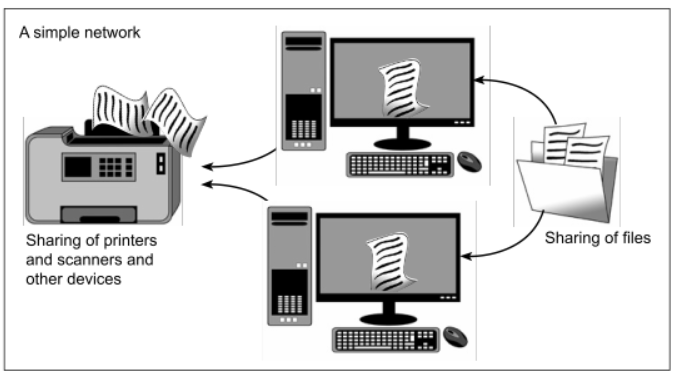
Sharing of files
Networks allow people to share files without having to carry flash drives or portable hard drives from computer to computer.
A server is a powerful computer in a network that provides shared resources such as files.
Centralisation of data
Data centralisation is a little more complicated than just sharing files:
Data is stored in a database. Users connect to the database regardless of their physical location. Any changes that they make to data are immediate and available to all the other users. The database makes sure that users cannot make conflicting changes to the data.
Flexible access
Leisure
Increased control and security
Disadvantages of having a network
People have had to learn how to protect their privacy and information when going online and how to communicate safely.
It can be expensive to set up and maintain certain certain types of networks.
It is possible that confidential or sensitive information may be ‘leaked’
Harmful software such as computer worms can spread quickly via a network.
a central fault in the network can cause loss of data.
Keywords
Network | a collection of computers and other devices that are connected either via cable or wirelessly |
Server | Powerful computer that provides shared resources in a network |
Internet | A global network consisting of many networks that are connected to each other |