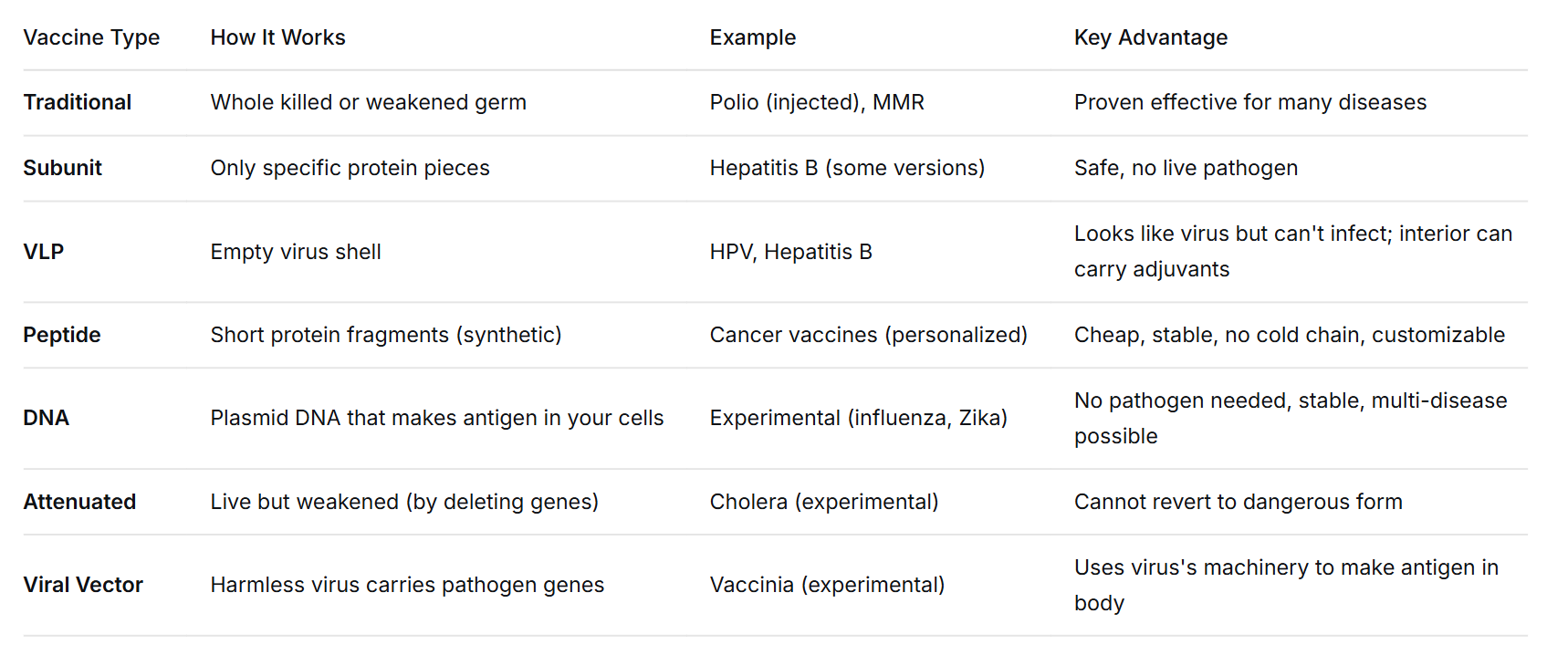
Vaccines
why does vaccination work at the individual and at the population level?
At the individual level, vaccines function to train the immune system to recognize a pathogen without causing disease. If the pathogen is encountered again, the immune system responds to protect.
At the population level, vaccines function to reduce the spread of individuals since there are fewer people to infect with a larger portion vaccinated.
list and briefly discuss the issues with traditional vaccines.
Some agents cannot be grown in culture which makes it difficult to produce the vaccine in the traditional way.
Animal/human cell culture is expensive.
Biosafety issues such as working with live pathogens cause dangerous situations.
Poor killing/attenuation may lead to a less effective vaccine or a more virulent pathogen that permits negative implications.
Reversion of attenuated pathogen.
Traditional vaccines do not work for all pathogens. Some are resistant.
Requires refrigeration which causes difficulty in transport and storage.
Short shelf life.
what are subunit vaccines and what are their advantages and disadvantages?
subunit vaccines use only specific protein epitopes of a pathogen instead of the entire germ.
Advantages — stable & safe, precisely defined, and free of contaminants
Disadvantages — takes time to develop, expensive to purify, protein shape may be in wrong conformation, and less effective
briefly explain the process for developing a single and multiple subunit vaccine.
Single subunit vaccine: clone the gene for a specific protein, express is in bacteria as a fusion protein, and then purify & remove the non-viral parts.
Multiple subunit vaccine: a mixture of subunits are used together to improve protection
what are VLP vaccines and why are they a good alternative to traditional vaccines?
VLP vaccines are empty virus shells that appear as a real virus but do not contain any genetic material and cannot cause infection.
Reasons why they are a good alternative:
favorable immunological characteristics w/small size and repetitive surface geometry trigger a strong immune response
induce both innate and adaptive immunity
safe
cheap to produce
approved vaccines currently exist on the market
interior can be used (filled with TLR ligands to act as built in adjuvants)
why is the HPV vaccine so good?
The HPV vaccine is good because of its structural features of the virus-like particles lead to the efficient generation of long-lived antibody producing cells and because of its unique features of the HPV life cycle which make the virus very vulnerable to antibody-mediated blocking of infection.
what makes peptide vaccine an attractive alternative to traditional vaccines?
A peptide vaccine is simple, fast and produced cheaply via chemical synthesis. It is characterized as a chemical drug instead of a live biological product. It has no biological contamination and it is water-soluble and stable. Peptide vaccines are also customizable.
discuss the role of carrier proteins in peptide vaccine delivery.
Peptides alone typically have poor immunogenicity so to remedy this, the peptide is attached to a highly antigenic carrier protein which stimulates the immune system much better.
list and discuss the limitations of peptide vaccines and some of the possible solutions to said limitations.
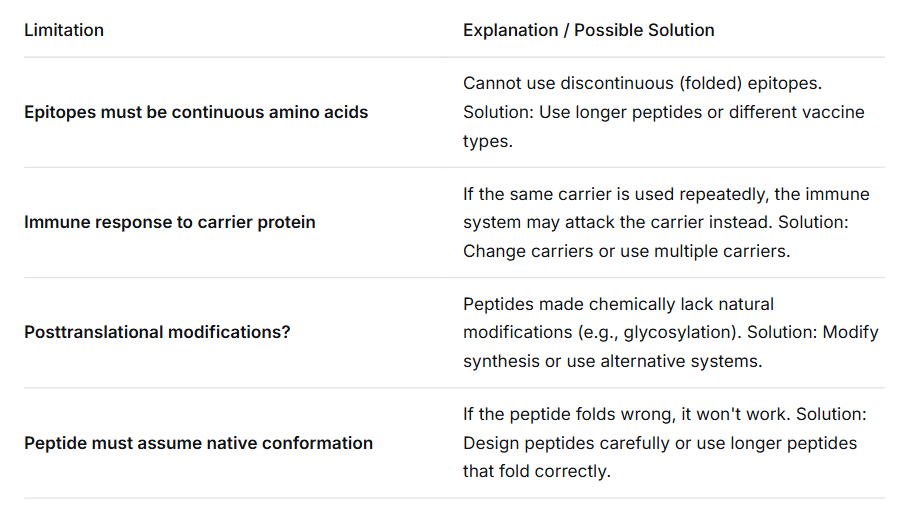
what are personalized peptide vaccines? explain the steps involved in developing a personalized peptide vaccine. how do we know that a PVP is working?
Personalized peptide vaccines are cancer vaccines made specifically for one patient. They target the unique differences between a patient’s healthy cells and their tumor cells.
Steps:
whole exome sequencing — sequence all protein-coding genes from both tumor tissue and healthy tissue
tumor RNA-seq — see which genes are active in the tumor
identify somatic mutations — find mutations present only in the tumor
design peptides — pick target epitopes and design short peptides
synthesize peptides — make up to 20 different peptides for that patient
mix with adjuvant and inject
The PVP is working when the patient mounts an immune response which is detectable in blood or tissues and the patient improves clinically by tumor shrinking or disease stabilizing.
list and briefly discuss some benefits of DNA vaccines.
Benefits of DNA vaccines are no culturing of the pathogen, no risk of reversion to virulence, safe for immunocompromised individuals, no peptides to make chemically, any pathogen is possible, cheaper to produce, long-term stability, and multi-vaccine plasmids possible.
briefly discuss microparticle DNA delivery.
DNA is coated onto cationic microparticles. This is injected into the tissues where the DNA is slowly released over several days which leads to prolonged antigen expression. This prompts a 250-fold increase in antigen production compared to standard delivery. However, the DNA is susceptible to exonucleases.
discuss deletion-attenuated vaccines and discuss the process for producing deletion-attenuated vaccines.
Deletion-attenuated vaccines are made by removing toxic or pathogenic genes from the pathogen. This eliminates the possibly of the germ reverting back to a dangerous form.
example process with cholera vaccine:
start with Vibrio cholerae and remove the enterotoxin genes
the resulting strain is enterotoxin-negative but can still colonize the intestinal surface (good for oral delivery)
because dangerous genes are deleted, there is no reversion to a fully toxic form
discuss the pros and process for producing vaccinia vector vaccines.
Advantages of vaccinia virus as a vaccine vector include broad host range, benign in most people, large 187 dsDNA genome, replicates in the cell’s cytoplasm, and presence of its own DNA polymerase and RNA polymerase.
Process for producing a vaccinia vector vaccine:
put the gene of interest into a plasmid with sequences that target the vaccinia TK gene
infect cells with vaccinia virus
transform the cells with plasmid
select for double recombinants (virus that have swapped the TK gene for the new gene of interest)
the resulting virus is TK-negative and now carries the pathogen’s gene, so when administered to a patient, it makes the patient’s body produce antigen from that pathogen
what is passive immunity and how does it differ from vaccination?
MAB passive immunity involves giving a person ready-made antibodies which provides immediate but temporary protective because there is no memory (no initial infection).
what are the major pathways of the immune response that vaccines target?
The innate immune system is triggered when the particles from a vaccine are encountered which brings macrophages, neutrophils and NK cells to the site to launch a non-specific first response.
The adaptive immune system is slower and more specific with B cells and T cells as the main players.
Vaccines work best when they stimulate both pathways and create immunological memory.
what is being done to improve DNA vaccine effectiveness?
To improve DNA vaccine effectiveness, microparticle delivery is considered, the route of vaccination is optimized, and adjuvants are used to boost the immune response.
why is the mortality data for diseases like measels, polio and resp infection relevant to vaccination?
Vaccines were created with the intention of reducing the amount of death cases reported to communicable diseases and with published numbers, the vaccines for diphtheria, measles and polio were quite effective.