Supply Side Policies
Supply Side Policies Overview
Purpose: Foster long-term growth by increasing the quantity and quality of Factors of Production (FOP), leading to full employment and potential output ⬆️.
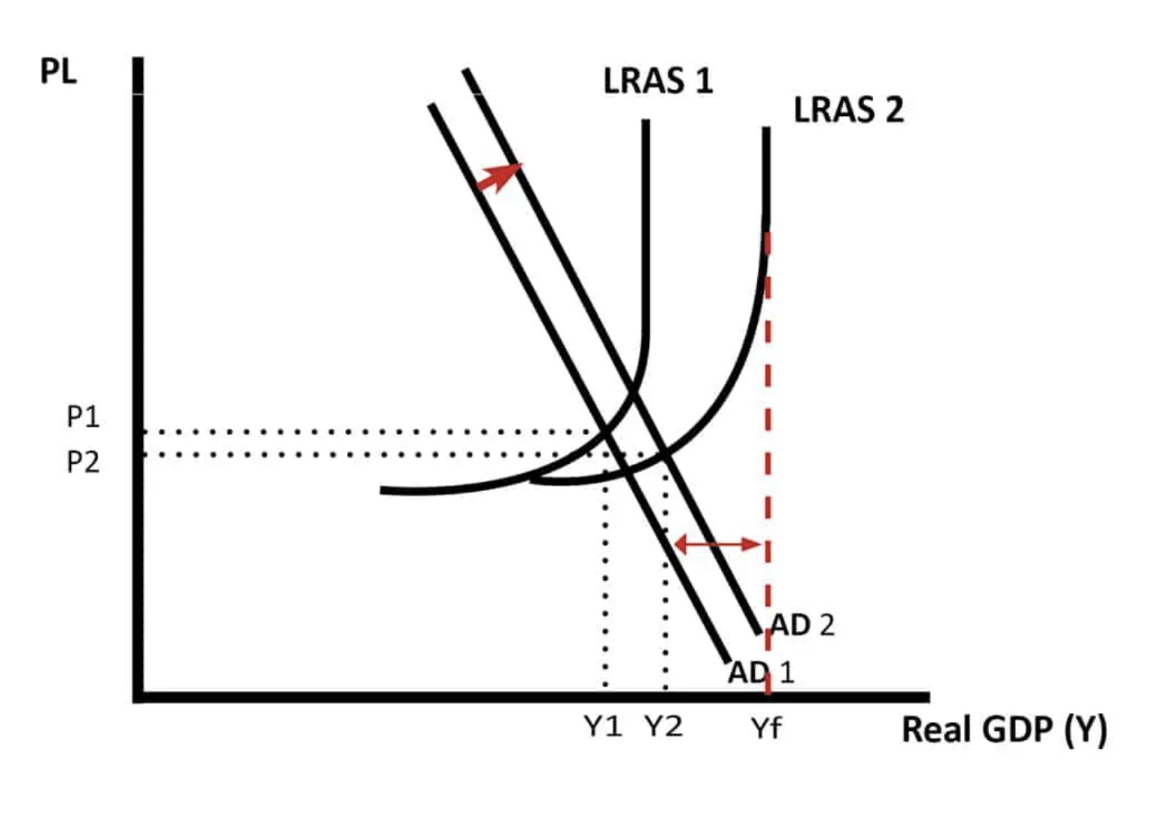
Impact on Long Run Aggregate Supply (LRAS): Increases in LRAS can arise from both Keynesian and Monetarist perspectives.
Types of Supply Side Policies
Market Oriented Supply Side Policies
Objective: Increase FOP's quantity and quality through market mechanisms.
Key Strategies:
Reducing Government Role: Minimizing government involvement to stimulate private sector growth.
Lowering Costs and Barriers: Encourage investment by reducing obstacles for businesses.
Interventionist Supply Side Policies
Objective: Direct government intervention to enhance the quality and quantity of FOP.
Key Strategies:
Government investment in education, healthcare, infrastructure, and targeted industries.
Goals of Market Oriented Supply Side Policies
Improve Productive Capacity:
Increase output while lowering prices.
Enhance competition leading to innovation and investment.
Decrease Labor Costs & Unemployment:
Labor market flexibility through reduced union power and minimum wages.
Reduce Inflation:
Promote competition and free trade to drive down costs.
Increase Investment Incentive:
Cuts in taxes and deregulation enhance investment incentives.
Specific Market Oriented Policies
Encouraging Competition
Deregulation:
Eliminating unnecessary regulations to incentivize competition and lower consumer prices.
Privatization:
Transitioning state-owned entities to private ownership to increase efficiency and reduce taxpayer burden, though risks of creating monopolies exist.
Trade Liberalization:
Enhancing competition through open trade policies.
Anti-Monopoly Regulations:
Limit mergers and acquisitions to maintain market competition.
Labor Market Policies
Union Power Reduction:
Lessened union influence to allow more flexibility in wage setting.
Limiting Unemployment Benefits:
Encouraging job-seeking by reducing benefits may lower living standards.
Incentive Policies
Tax Cuts:
Enhancing disposable income for both households and firms to stimulate saving and investing.
Limitations of Market Oriented Policies
Equity Concerns:
Policies may disproportionately benefit higher income groups, harming lower-income workers.
Political and Economic Power Dynamics:
Lobbying by vested interests can distort policy effectiveness.
Environmental Impact:
Deregulation may harm environmental quality, disproportionately affecting impoverished communities.
Goals of Interventionist Supply Side Policies
Aim to correct market failures and improve productive capacity through direct government involvement.
Key Strategies in Interventionist Policies
Education and Training:
Enhance human capital through public spending on education.
Healthcare:
Access to quality healthcare to boost workforce productivity.
Research and Development:
Subsidization of R&D to foster innovation and supply positive externalities.
Infrastructure:
Government provision of essential infrastructure enhances efficiency for firms.
Industrial Policies:
Support for strategic industries to promote long-term economic health.
Comparison of Market vs. Interventionist Policies
Market-Based Policies
Focus on deregulation, privatization, trade liberalization, and tax reforms.
Interventionist-Based Policies
Emphasize government support in healthcare, education, and direct industrial support.
Impact on Aggregate Demand and Supply
Both policies aim to enhance LRAS, contributing to lower inflation over time.
Short-term impacts may cause inflation due to increased government spending (G) and business investment (I).
Pros and Cons of Each Approach
Market Oriented Pros
Improved resource allocation leads to growth in potential output with lower prices.
Promotes efficiency with less government spending required.
Market Oriented Cons
May exacerbate income inequality and environmental issues.
Potential political resistance and vested interests.
Interventionist Pros
Directly targets essential sectors for growth and mitigates market failures.
Interventionist Cons
Costs to government and possible inefficiency in decision making.
Combination of Demand-Side and Supply-Side Policies
Targeted fiscal policy through government initiatives can boost both Aggregate Demand and Aggregate Supply, leading to more sustainable economic growth.
(AD short run AS long run)