AP Environmental Review
Unit 1
1.1-Introduction to Ecosystems-
Ecosystem Basics
Individual =One organism (Elk)
Population = Group of individuals of the same species (elk herd)
Community = all living organisms in an area
Ecosystems = all living and nonliving things in an area (plants, animals, rocks, water, air
Biome = large area with similar climate conditions that determine plant and animal species there
Ex.tropical rainforest
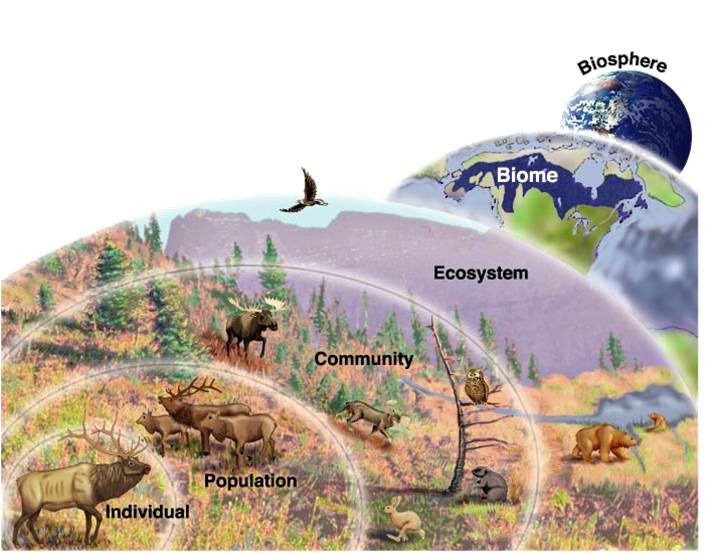
An ecosystem is the interaction of living and nonliving things in a specific area
An environment Is the entire natural world
A Habitat is a specific environmental condition that a given species needs
Ex. The artic would be a great habitat for caribou but would be for a capybara
Organism Interactions

Competition: Organisms fighting over a resource like food or shelter; limits pop. size
Predation: one organism using another for energy source ( Hunters, parasites, even herbivores)
Mutualism: a relationship that benefits both organisms (coral reef)
Commensalism: a relationship that benefits one organism and does impact the other (Birds nest in trees)
Predation (±/-)
Herbivores (PLant eaters0 eat plants for energy (Giraffe and tree)
True predators: (Carnivores) kill and eat prey for energy (Leopard and giraffe)
Parasites: Use a host organism for energy, often without killing the host and often living inside the host
Ex. mosquitoes, tapeworms, sea lamprey
Parasitoids: lay eggs inside a host organism; eggs hatch and larvae eat the host for energy
Ex. parasitic wasps, bot flys
Symbiosis sym = together | bio= living | osis = condition
Symbiosis refers to any organisms that live in close proximity to each other (They are two different organisms)
Any close and long-term interaction between two organisms of different species
Mutualism (+/+), commensalism (+/O), and parasitism (±/-) are all symbiotic relationships
Mutualism: organisms of diff. species living close together in a way that benefits both
Coral (animals) provide reef structure and CO2 for algae; algae provide sugars for coral to use as energy
Lichen= composite organism of fungi living in algae; algae provide sugars (energy) and fungi provide nutrients
SYMBIOSIS IS NOT THE SAME THING AS MUTUALISM
Competition
Reduces pop. size since there are fewer resources available and fewer organisms can survive
Resource partition: different species using the same resource in different ways to reduce competition
Temporal partitioning: using resources at different times, such as wolves and coyotes hunting at different times (night vs day)
Spatial partitioning: using different areas of a shared habitat ( diff. length roots)
Morphological partitioning: using different resources based on different evolved body features.
1.2 Terrestrial (land) biomes
Biomes
Biome: An area that shares a combination of avg. yearly temp. and precipitation (climate)
Ex. Rainforests is a well-known biome that over the course of the year is going to have really high rainfall as well as warm temperatures whereas the desert is going to be a biome that is characterized by very low precipitation and may also have high temperatures
The community of organisms (plants and animals) in a biome is uniquely adapted to live in that biome
Ex. Camels and cacti have water-preserving traits for desert; shrubs and wildflowers store lots of energy in roots to recover quickly from fires in grasslands.
Biome characteristics
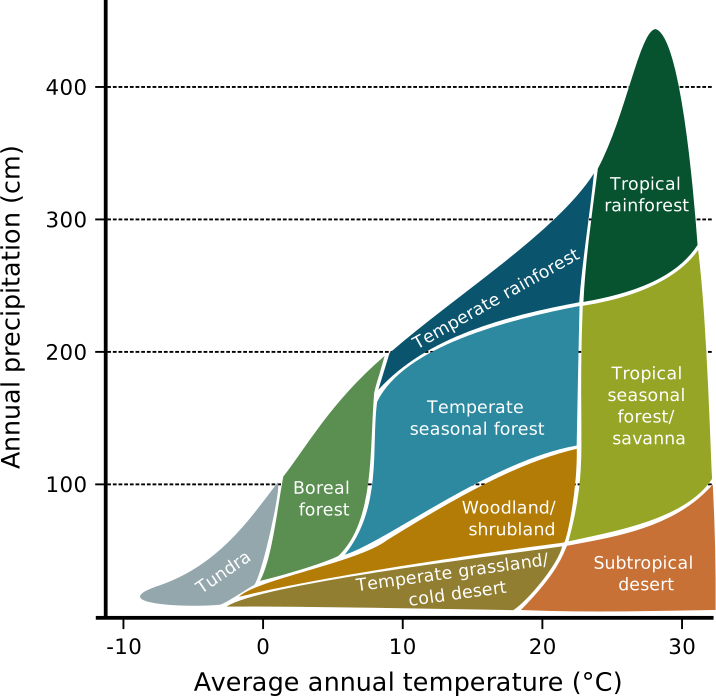 Biomes are defined by annual temp and precipitation. avg.
Biome chart can also predict where on earth biomes are found
Ex. Tundra and boreal= higher lat. (60 degrees +) —— Temperate = mid lat, (30 degrees - 60 degrees) ——- Tropical = closer to the equator
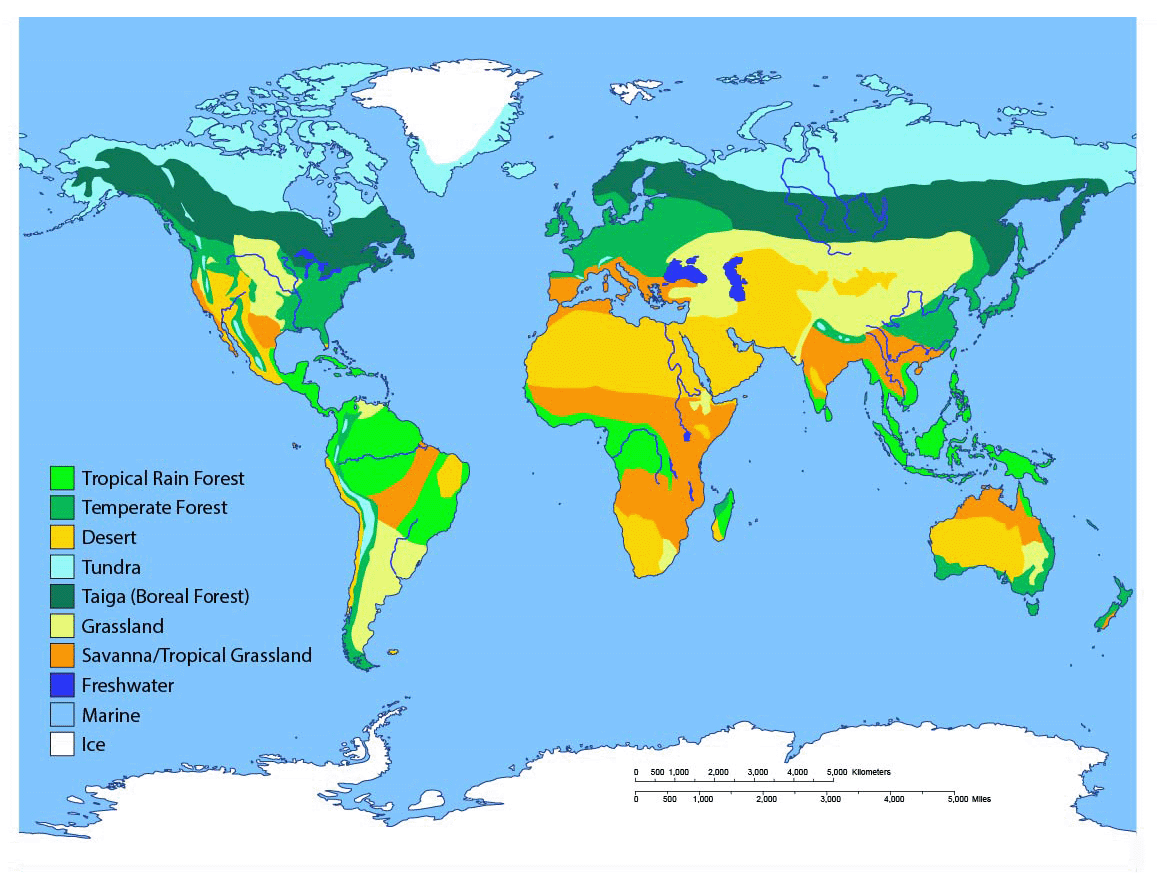
Latitude ( distance from the equator) determines temp. and precip. which is why biomes exist in predictable patterns on earth
Nutrient availability
Plants need soil nutrients to grow, so availability determines which plant can survive in a biome
Ex. Frozen soils of tundra don’t allow nutrients in dead org. matter to be broken down by decomposers
low soil nutrients
low water availability
few plants survive here
Tropical rainforest = nutrient-poor soil (high competition from so many different plant species)
Boreal forest = nutrient-poor soil ( low temp, and low decomp. rate of dead org. matter)
Temp. forest = nutrient-rich soil ( lots of dead org. matter - leaves and warm temp/ moisture for decomp.)
Shifting biomes
Biomes shift in location on Earth as climate changes
Ex. warming climate will shift boreal forests further north as tundra permafrost soil melts and lower latitudes become too warm for aspen and spruce
1.3 Aquatic Biomes
Characteristics of Aquatic Biomes
Salinity-How much salt there is in a body of water, determines which species can survive and usability for drinking (Freshwater vs estuary vs ocean)
Depth- Influences how much sunlight can penetrate and reach plants below the surface of photosynthesis
Flow- Determines which plants and organisms can survive, how much o2 can dissolve into water
Temp.-Warmer water holds less dissolved 02 so it can support fewer aq. organisms
Freshwater: Rivers and lakes
Rivers have high 02 due to flow mixing water and air and also carry nutrient-rich sediments (deltas and flood plains = fertile soil)
Lakes= standing bodies of fresh h2o (Key drinking h2o sources)
Littoral:Shallow water w/ emergent plants
Limnetic: Where light can reach (Photosynth)
Not rooted plants, only phytoplankton
Profundal: Too deep for sunlight (No photos.)
Benthic: Murky bottom where inverts (Bugs) live, nutrient-rich sediments
Freshwater: Wetlands
Wetland-Area with soil submerged/saturated in water for at least part of the year, but shallow enough for emergent plants
Plants living here have to be adapted to living with roots submerged in standing water (cattails, lily pads, reeds,)
Benefits of wetlands
Stores excess water during storms, lessening floods
Recharges groundwater by absorbing rainfall into the soil
Roots of wetland plants filter pollutants from water draining through
Highly plant growth due to lots of water and nutrients (dead organic matter) in sediments
Estuaries
Areas where rivers empty into the ocean
A mix of fresh and saltwater (species adapt to this ex. mangrove trees)
High productivity (plant growth) due to nutrients in sediments deposited in estuaries by river
Salt marsh:
Estuary hab. along the coast in temp. climates
Breeding ground for many fish and shellfish species
Mangrove swamp
Estuary hab. along coasts of tropical climates
Mangrove trees with long, stilt roots stabilize the shoreline and provide habitat for many species of fish and shellfish
Coral Reef
Warm shallow waters beyond the shoreline; the most diverse marine (ocean) biome on the heart
Mutualistic relationship between coral (animals) and algae (Plants)
Coral take CO2 out of the ocean to create a calcium carbonate exoskeleton (the reef) and also provide CO2 to the algae
Algae live in the reef and provide sugar (energy) to the coral through photosynthesis
Both species rely on the other
Coral couldn’t survive without energy from algae
Algae need the home of the reef and CO2 from the coral
Intertidal zones
A narrow band of coastline between high and low tide
Organisms must be adapted to survive crashing waves and direct sunlight/heat during low tide
Ex. Barnacles, sea stats, crabs that can attach themselves to rocks
Shells and tough outer skin can prevent drying out (desiccation during low tides)
Diff. organisms are adapted to live in diff. zones
Ex. Spiral wrack(Type of seaweed) curls up and secretes mucus to retain water during low tide
Open ocean
Low productivity/area as only algae and phytoplankton can survive in most of the ocean
So large though, that algae and phytoplankton of the ocean produce a lot of earth O2 and absorb a lot of atmospheric CO2
Photic zone= area where sunlight can reach (photosynthesis)
Aphotic zone (abyssal)= area too deep for sunlight
REMBER BIOMES SHOULD BE DETERMINED BY AVERAGE TEMPERATURE AND PRECIPITATION AND THE ORGANISMS LIVING IN THOSE BIOMES ARE UNIQUELY ADAPTED TO THOSE TEMPERATUES AND PRECITATION PATTERNS.
Law of Conservation of Matter: Matter is never created or destroyed, it only changes forms
1.4 The Carbon Cycle
Biogeochemical Cycle Terminology
Reservoirs: Things that temporarily store matter
Sources: Processes that move matter around between reservoirs
Sinks: Reservoirs that store more matter than they give off
Carbon Cycle Key Points
Carbon sources return carbon to the atmosphere while sinks remove carbon from the atmosphere
The amount of time carbon spends in different reservoirs significantly caries
The atmosphere is a critical carbon reservoir because the amount of carbon the atmosphere stores at any given time determines the earth’s global climate
The more carbon dioxide and methane that are added to the atmosphere the warmer Earth becomes
🏔 Photosynthesis is a really important step in the carbon cycle
Photosynthesis: Removes carbon from the atmosphere and stores it in plant life
The process of plants taking carbon out of the atmosphere and converting it to biological molecules like glucose or starch or other plant tissues
If plants have really long lives they can actually become carbon sinks
Ex. A sequoia or redwood tree that lives for thousands of years takes in so much more carbon than it gives off lowering the levels of carbon dioxide in the atmosphere
Respiration: Returns carbon dioxide to the atmosphere as plants and animals break down glucose to use for energy
Organisms like plants and animals are breaking down glucose and exhaling or respiring that carbon dioxide out adding it back to the atmosphere
🏔 The most important carbon cycle step from a human standpoint is extraction and combustion
As we dig up fossil fuels to burn them for electricity we’re returning carbon dioxide to the atmosphere that was out of circulation for millions and millions of years
This is why the rate of carbon cycling is so important
🧠 Think about it like this
Respiration as spending a dollar that you just found on the ground whereas burning fossil fuels is like living on a credit card because you’re putting way more carbon dioxide into the atmosphere then you’re saving or taking out
1.5 The Nitrogen Cycle
The movement of nitrogen between reservoirs
🏔 Nitrogen Cycle Key Points 🏔
Nitrogen cycles pretty quickly through its reservoirs
The major nitrogen reservoir is the atmosphere
But it exists in a form that’s biologically unavailable to plants or animals
This is because the triple bond between these nitrogen atoms in its gas phase is just too strong to be broken apart by plants or animals
Nitrogen Fixation- Converts biologically unavailable nitrogen gas (N2) into biologically available forms like ammonia (NH2) and nitrate (NO2)