Biology Test 1 Notes 1-3
Chapter 1
Basic Properties of Life
Order → cells, tissues, organs, organ systems
Reproduce
Growth + development (controlled by DNA)
Process energy (chemical)
Respond to stimuli
Regulate internal environment (homeostasis)
Evolutionary adaptation
Organelle
Mitochondria
Lysosomes
Smooth ER
Rough ER
Vacuoles
Golgi apparatus
Ribosomes
Nucleus
Hierarchy of Organization
Biosphere - all environments on Earth where organisms live
Ecosystem - the living organisms within a biosphere & their physical components with which they react
Community - all the living organisms on a particular area
Population - particular species of organism
Organism - any living thing
Organ System - a group of organs performing similar functions
Organ - a group of tissues performing the same function
Tissue - a group of similar cells performing the same function
Cell - the basic unit of life
Organelle - small organs found within the cell with particular functions
Molecule - made up of atoms that are held together by chemical bonds
Types of Cells
Prokaryotic
Develops first
Smaller of 2 types
No membrane bound
Nucleus
Asexual reproduction
Single cell
Bacteria
Eukaryotic
Membrane bound nucleus
Sexual & Asexual reproduction
Single and Multicellular
Plants, animals, algae
Interaction of Living Organisms with their environment
Producers - make food through photosynthesis
6Co2+6H2O → C6H12O6+6O2
Consumers - carnivores, herbivores, omnivores
Decomposers
Biotic Factors - living factors (trees, animals)
Abiotic Factors - without life (sand, rocks, water, air)
Dynamics in a Ecosystem
Recycling of Materials
One way energy flow - sunlight is converted into energy by producers → eaten by consumers → exits as heat
Genes - units of heredity that transmit information, genes are grouped in chains
Chromosomes - made up of DNA
DNA → double helix made up of nucleotides
Diversity of Life
Biodiversity
Forest - trees, snakes, deer, rabbit, fungi
Taxonomy - study of classification
Domains
Bacteria - prokaryotes ( most diverse and wide spread) always unicellular
Cocci - round
Bacillus - elongated
Spirillum - corkscrew
Archaea
Psychrophiles - found in extreme cold
Thermophiles - found in extreme heat
Methanogens - produce methane gas (found in the bottom of swamps, ponds, lakes and in our digestive tract)
Halophiles - found in extremely salty areas
Eukarya - nucleus that is membrane bound
Multicellular (humans)
Unicellular (profist, algae)
Evolution - a change over time
Natural Selection - best traits are passed from one generation (survival of the fittest)
Chapter 2 - Chemical Bases of Life
Solids - Liquids - Gases
Element - anything that cannot be broken down into another substance and still retain the properties of the original element
Atomic particles - p+n = atomic mass, p = atomic number
Protons(+) - inside nucleus
Neutrons(+-) - found in nucleus
Electrons(-) - found in orbit outside nucleus
Ions result when you change the number of electrons
Isotopes result when you change the number of neutrons
Different elements are made when you change the number of protons
Valence electrons - one electron found in the outer shell
Noble gases - don’t react with any element because their outer shell is full
Chemical Bonds
How are chemical bonds formed?
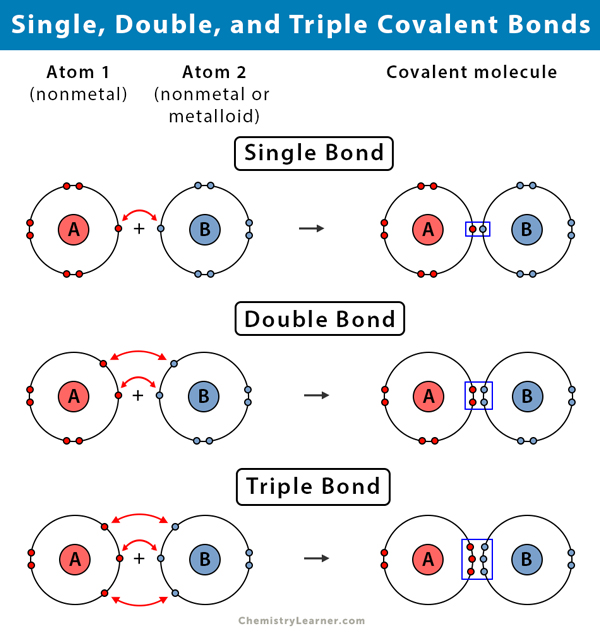
Covalent bonding - sharing electrons
Ionic bonding - atom either gains or loses electrons
Hydrogen bonding
Covalent Bonds
Single
Double
Triple
Ionic Bonds

Properties of Water
Strong cohesion (holding together of molecules of one molecule
Adhesion - elements of different kinds
Can form ice (floats because molecules are further apart than water)
Called solvent of life
Moderates temperature
Solvent - substance that does the dissolving
Solute - substance being dissolved
Chemical reaction - changes one substance into another
Ex: 2H2 + O2 ←→ 2H2O
Buffers - substances that minimize change in pH
Acid - substance that has a pH lower than 7
Base (Alkaline) - substance that has a pH greater than 7
Chapter 3 - Molecules of a Cell
Anything that contains carbon is considered organic.
Hydrocarbons - substances that contain hydrogen and carbon
Functional Groups necessary for life
First five are polar and hydrophilic
Hydrophobic - Methyl
Hydroxyl - Hydrogen bonded to O2 ( If bonded to carbon → alcohol)
Carbonyl - Carbon double bonded to O2
Carboxyl - Carbon + Oxygen + Hydroxyl
black carbon, white hydrogen, red oxygen
Amino - hydrogen, carbon, nitrogen double bonded to hydrogen
Amino acids are the building blocks of proteins
Phosphate - O2 + Phosphorus
Energy transfer (DNA, RNA)
Methyl - CH3
Classes of Molecules
Carbohydrates (CHO)
Simple sugars (mono/sacchar/ides) sacchar - sugar
Disaccharides sucrose
Polysaccharide -
starches (plant energy)
Glycogen - (animal energy)
Cellulose - plant cell wall
Chitin - exoskeleton of insects, crustaceans
Lipids - don’t dissolve in water
Fats - saturate and unsaturated
Phospholipids - make up the majority of the cell membrane (heads are hydrophilic tails are hydrophobic)
Steroids - natural or artificial (found in cell membrane)
Proteins -
Structural amino acids - provide support (hair, connective tissues)
Connective tissues muscles
Transport - hemoglobin (loves oxygen, carbon-monoxide)
Signaling devices (insulin)
Catalyst - regulate body functions
Immunological - used in defense of foreign objects
Nucleic acids - DNA RNA