3.1 The Division of Powers
Federalism: an institutional arrangement that creates two relatively autonomous levels of government, each possessing the capacity to act directly on behalf of the people with the authority granted to it by the national constitution
National gov handles things like:
- defense of the nation against foreign threats
- promoting national economic prosperity
Subnational handles:
- admin of education
- health care
- public safety
- other public services
All constitutions under federalist systems formally allocate legislative, judicial, and executive authority, another common trait among federalist govs is that national courts commonly resolve disputes between levels and departments of government
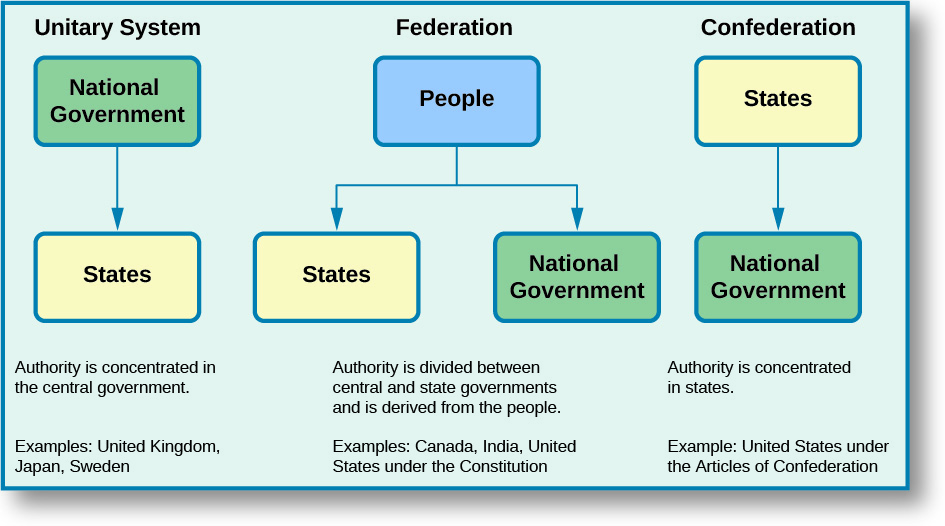
Federalism & The Constitution:
- The constitution contains provisions that direct the functioning of U.S. federalism. Some delineate the scope of national & state power, while others restrict it. The remaining provisions shape relationships among the states and between the states and the federal gov
Amendment X = states reserved powers (“The powers not delegated to the United States by the Constitution, nor prohibited by it to the States, are reserved to the States respectively, or to the people.”)
- overtime states’ reserved powers are no longer exclusive
- ex. education, healthcare, income security, and welfare are all programs the fed gov has administrated to state residents
- Concurrent powers = shared & overlapping powers that range from taxing, borrowing, and making/enforcing laws, to establishing court systems
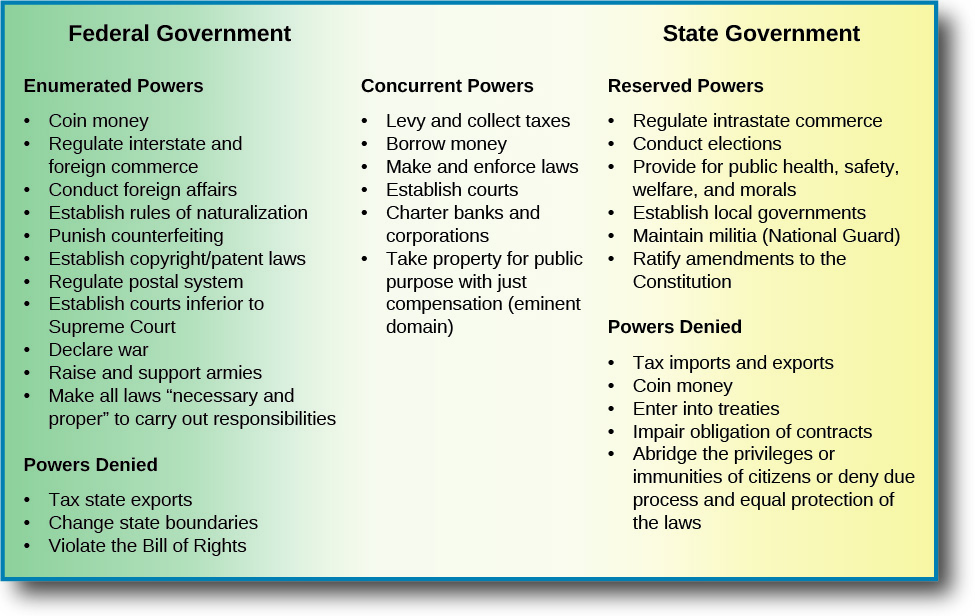
Important parts of the Constitution:
- Article IV, Section 1 (full faith & credit clause/comity clause): requires states to accept court decisions, public acts & contracts of other states. EX. drivers license
- Supremacy clause (Article IV): fed law is the supreme law of the land when constitutional
- Article I, Sections 9 & 10: lays out restrictions on federal authority (Denied powers)
- 9: gov cannot suspend the writ of habeas corpus (right to a fair trial), cannot pass a bill of attainder, or enact ex post facto law
- 10: states cannot enter into treaties with other countries, coin money, and levy taxes on imports & exports (Denied powers)