TRANSPORT IN PLANTS
Cell membrane- Material exits and enters the cell via the cell membrane. Only small (simple) molecules can cross the cell membrane.
Diffusion: Particles move from an area of high concentration to an area of low concentration.
Osmosis: The diffusion of water through a selectively permeable membrane. Water moves from pure water or a dilute solution into a concentrated solution.
Hypotonic, Isotonic and Hypertonic
The solution with the lower solute, higher water concentration is HYPOTONIC.
The solutions of equal solute and solvent concentration is ISOTONIC
The solution with the higher solute concentration, lower solvent concentration is HYPERTONIC
Isotonic- The inflow of water is equal to the outflow of water from osmosis
Hypotonic- A hypotonic solution contains more water (and less solute) than the cell. Water enters the cell by osmosis. The cell vacuole and the whole cell expands
Hypertonic- A hypertonic solution contains less water and more solute than the cell. Water will leave the cell. The cytoplasm will shrink. Plant cells become plasmolysed. Animal cells become created.
Active Transport is defined as a process that involves the movement of molecules from a region of lower concentration to a region of higher concentration against a gradient or an obstacle with the use of external energy.
Xylem vessels and transport of water and dissolved minerals to all parts of the plant.
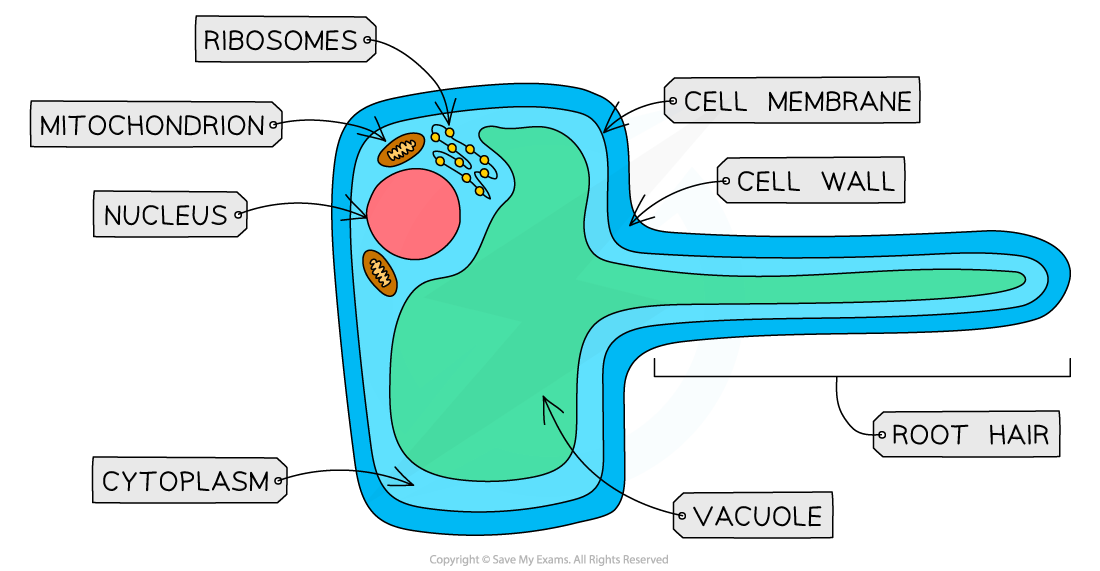
Osmosis in plants- Absorbtion of water from soil by root hairs through root pressure.

The special lignin structure of xylem is a helix or coil of lignin that strengthens the cells walls of xylem vessels. This structure allows the xylem to grow in length at the plant grows.
Transpiration: Loss of water from leaves
Transpiration pull: The suction like force that helps to draw water from the leaf mesophyll xylem leaves. Capillarity, Adhesion, Cohesion of water molecules
Capillarity- Based on the chemistry of the water molecule
Cohesion- Water molecules stick together
Adhesion- In a narrow vessel water molecules adhere to the walls of the vessel.
The net effect is that transpiration pull acts like the suction of a straw and the xylem vessel acts as structure.
TRANSPIRATION: EVAPOURATION OF WATER FROM LEAVES
The transpiration stream is the column/flow of water in the xylem vessel.
Transpiration creates the transpiration pull
Transpiration pull pulls/moves water molecules up xylem vessels to leaves. It is a force created by transpiration.
Uses of water by the plant:
Water for photosynthesis
Keeps cell turgid (leaves need to be turgid and upright facing the sun for photosynthesis)
Water as a solvent mineral nutrition via the roots
Evapouration for cooling (thermoregulation)
Factors affecting rate of transpiration:
Temperature
Humidity
Wind speed
Light intensity
Comparison between Factors that affect the rate of Transpiration or photosynthesis
Transpiration | Photosynthesis |
Temperature | Temperature |
Light Intensity | Sun energy |
Humidity | Water availability |
Wind speed | Co2 concentration |
Chlorophyll |
PHLOEM
Transport of food plants
How do plants move food that is made in the leaves to the other parts of the plant?
TRANSLOCATION in the phloem
Plants are able to use a combination of PASSIVE TRANSPORT and ACTIVE TRANSPORT to move food substances around the plant.
Pressure flow hypothesis
It is a description of the mechanism by which food substances move through the phloem.
Water control in plants is related to:
Water for photosynthesis
Water for turgidity
Water for cooling the plant
Water to be excreted
Water enter plant root cells by osmosis. Water leaves plants by:
Transpiration
Transpiration pull
Transpiration stream
Capillarity
Adhesion of water molecules to a narrow vessel
Cohesion of water molecules to each other
Three types of tissue in plants:
Dermal Tissue- Epidermal tissue (epidermal cells) and guard cells
Ground Tissue- Includes packing tissue and photosynthsis tissue
Vascular Tissue- Xylem and phloem
Factors that effect the rate of transpiration
Structure and function of stoma
Temperature
Humidity
Wind Speed
Light Intensity
Controlling water in a plant is Osmoregulation
Reduce transpiration
Increase uptake of water from roots
To store water in the plant
Water Conservation
Reduce transpiration
Extra- thick waxy cuticles
Reduced leaf number
Stomata close during the day and open at night (due to temp)
Sunken groups of stomata in the leaf
Leaves that can roll and cover stomata
Tiny leaf hairs to trap water
Increase in temp increases rate of transpiration
Increase in light intensity increases the rate of transpiration
Increase in realative humidity decreases the rate of transpiration
Higher wind velocity increases the rate of transpiration
Sufficient availability of water increases the rate of transpiration.