CHEMISTRY OF THE ENVIRONMENT
Chemical test for water:
Add anhydrous copper sulphate—>Colour changes from white to blue.
CuSO4(white) + 5H2O ⇌ CuSO4.5H2O(blue)
Physical test for water(for pure water):
Heat to boiling. It should boil at exactly 100 degrees.
Another test for water:
Use cobalt(II) chloride paper. It will turn blue to pink in the presence of water.
Purification of water for drinking:
Sedimentation and Filtration: Water is filtered through beds of sand and gravel to: remove suspended solid particles.
Chlorination: to kill harmful bacteria
Use of carbon to remove taste and odours
Why is distilled water used rather than tap water in experiments?
Contains fewer chemical impurities
Water from natural sources may contain:
Plastic - harmful to aquatic life
Sewage - harmful microbes that cause diseases
Nitrates and phosphates from fertilisers - leads to deoxygenation of water
Harmful microbes
Dissolves oxygen and metal compounds which are beneficial
Fertilisers:
NPK fertilisers provide the elements nitrogen, phosphorous, and potassium for improved plant growth.
Ammonium salts and phosphate salts are also used as fertilisers.
Composition of clean air:
Nitrogen —> 78%
Oxygen —> 21%
Argon —> 0.9%
Carbon dioxide —> 0.03%
Water vapour —> variable
To obtain Nitrogen/Oxygen from air:
Air is filtered and then cooled down to form liquid
Fractional distillation of liquid air
Uses of oxygen:
Oxygen cylinders
Combines with acetylene to form a flame that has a very high temperature, so it is used in welding metals
Air pollution:
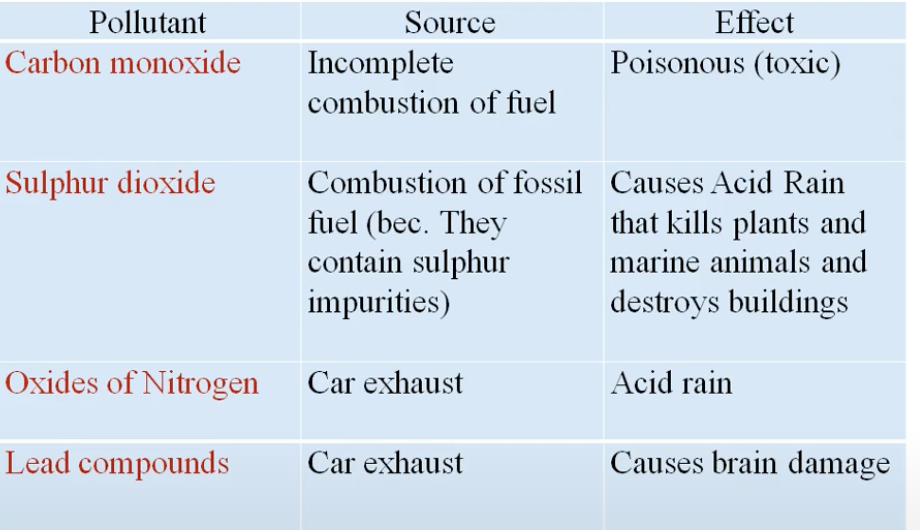
Methane is obtained from the decomposition of vegetation and waste gases from digestion in animals. Higher levels of methane lead to increased global warming, which leads to climate change.
Greenhouse gases like carbon dioxide and methane absorb the thermal energy which is re-emitted in all directions. This reduces the thermal energy lost to space. This process is known as the greenhouse effect.
As concentration of greenhouse gases in the atmosphere increases, more thermal energy is trapped within the Earth’s atmosphere causing the Earth’s average temperature to rise. This is known as the enhanced greenhouse effect.
How to help reduce the effects of climate change:
Planting trees
Decrease use of fossil fuels
Use of renewable energy like wind, solar energy
Reduce livestock farming
How to help reduce the effects of acid rain:
Reducing emissions of sulfur dioxide by using low-sulfur fuels and flue gas desulfurisation with calcium oxide.
Use catalytic converters in vehicles.
2CO + 2NO —> 2CO2 + N2
Flue-gas desulfurisation:
Removal of sulfur dioxide(acidic) from the waste gases that come out of the chimneys in factories using limestone or slaked lime(which is basic). The gases pass through it and are neutralised.
Effects of acid rain:
Destroys buildings
Kills tree
Harmful to marine life
How to test for sulfur dioxide:
Use potassium dichromate. Colour will change from orange to green if sulphur dioxide is present.
Slaked lime- Calcium hydroxide
Lime- Calcium oxide