Nok
Ancient Agrarian Societies: Nok Society
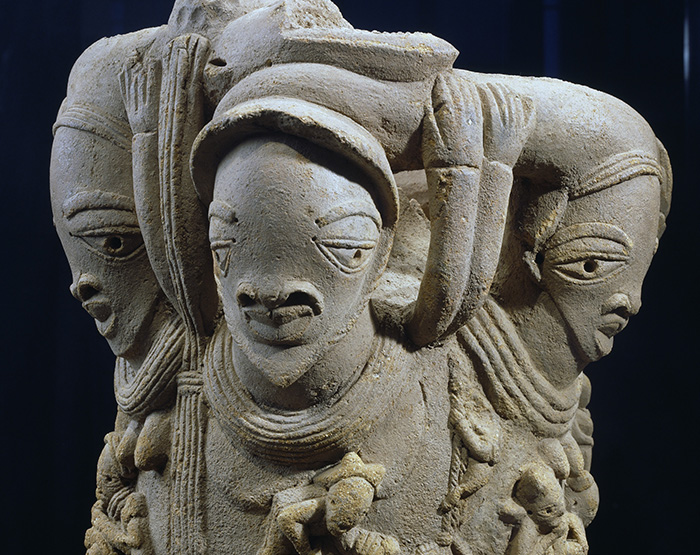
Photograph of a three-headed stone statue.
By Trevor R. Getz
We have few written records to tell us about complex agricultural societies in West Africa. But archaeological evidence proves they existed as at least as far back as 2000 years ago! The Nok society is one of these.
Introduction
We usually learn of Ghana and Mali as the first complex societies in West Africa. But these states are recorded as existing after the tenth century CE (about a thousand years ago). Agriculture, however, emerged in West Africa possibly as long as 4,000 years ago. Before that time, people lived in the Sahara. Today the Sahara is a desert, but then it was a vast grassland. They herded cattle and ate wild grasses. But as the world began to dry, these people were driven into river valleys. They began to cultivate the wild grasses so that they would have enough food to eat. By 2000 BCE, foods like pearl millet, barley, and cattle were sustaining dense populations.
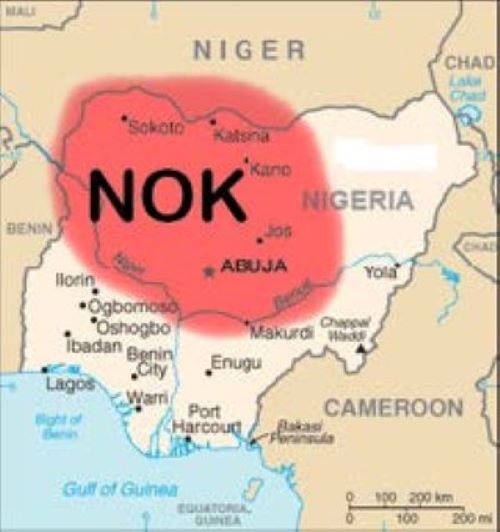
A map shows the area where Nok culture existed, which includes parts of Nigeria and is near the Gulf of Guinea.
General vicinity of Nok culture, by Locutus Borg. Public domain.
What if Ghana and Mali were the first complex societies in West Africa? That would mean 3,000 years had passed between the beginning of farming and the growth of any kind of state. This seems unlikely. Unfortunately, we don't have many written records to tell us that there were large and complex societies in this part of Africa before the tenth century. There are many possible reasons for this. First, this region suffered a number of invasions and a great deal of conflict in later years that may have destroyed some records. Second, this is a region where history was often maintained through oral tradition (or spoken words), rather than writing. In fact, part of the reason we know about Ghana and Mali is through writings from Muslims from North Africa. These Muslims had crossed the Sahara Desert to this region by the tenth century and recorded what they found. But even though we don't have written records for earlier societies, we do have a great many archaeological remains. These tell us quite a bit about complex African societies before the tenth century. One of these societies was Nok, in the northern part of today's country of Nigeria.
Iron, terracotta, and Nok
Archaeologist Bernard Fagg was working around the town of Jos, in Northern Nigeria, when he first found hundreds of terracotta sculptures. These sculptures of brownish-red pottery all exhibited a similar style. There were human figures with long heads, almond-shaped eyes, and elaborate hairstyles. The styles were somewhat similar to those worn by some Nigerians today. Many of the figures showed common human experiences: love, sickness, music, and war. The depictions of love are among the most interesting. For example, there is a sculpture of a man and a woman kneeling in front of each other, with their arms wrapped around each other. There was also quite a lot of jewelry and useful pots.
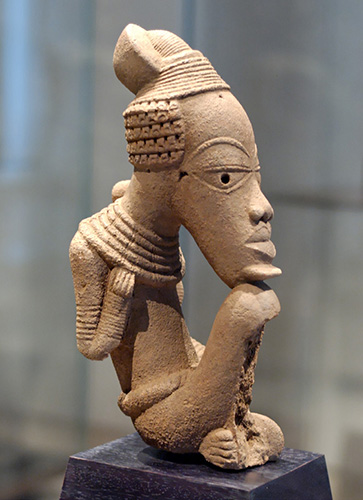
Sculpture of a figure with an elongated face in a seated position.
Nok terracotta figure. Public domain.
Then, Bernard Fagg discovered something else. This was a discovery he had not expected—iron furnaces. At that time, it was believed that the technology to create iron had only been invented once, in Eurasia. The common belief was that iron technology did not spread to Africa until much later. But Fagg was able to date charcoal inside these furnaces as far back as 280 BCE. Later archaeologists dated some of it to an even earlier period, perhaps 500 BCE. Also, there were many furnaces, suggesting a dense population. Most interesting, archaeologists have been able to show that stone and iron tools were in use at the same time. They have also demonstrated that the people of Nok may have developed iron smelting technology on their own, rather than learning it from someone else.
Nok society
Nok society was not built around cities. Instead, they tended to live in lots of settlements, possibly each centered around an extended family. Each settlement probably had its own farm and its own cattle, and most of the work would have been agricultural, as we know from the many grain-grinding stones and other tools found in every house. Women likely did most of the work in transforming crops into food. We don't know this for sure, but archaeologists have found terracotta figures that depict men as the ones working with iron.
Both the making of terracotta and iron may have happened in these settlement sites. We think this is true because both metal slag from iron-making and bits of terracotta have been found in some settlements. We don't know if everyone could make these things or if they were made by specialists in the community. More terracotta waste has been found than iron, which may indicate that this was a specialized craft. There is some evidence that there may have been a specialist guild or class for making terracotta, because so much of it is stylistically the same, but not all experts agree.
Archaeologists have also uncovered sites that seem to have been used for religious or spiritual rituals. Some sites were located where one large sculpture was intentionally left or buried in the ground. This suggests it may have been a marker or shrine. Sometimes, there are five or six similar sculptures. These sites are almost always far away from settlements, suggesting they were shared locations for worship or ritual. They may have played a role in the governing of this society. People might have met at these sites to make agreements or hear disputes. Certainly, there is no evidence of kingship or palaces or even temples to signify a ruling class.
The final kind of site associated with Nok culture are furnaces. These were distinct sites, away from settlements or ritual sites, where iron was made. As we said above, some iron may have been made in households, but most of it was produced and worked in these furnace sites. It is possible that there were expert blacksmiths that may have had a different class status.
Conclusions
We do not know what happened to the Nok. Their terracotta style seems to have died out somewhere around 100 CE. They may be the ancestors of the modern Yoruba culture of Nigeria.
We do believe that the Nok were one of many complex societies that lived in this region before Ghana and Mali. But we know little about them. These societies may have traded with each other, although we don't have a lot of evidence to prove it. However, we are constantly learning more about this era in African history. We are finding out that it had societies similar to other agrarian cultures around the world, but that were also unique.