Integumentary System
Integumentary System
- The integumentary system consists of accessory structures, including the hair, nails, sebaceous glands, and sweat glands.
Skin:
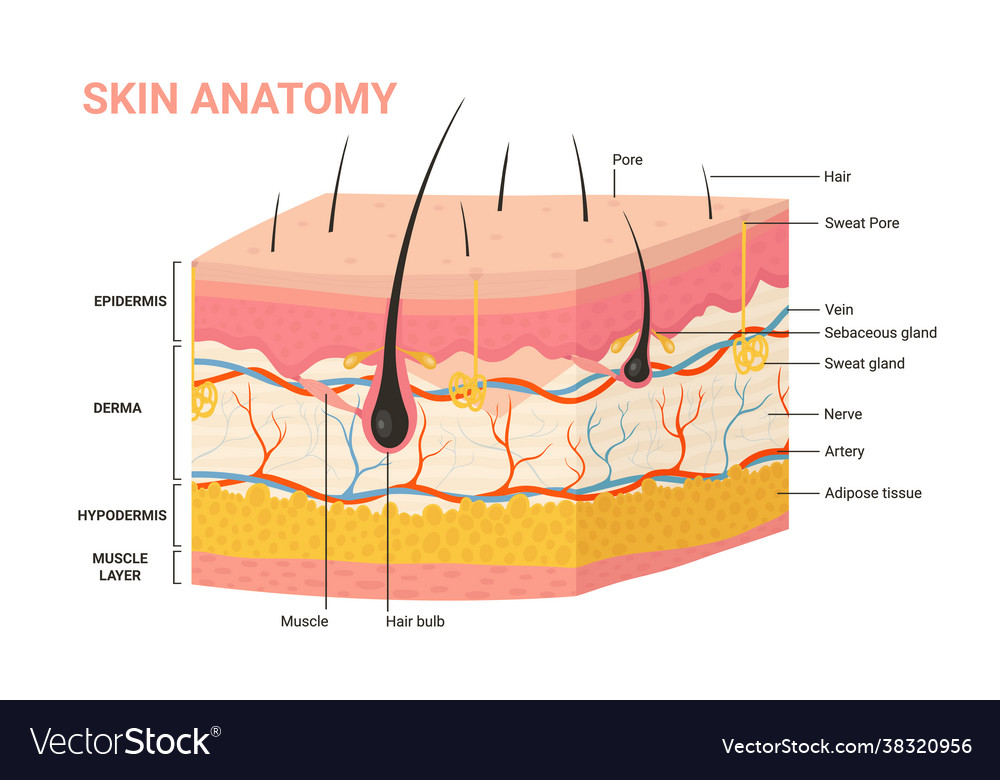
- Skin is the exterior covering the body, it weighs more than 6 pounds in the average adult and covers more than 3,000 sq inches. It is the largest organ of the body. It is supplied with blood vessels and nerves.
- Functions: provides protection from invasive bacteria and other harmful agents. It protects delicate cells beneath the surface from injury. It inhibits excessive loss of water and electrolytes. It produces a protective pigmentation to protect the body against excessive exposure from the sun. Helps produce Vitamin D.
- Regulates body temp, when the body is cold the blood vessels constrict, this allows more heat-carrying blood to circulate to the muscles and organs. When the body is too hot, the blood vessels in the skin dilate, which brings more blood to the surface for cooling by radiation. At the same time, sweat glands secrete more sweat that cools the body when it evaporates.
- The skin provides sensations. Contains millions of nerve endings that act as sensory receptors for pain, heat, cold, and pressure. When stimulation occurs, nerve impulses are sent to the cerebral cortex of the brain, and the brain triggers any necessary response.
Epidermis Layers
Stratum Germinativum
The stratum germinativum is composed of several layers of living cells capable of cell division, it is the innermost layer of the epidermis and contains melanin (skin pigment). The more melanin, the darker the skin color.
-Damage to this layer, like severe burns, requires skin grafts.
- keratinization is the process of forming fibrous protein (similar to what’s in hair and nails)
\n
The Dermis
Beneath the epidermis and is composed of connective tissue.
-contains lymphatics (fatty tissues), nerves, nerve endings, blood vessels, sebaceous and sweat glands, elastic fibers, and hair follicles.
The Dermis is divided into two layers
- Papillary layer- arranged into microscopic structures to form ridges. (fingerprints/footprints)
- Reticular layer- beneath the papillary layer; white fibrous tissue that supports the blood vessels.
Subcutaneous Tissue (Hypodermis)
composed of adipose and connective tissue. It supports, nourishes, insulates, and cushions the skin.
-Subcutaneous tissue connects the dermis to underlying tissue.
The Hair
A thread-like structure formed by a group of cells that develop within a hair follicle or socket. Each hair has a shaft that is visible and a root that is embedded in the follicle.
- A pilomotor muscle is attached to the side of each follicle. It is stimulated by skin irritants, emotional arousal, or cold temperatures, and reacts by contracting. This results in goosebumps.
- The transparent cuticle covers the hair shaft like shingles on a roof, protecting it from the elements and chemicals, and from losing moisture.
- The Cortex provides most of the hair’s weight. It contains the melanin that provides the hair’s color, stores oil, provides flexibility and elasticity, and adds shape to the hair. When the cuticle is damaged the hair looks dry and dull.
- The Medulla is an inner hollow core that runs the length of the shaft.
Sebaceous Gland
- Oil glands, they have tiny ducts that open into each hair follicle
- Each Sebaceous Gland secretes sebum, which lubricates the hair and skin, the amount of secretion varies with age, puberty, and pregnancy
Nails
- Fingernails and toenails are hard keratin structures that protect the ends of the fingers and toes. The nail root also called the Germinal Matrix or nailbed begins several millimeters into the finger and extends to the edge of the white, crescent-shaped lunula. This is where the growth occurs, approximately 1mm. Per week.
- The under-surface of the nail plate or the body of the nail has grooves that help anchor it.
- The cuticle is also called the eponychium, it fuses the nail plate
- \
Ingrown nail
- Ingrown nails are simply those that have curled down or around and are growing into the skin. They may become swollen or inflamed.trim toenails straight across to avoid this growth pattern
Sudoriferous Glands
- Sweat glands, about 2 million are distributed over the surface of the body, more numerous on the palms of the hands, soles of the feet, forehead, and axillae (Underarms)
- Produce sweat or perspiration. As sweat collects on the skin's surface, it evaporates and creates a cooling effect. Sweat also rids the body of waste through the pores of the skin
- As it accumulates, sweat may become odorous by the action of bacteria
- The average person loses approximately ½ liter of fluid through sweating each day
\n