19- tiaga and tundra
Global and Climactic Distribution of Taiga
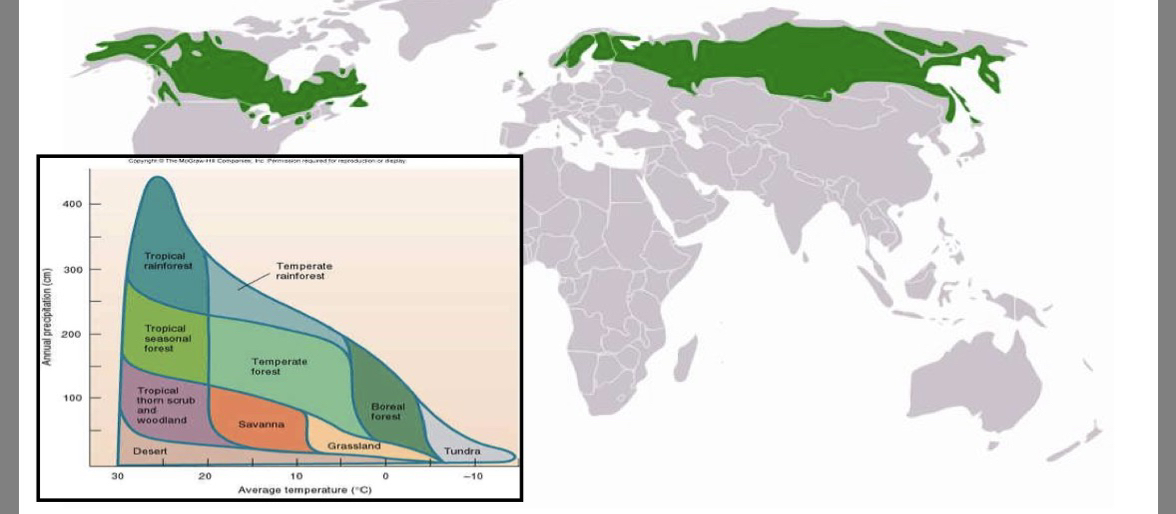
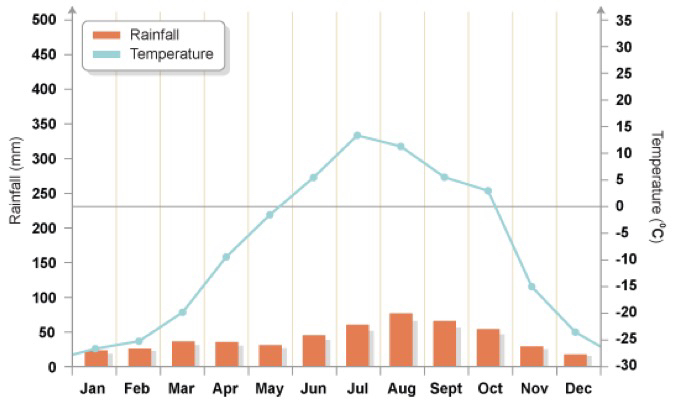
Climate, Precipitation & Growing Season
Growing season: around 130 days a year.
Boreal biome plants have a low temp. threshold for growth, hence the growing season.
When the vegetation in the taiga comes alive, is usually for slightly longer than the climatic definition of summer.
Latitudinal Tree Line
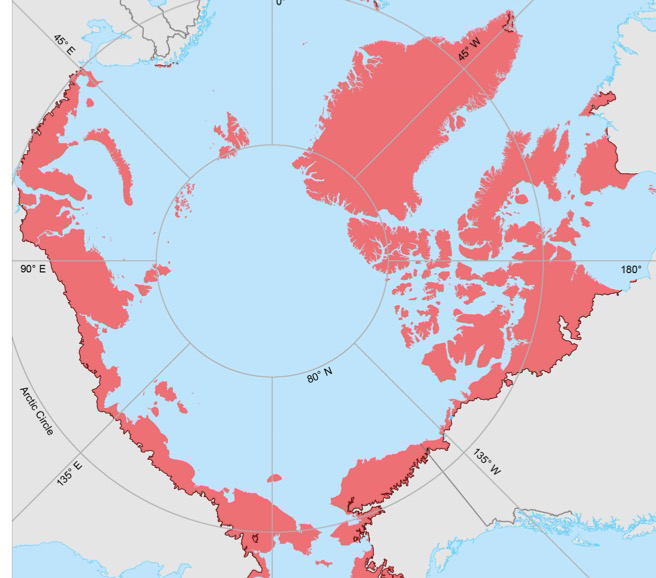
- This line circles all the northern landmasses for more than 13,300 km.
- The largest ecological transition zone on earth – a fuzzy boundary that meanders north and south and may appear gradual or sharp, depending on location.
- North of the line, the climate is too cold, dry, or has too short a growing season for trees to survive, hence tundral flora is found north of this line.
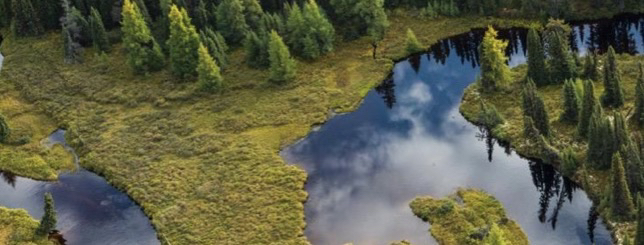
Taiga Landscape
Taiga Plants
• Not a large variety of plant life mainly lichens and mosses.
• Most common type of tree found in the taiga is the needleleaf.
• Four kinds of needleleaf trees are common:
• three evergreens - spruce, fir, and pine; and
• one deciduous - larch (a.k.a. tamarack).
• Under certain conditions, broadleaf trees, such as birch and aspen, are able to survive.
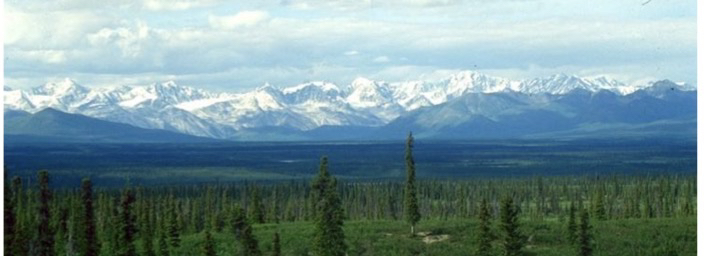
Evergreens: leaf type, root system, shape, and colour.
• Growing new leaves takes a lot of energy. By keeping their leaves, the evergreens are able to use that limited energy for structural growth rather than producing leaves.
• Roots are shallow.
• The ground freezes during the winter months and plant roots are unable to get water. The adaptation from broadleaf to narrow needle-like structures limits water loss through transpiration.
Evergreen needles do not contain very much sap. This limits the risk of needle damage from freezing temperatures.
• Needles contain a chemical that repels animals who would eat the needles.
• Dark green colour of the needles absorbs the sunlight, and since the needles are always present, once temperature start to get warm, photosynthesis quickly begins.
• Conical shape of the evergreens allows the snow to slide off the branches rather than pile up, hence less risk of broken branches due to the weight of the snow.
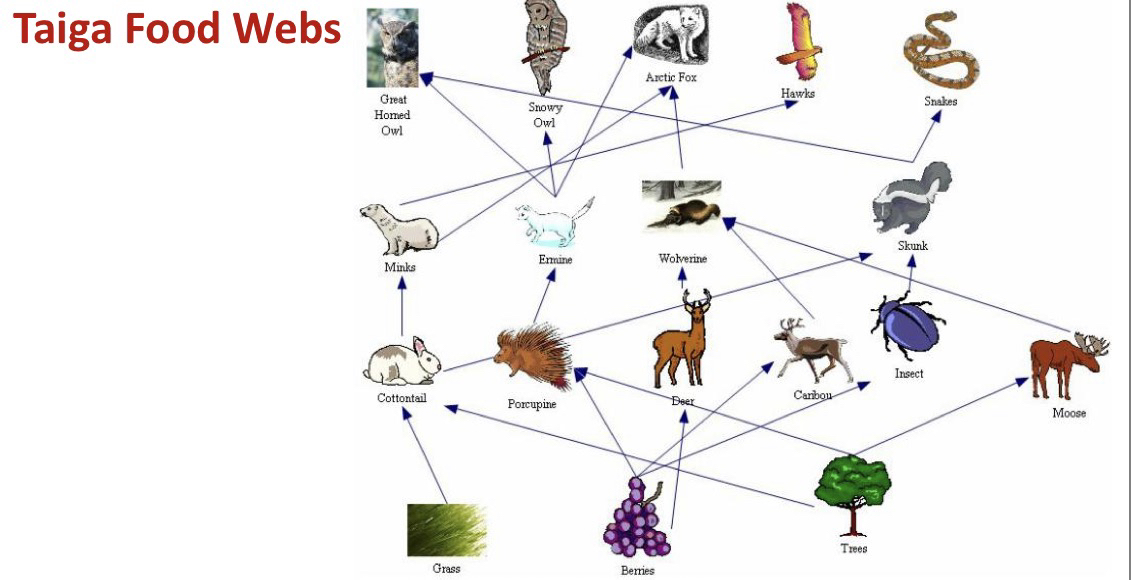
Animals - Relatively
Few Species:
- Canadian taiga supports some reptiles, 85 mammals, 130 fish and (approx) 32,000 insects.
- Large mammals include bison, moose, reindeer, elk, roe deer and bears (black, grizzly, polar).
- Smaller taiga mammals include predators (e.g. lynx, wolverine, red fox, bobcats and several mustelids) and herbivores (e.g. beavers, snowshoe and mountain hares, squirrels, chipmunks, voles).
- Bogs and ponds throughout taiga in summer: a breeding place for a wide variety of insects.
- Many migratory birds come to taiga to nest and feed on the huge insect population, inc. ravens, chickadee, woodpeckers, and warblers.
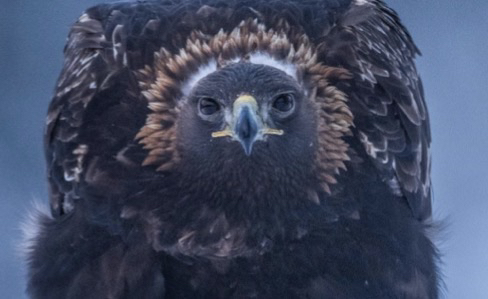
- Large predatory birds inc. osprey and golden, white-tailed and bald eagles.
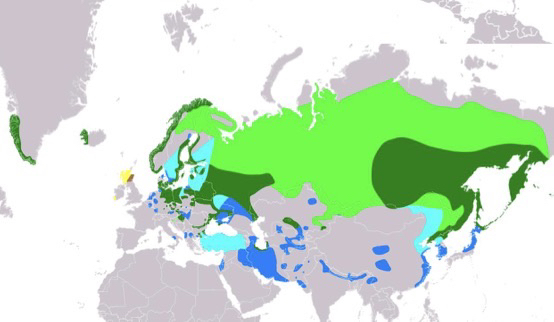
The white-tailed eagle (WTE) and
golden eagle (GE ) are not confined to the tiaga; they have remarkable global distributions.
Golden Eagle popns have grown by 20% in Scotland in the last 15 years and white tailed eagles have expanded to 150-200 pairs in the 50 years since reintroductions began. At least 3 WTEs were illegally killed in the UK in autumn 2025.
Animal Adaptations
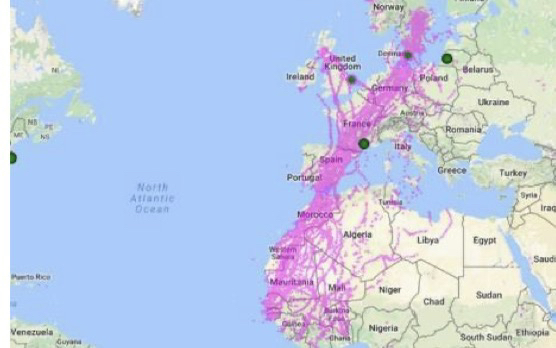
• Migrate to warmer climates once the cold weather begins (see right re. ospreys).
• Hibernate when temperatures drop.
• Producing a layer of insulating feathers or fur to protect them from the cold.
• Seasonal change in colour of feathers or fur protects the animal from its predators.
For example, the ermine, a small mammal, is a good example of this adaptation. Its dark brown summer coat changes to white in the winter.
Tundra
Tundra Landscape
Tundra comes from the Finnish word "tunturia", which means a barren land.
The ground is permanently frozen 25 to 100 cm down so that trees can not grow.
The bare and sometimes rocky ground can only support low growing plants – creeping willow, mosses, heaths (heather), and lichen.
Tundra Seasons
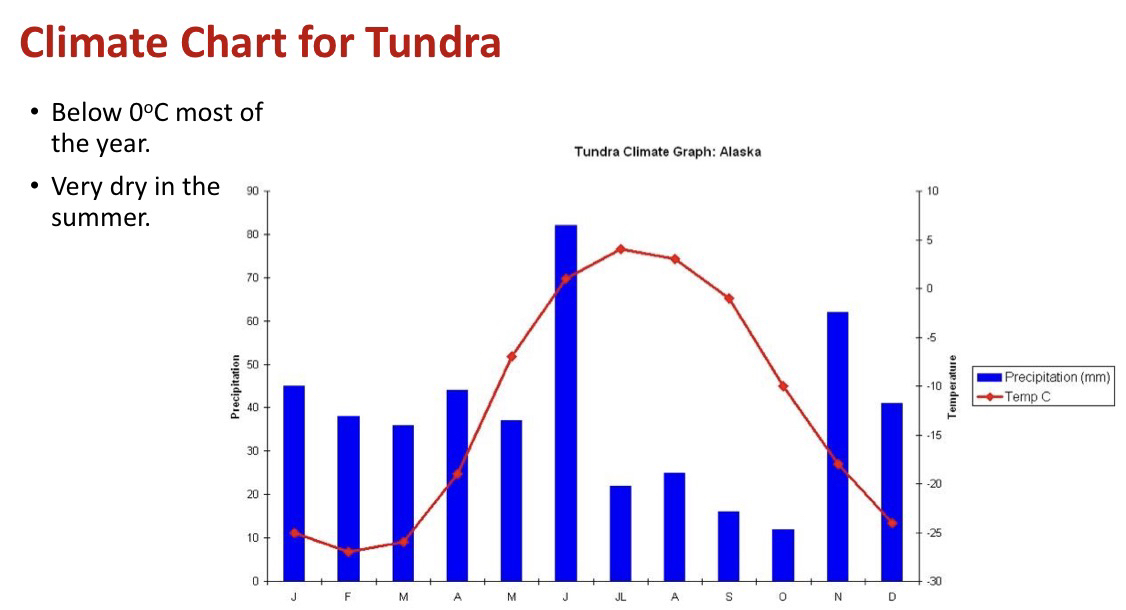
• Long winter and summer. Short spring & autumn.
• The world's coldest and driest biomes. Average temp in some months: -28° C.
• Only about 15 – 20 cm of precipitation (mostly snow) fall each year.
• Below the soil is permafrost: a permanently frozen layer of earth. Nearly 75 % of tundra is covered in permafrost.
• A windy place - winds regularly reach 97 km/h.
Winter: Sun barely rises during some months in the winter
• Temps can drop to -70° C
• Huge selective pressure imposed by these winters. e.g. Arctic wooly bear moth.
Summer: Sun can shine almost 24 hours a day. Average summer temps.: 3° to 16°C.
• Top layer of soil may thaw just long enough to let plants grow and reproduce.
• Water cannot sink into the ground (due to the permafrost): very soggy land with marshes, lakes, bogs and streams.
• Millions of insects breed in these areas. These attract many migrating birds.
Tundra Plants
• Low floral diversity: 1,700 different species in global tundra.
• Few trees except lower latitude birch and carpets of willow only 8 cm high.
• Most plants grow in a dense mat of roots which has developed over thousands of years.
• The soil is very low in nutrients and minerals, except where animal droppings present.
Plant Adaptations
• Grow slowly
• Live a long time
• Low growing
• Leathery leaves
• Fine silk hairs
• Store nutrients in foliage to enable quick growth
• Produce anti-insect chemicals
• Shallow roots
• Survive a long time without water
Animals
• 48 species of tundra mammals (not many!), inc. shrews, lagomorphs, lemmings, wolves, wolverines, foxes, bears and deer, reindeer (caribou), musk ox
• Not many insect species but vast numbers.
Mosquitoes can replace body water with a glycerol: works like antifreeze and allows them to survive under snow during the winter
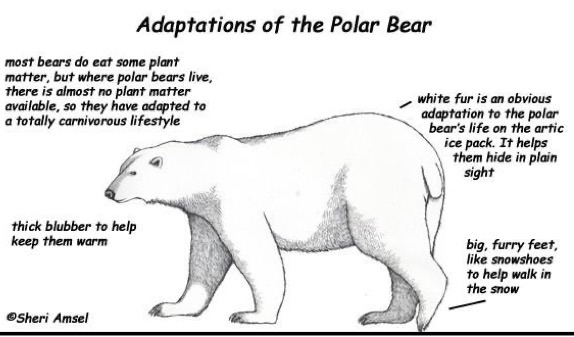
Adaptations of Tundra Animals
• Fur changes colour seasonally
• Thick fur/feathers
• Insulating fat
• Burrows in frost-free ground
• Larger, spreading feet
• Short legs
• Migrate
• Diverse diets
• Lower metabolic rate - semi-hibernation – when conditions get harsh
• Large animals (e.g. reindeer and musk oxen) can feed on lichen and foliage
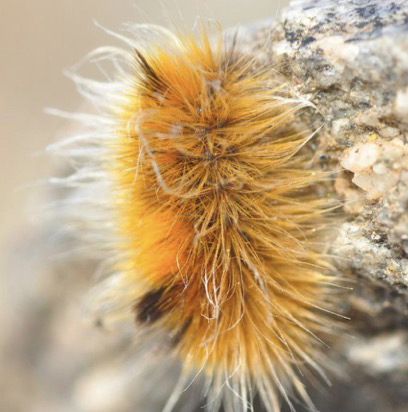
Arctic Woolly Bear Moth
Undergoes an annual period of diapause that lasts for much of the year. In this dormant state, can withstand temps as low as −70 °C.
Occurs from 70O to as high as 83O north.
Vast majority of lifespan (approx. 7 years total lifespan) spent as larva, going into diapause every winter.
Larvae appear to only feed in June, when leaves of arctic willow (Salix arctica) reach peak concs of nutrients and carbohydrates.
Day length is close to 24 hours in the Arctic in June.
Females usually flightless but males exposed to bat ultrasound will reverse their flight course, and are sensitive at ranges up to 15–25m
Larvae are preparing to hibernate by early July. As temps decrease in late summer, larvae begin synthesizing cryoprotective compounds inc. glycerol and betaine.
These "antifreezes" protect cells from cold conditions and their creation is helped by mitochondrial degradation allowing the bottlenecking of oxidative phosphorylation reaction (the ATP generation reaction).
Larvae continue to produce energy from stored glycogen while frozen but their degraded mitochondria mean their metabolism almost stops entirely, inducing dormancy.
Mitochondrial function is fully restored in the spring after a few hours of resumed activity