Impacts of Technology
copyright/IP/digital citizenship - cyberbullying/social networking/
Intent and purpose of the Copyright Act 1968 (Australia)
Copyright law creates incentives for people who invest time, effort, talent and other resources in creating new material (particularly cultural and educational - which benefits society)
The Copyright Act 1968 (Australia) provides automatic copyright protection to creators of works
The simple definition of copyright: it is a bunch of rights in certain creative works such as text, artistic works, music, films, and computer programs
The rights are granted exclusively by the owner to reproduce their own material, rights can be transferred or purchased
The owner can also grant permission to others to use material if asked.
Items can become copyright-free 70 years after the death of the author
If an individual makes it, they own the copyright
However, if an employee makes it, the employer has a copyright.
Copyright Act 1968 (Australia) - key points
copyright protection is free, and applies automatically when material is made
There is NO registration system for copyright in Australia
Copyright DOES NOT PROTECT:
ideas, information, styles or techniques
names, titles or slogans
There are some situations where copyright laws allow people to use copyrighted material for their own personal use but these are narrow and specific.
Australian copyright law applies to actions to actions that take place in Australia, even if the material used was created or first published in another country
Fair Dealing
Australian copyright law allows copying or re-use of copyright material under certain circumstances. The provisions of the Copyright Act that set out these circumstances are known as ‘exceptions’. If an exception applies, you do not need to ask the copyright owner for permission to undertake acts within its scope.
Fair dealing means it can be copied, but only under certain conditions:
for review or criticism
for parody or satire
news reporting
providing legal advice
for research or study
For written work, the Copyright Act states that certain acts constitute fair dealings, i.e. copying up to 10% of one chapter of a book or copying one article, for research or study.
Private Use
It is permissible to record a broadcast to view at a later time (convenience) for private use - time-shifting
It is permissible to reproduce the following items into different formats (format-shifting, as long as you are making the reproduction from a non-infringing copy that you own.
books (including novels, children’s books, reference books)
newspapers and other periodical publications (such as magazines and journals)
photographs
films on videotape (not DVDs)
Important: the copy you make must be in a different format to the original and you may only make one private use copy into one different format
Cd copy, extract audio into mp3
Moral Rights
Became part of copyright in Australia in 2000
the right to be clearly labelled as the author
the right for others to NOT claim your work
must credit or pa
the right to NOT have your work treated in a poor manner (copied)
Appropriate referencing techniques for digital publications
How to acknowledge a source
When you write a task, sometimes you use your own words but sometimes, you would also take some words and information from other sources such as the internet or books.
Method 1 - end of text bibliography/reference
A bibliography should appear on a separate page at the end of your assignment. Submit the sources in alphabetical order.
Should include:
Title
Author’s name
Link
Date … was published
Method 2 - in-text (refer to your reference within the text)
By adding part of the reference detail (name of author, year) within the sentence or at the end of it.
Method 3 - footnotes
First, you put a number at the end of the sentence for the source you want to acknowledge. Then at the bottom of the page, you put the source details.
Acknowledgement of the intellectual property (IP) owner
The property of your mind or propriety knowledge. It is a productive new idea you create. It can be an invention, trademark, design, or brand.
the idea must be original or new, but determining whether it is new or original is not always easy.
it is critical to apply for an IP right to protect your idea if you want to build a business and establish your presence in a market.
Beware of publicity in the early days
if you think that a patent or design right might be what you need, beware of publicity
in today’s digital world, it is important not to publish your patent or design until your ownership has been confirmed. Keep your idea out of the public domain.
publishing your idea in any form may jeopardise your ability to claim a patent or design right before you even apply.
Creative Commons
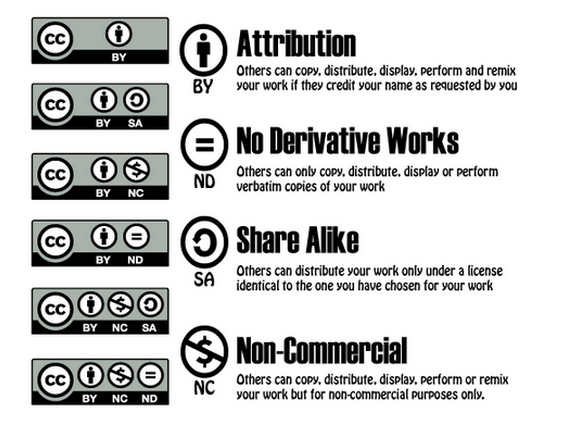
Creative Commons licenses are free copyright licenses that creators can use to indicate how they would like their work to be used.
Creative Commons Licenses
Creators can choose from a set of 6 licenses with varying permissions, from the most open license to the least open license
Most open license/licenses generally recommended for open educational resources (or OER): Creative Commons Attribution (CCBY)
CC BY means anyone may distribute, remix, tweak and build upon the creator’s work, even commercially, as long as they give credit.
All CC licenses require attribution; on top of attribution, the creator may choose to add a combination of three other conditions.
For example, if creators want to prohibit commercial uses, they would add the NonCommerical condition; if they want to require that downstream users also reshare their adaptation under the same terms, they would add the Share Alike condition
Types of IP
Patent
Protects inventions and new processes
protects how an invention works or functions
Polymer banknotes originated from the Reserve Bank of Australia
Trademarks
Protects logos, words, letters, numbers, colour, a phrase, sound, scent, shape, picture, aspect of packaging or branding - or any combination of these
A trademark identifies the particular goods or services of a trader as distinct from those of other traders.
Qantas logo, Cadbury purple, Nike swoosh logo
Registered Design
Protects product designs
The visual appearance of a product is protected, but not the way it works
Footwear, fashion items, kitchen appliances
shape of Coca-Cola bottle
design of Nike Air Jordans 1
Plant breeder’s rights
Protects new plant varieties
Plant breeder’s rights protect the commercial rights of new plant varieties
Cotton plants with insect resistance
pink iceberg rose
Copyright
Protects drawings, art, literature, music, film, broadcast, computer programs
The owner’s original expression of ideas is protected, but not the idea themselves
Game of Thrones, TV series
The Simpsons
Friends
Digital citizenship
Using the internet to comment on what you see online, share info about yourself or others, communicate with friends, play games, buy stuff online. If you do any of these, you are a digital citizen
Responsible use of digital networking
Digital limits - You need to protect your reputation online. Identify the limits you have on the information you share online. Analise the way you and others spend time online
Netiquette - Whether you chat, email, blog or message, there are basic rules you should know. Behave.
Cyberbullying
Harassment
Involves the bully sending offensive and malicious messages to an individual or a group and is often repeated multiple times.
Cyberstalking is one form of harassment that involves continual threatening and rude messages and can lead to physical harassment in the real, offline world.
Flaming
Refers to an online fight exchanged via emails, instant messaging or chat rooms. It is a type of public bullying that often directs harsh language, or images at a specific person
Exclusion
The act of intentionally signalling out and leaving a person out of an online group such as chats and sites. The group then subsequently leave malicious comments and harasses the one they singled out.
Outing
When a bully shares personal and private information, pictures, or videos about someone publicly. A person is ‘outed’ when their information has been spread throughout the internet.
Masquerading/Catfishing
A situation where a bully creates a fake identity to harass someone anonymously. In addition to creating a fake identity, the bully can impersonate someone else to send malicious messages to the victim.
Trolling
Trolls are people on the internet who leave intentionally provocative or offensive messages on the internet to get attention, cause trouble or upset someone.
It is considered a form of cyberbullying when it is used purposely against a person.
Strategies to manage/limit cyberbullying
Ignore or block the communications.
Obtain screenshots of the cyberbullying material as evidence.
Tighten up security and preference settings to limit access to trusted sources.
File a complaint with the website, Internet Service Provider (ISP), or telecommunications company.
Enlist help from the school psychologist, school counsellor, principal, or school resource officer.
Contact the police if the cyberbullying includes threats of harm – cyberbullying is a crime in many states and the threat of prosecution is often the greatest resource.
Social Networking
Concept
The use of dedicated internet sites and applications where people can interact with others or find people with similar interests
Social networks are networks of social interaction and personal relationships
Types of social networking and their features
social networks - connect with people facebook, twitter, Snapchat, Instagram
discussion forums - share news and ideas reddit, quora
Interest-based networks - share interests and hobbies Goodreads
professional networks - connect with other professionals LinkedIn
media sharing networks - share photos, videos and other media Youtube, Instagram, TikTok
Virtual Communities
A social network of individuals who interact through specific social media, from potentially around the world to pursue mutual interests or goals.
Types - Online chat rooms
A way of communicating with a set-up "community" in real time.
The development of online chat rooms allowed people to talk to whoever was online at the same time they were. This way, messages were sent and online users could immediately respond.
Chat room users communicate through text-based messaging – which can also include posting images/audio/video
Types - Virtual worlds
most interactive of all virtual community forms.
one of the types is living as a character in a VR world, where users can control their character and interact with other characters
gives users a chance to have a ‘fantasy’ life
Advantages
No geographical barriers
Allows participation at the convenience of the participant
Provides a forum for people to discuss topics of interest
Provides a sense of belonging and social support
Promotes interaction with others that can lead to physical meetings
Disadvantages
Discrimination is different but not absent
Easy for a few to dominate the discussion
Isolation from the physical world
Being able to hide anonymity may cause cyberbullying or online harassment
Possibility of losing touch with reality
Work-life balance
A person’s control over responsibilities across their workplace, family, friends and self
recognized that technology impacts the control an employee may or may not have with such responsibilities.
Advantages
flexibility technology can offer, allows workers to regulate the pace, location and time of day on which they work.
potential for greater productivity and efficiency that tech offers
Saves travel cost and time for the worker.
Opportunities for workers with disabilities to engage in work from home.
Disadvantages
can lead to increased expectations from employers and colleagues, an increase in workload, and a sense of ‘never being off duty’.
Negative impact on family life has also been recognised, specifically that technology can lengthen the working day, encroaching on family life.
lack of physical activity due to extended hours of sitting can contribute to health problems like obesity and cardiovascular issues
mental health issues may occur if there is unregulated prolonged use of technology for work. e.g stress, anxiety, depression and sleep deprivation
Physicalhealthissuesmayoccurifthereisunregulatedprolongeduseoftechnologyforworkeg.eyestrain, poor posture and RSI (repetitive strain injuries).
real estate agents, 11pm call at night but could be a good offer
the author's name, the title, the date, and the source