Unit 8 South, South East Asia
192. Great Stupa at Sanchi
Form:
-mandala plan (map of the cosmos)
-sandstone
Content:
-4 gateways
-hemispherical dome
-yakshis and yakshus- nature goddess/god
Function:
-monastery
-reliquary mound holds Siddhartha's relics
-symbolic representations of the Buddha (footprints, lion, elongated pathway, empty seat)
-no actual pictures of Buddha's face
-show inclusiveness of Buddhism
Context:
-300-100 BCE Madya Pradesh, India
-late Sunga dynasty

193. Terracotta warriors
Form:
-lifesize painted terra cotta warriors
Content:
-warriors with individual faces but same bodies
Function:
-funerary art
-express imperial power and authority
Context:
-Qin Dynasty in China
-221-209 BCE
194. Funeral banner of Lady Dai (Xin Zhui)
Form:
-T-shaped painted silk banner
-over 6' long
-set in registers
-depth shown
-naturalistic scenes not just abstract shapes
-bi: disc with a hole that represents the sky
Content:
-registers represent the 3 layers of the universe
-Lady Dai stands on platform with her servants as she is pictured ascending into heaven
-dragons frame the scene on both sides
-sacrificial funerary rituals shown taking place in a mourning hall in the bottom register
Functions:
-put over the tomb
Context:
-Han Dynasty, China- 180 BCE

195. Longmen caves (grottoes)
Form:
-limestone
-guardians and vajrapani are more in motion and engaging figures
Content:
-110k Buddhist statues, 60 stupas, 2800 inscriptions carves on steles
-the Vairocana Buddha (representing the celestial Buddha) with bodhisattva, a heavenly king, and a thunderbolt holder on the sides
Function:
-signifies the arrival of Buddhism in China
Context:
- Luoyang, China- Tang Dynasty
- 493-1127 CE

196. Gold and jade crown
Form:
-metal work with gold and jade
Content:
-3 prongs in the back; prongs look like antlers coming out the sides
-jade pieces hanging down- connected by thin wiring
Function:
-queen crown
Context:
-found in tomb of a queen
-Silla Kingdom, Korea
-Three Kingdoms Period
-5th-6th century CE

197. Todai-ji
Form:
-bronze and wood (sculpture)
-wood and ceramic roofing (architecture)
-bracketing system to support the roof
-massive pillars
-contrapposto stance of the Nios (powerful, dynamic bodies)
Content:
-50' tall wood statues: Ungyo (open mouth) and Agyo (closed mouth)
-Colossal Buddha image (bronze)
Function:
-Buddhist temple
-meant to meditate with the Buddha statue
-expression of Buddhism and State mixing in Japan
Context:
-743 CE rebuilt 1700 CE
-various artists of Kei school
-commissioned by emperor Shopu
-Nara, Japan 1st imperial capital, end of Silk Road

198. Borobudur Temple
Form:
- relief sculptures
- elevates
- clockwise up and around
Content:
-72 stupas, 1460 reliefs, 9 platforms in sets of 3, 504 Buddha statues
-narrate Buddha's teachings
-Jataka tales (Buddha's past lives)
Function:
-built as monument to Buddha
-pilgrimage site/shrine
-narrative guides you
-physical and spiritual journey to higher state of consciousness
Context:
-Buddha- poet, thinker, and architect of this temple
-Saliendra dynasty commissioned this (the leaders of maritime power

199. Angkor, the temple of Angkor Wat, and the city of Angkor Thom
Form:
-Panchayatana plan (one main room with 4 surrounding, on a platform)
-Mandala (cosmic map of the world)
-Enter a grand space
-Corbelled gallery roofing
Content:
-Water surrounding temple
-Angkor Thom: Buddhist part
-Angkor Wat: Hindu part
-Sculptures in rhymic dance poses
-Horror vacui of sculptural reliefs
Function:
-Meant to be a tomb, express the divine power of a leader
-Built complex to show his power and might
Context:
-Hindu and Buddhist parts of a medieval capital of Cambodia
-Cambodia, Hindu, Angkor Dynasty 800-1400 CE

200. Lakshamana Temple
Form:
-Sandstone
-Axial plan
-Panchayatana temple type: Configuration of 5 rooms is the typical setup for Indian temple
-High base/platform
-Deep entrance porch
-Complex horizontal banding crosses the ribs of the tower
Content:
-Series of rooms
-Tallest part of building: marks spot of most important part of building (inner sanctuary that holds the image)
-4 shrines/chapels around main room
-Lion statues (symbols of male figures)
-Murti: embodied image of a divine figure
-Mandapa: hall
-Sensuous couple (controversial figures): shows deeper connection with gods
Function:
-Hindu temple dedicated to Vishnu
-Mandir temple: Space that is the house for gods (in this case, for Vishnu)
-place of worship, the divine endowed in its idealized architectural form
Context:
-Chandella Dynasty 950 CE
-Khajuraho, India (North Central India)

201. Travelers among Mountains and Streams
Form:
-hanging scroll (see all at once)
-ink and colors on silk
-in proper scale
-Neo-Confucianism ideals
Content:
-Chinese landscape (no specific place)
-waterfall, travelers, boulders, trees, mist
Function:
-reverence for rocks and stone because of their "chi" (energy)
-evoke Buddha
-after long period of political disunity
Context:
-artist: Fankuan (scholarly artist)
-Song Dynasty, China
-1000 CE

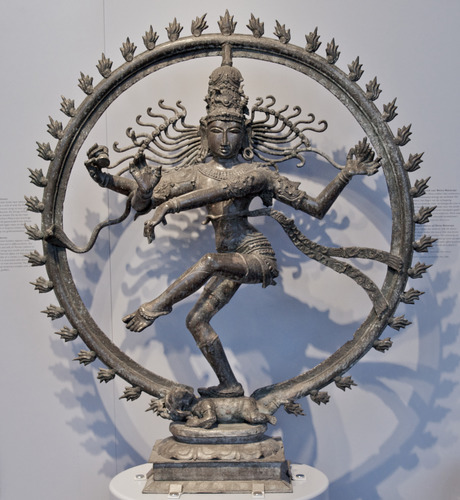
202. Shiva's Lord of Dance
Form:
-cast bronze
-stance signifies refuge for troubled soul
Content:
-Shiva: destroyer god-keeps us from afterlife, but also creator
-flaming circle crushing Apas mara (dwarf)
-Hindu trinity: Brahma (creator), Vishnu (preserver), Shiva (destroyer/transformer)
-Wedas: sacred texts of Hinduism
Function:
-shows the never-ending cycle of life Indians believe in
-immortal symbol that in this physical world there will always be ignorance or things we have to overcome
Context:
-Hindu, India
-Chola Dynasty 1000-1100 CE

203. Night Attack on the Sanjo Palace
Form:
-combining image and text
-Yamato-e: high vantage points, strong angles, cropping, narrative scroll
-read right to left
-strong angles
-handscroll
-extraordinary detail
Content:
-rival families (Fujiwara and Minamoto) attack the Taira clan and defeat them
-establish shotgun empire
-battle: 1159
-extreme detail of armor, weaponry, war tactics
-struggles between emperor and rising shogons
Function:
-turning point in Japanese history
Context:
-piece made 1250-1300 CE
-Karamkura Period, Japan

204. David Vases
Form:
-Mongolian style
-white porcelain with cobalt blue underglaze from Iran
-2 1/2 feet tall
-text
Content:
-peonies= prominent scrolling flower
-inscription with date, location, temple, patron, and purpose
-phoenix and dragon balanced (symbol of Daoist faith- ying and yang)
-elephant handles
Function:
-made for Daoist temples to honor a military leader who was diefied
-expression of Silk Road
-held flowers beside an altar
Context:
-apart of wealthy man's collection
-1351 CE
-Yuan Dynasty, Mongol Empire
-Beijing, China

205. Portrait of Sin Sukju
Form:
-crisp and angular lines
-color characterization
-hanging scroll
-ink and color on silk
-possible collaborative pice
Content:
-head slightly turned (1 ear shown)
-rank badge worn on front and back
-peacocks with plants and cloud
-intellectual scholar
-seated in specific chair
Function:
-respect for one's elders and ancestors
-officially honors for his distinguished service @ court and loyalty to the King during hard times
-portrait cherished by descendants
Context:
-Imperial Bureau of Painting, Korea
-1417-1475 CE

206. Forbidden City
Form:
-Stone masonry, marble, brick, wood, and ceramic tile
-Layout based on Chinese philosophy
-Certain palette to signify (dark red-sun, yellow-earth, blue-heaven)
Content:
-30 ft. tall walls surrounding the city
-Moat around the wall
-Series of bridges
-Front Gate (Mao Zedong's portrait over doorway), Meridian Gate
-Private realm: where the royal family lives (outer and inner court)
Numbers everywhere
-Complex of roughly 100 buildings, 9000 rooms
Function:
-Express that the emperor is the Son of heaven
-Political and ceremonial center for nearly 500 years
-Main building: to discuss the issues of the state
-Importance of numbers spiritually
-Walls provide privacy and protection for the families
Context:
-Largest political complex in the world
-City at center of a city
-Beijing, China, Ming Dynasty 15th century CE-later

207. Ryoan-ji
Form:
-asymmetrical
-abstract
-gravel=flowing elements
-stones=islands, shore, bridges
Content:
-15 stones
-raked stone garden
-monastery (Zen Buddhist monks)
-mirror pond
Function:
-can only enter garden through your mind (spiritually enter)
-power of emptiness
-each rock is a different visual "pull"
-Zen seated meditation
Context:
-1480 CE, Kyoto, Japan
-Muramachi Period
-Zen Buddhist

208. Jahangir Preferring a Sufi Shaikh to Kings
Form:
-texts, geometry, natural world
-Persian traditions
-proportions play into importance
Content:
-manuscript pages
-Mugal leader sitting on throne
-text describing reign
-children dressed up
-guy at bottom is the court artist
-Suffi: Muslim mystic giving gift to Jahangir
-combo of the sun and moon symbolizing ruler's emperorship and divine truth
Function:
-Mughal painting skill
-cross-cultural nature of Art
-artist puts himself at lowest class
Context:
-artist: Bichitr (Hindu)
-1620 CE
-signed

209. Taj Mahal
Form:
-Iwan
-Onion domes
-cross axial plan
-fused aspects of other Islamic traditions
-marble, stone masonry
-stone inlay
-symmetrical harmony
Content:
-charbagh- Persion garden into 4 quadrants representing paradise on Earth
-flowing water throughout
-Arabic text from the Quran
-chartriss
-mosaics
-cenotaphs: inscriptions (symbol of tombs, tombs are actually empty)
-minarets
Function:
-resting place for Shah Jahan's wife, Mumtaz Mahal
-India 1632-53 CE
-architect: Usted Ahmad Lahori
-Mughal Empire

210. White and Red Plum Blossoms
Form:
-ink, watercolor, gold leaf
-swirling illusion of expansion
-byobu: painted screen
-rich colors/gold
Content:
-swirling water
-nature/flowers alongside
-early spring
-two flowering trees
-vantage points
-turns simple landscape theme into dream vision
Function:
-rimpa school painting
-painted screen
Context:
-1710-16 CE Japan
-artist: Ogata Korin
-Edo period

211. Under the Wave off Kanagawa
Form:
-polychrome and woodblock priint made of ink and color on paper
-Ukiyo-e: Japanese woodblock prints made during Edo Period
-part of series of 36 showing Mt. Fuji in each
-genre scene in series/travel
-flat colors, high angles, cropped, large foreground, nature specific
-large foreground
Content:
-text: name of series, artist, censor's seal
-crashing wave (dragon claws)
-Mt. Fuji in background (small in comparison)
Function:
-show moutain and wave's resemblance
-show Dutch influence
-genre scenes in seires'travel of the sacred Mount Fiji
Context:
-artist: Katsushika Hokusai
-1830-33 CE Edo Period

212. Chairman Mao en Route to Anyuan
Form:
-Propaganda
-Portraiture
-Socialist realism (clear, intelligible subject/emotionally moving themes)
Content:
-Mao on way to organize a coal worker/miner strike
-Portrait of Mao (oil paint)
-Telephone poll and water cascades from a dam (modernity)
-Chinese landscape
-Umbrella under his arm
Function:
-Used Chinese landscape to portray that Mao was capable of leading a revolution
-Combatting tradition Chinese art but still not modern
-Mao as a person working for the people
Context:
-based on oil painting by Lui Chunhua
-artist unknown 1969 CE