Chapter 9
Chapter Learning Outcomes
Discuss how Wundt created the first program in psychology, what its tenets were, and what its successes were.
Explain how Titchener’s Structuralism was similar to and different from Wundt’s approach
Discuss the more rational and phenomenological alternatives to Wundt; specifically the programs Brentano, Stumpf and Külpe
Discuss who Clever Hans was and why he is important
Explain Husserl’s phenomenology and its relationship to psychology
List and discuss some of the ways that Ebbinghaus is still relevant.
Intro
Wilhelm Wundt - The founder of experimental psychology as a separate discipline and of the school of voluntarism.
had an experiment that convinced him psychology being a scientific discipline was possible.
Wundt suddenly realized that he was measuring the speed of a central mental process, that for the first time, he thought, a self-conscious experimental psychology was taking place. The time it takes to switch attention voluntarily form one stimulus to another has been measured-it varies around a tenth of a second.
At this moment, the unfolding of Wundt’s theoretical system began. For it was not the simple fact of the measures speed of selective attention that impressed him as much ass it was the demonstration of central voluntary control process. From then on, a prominent theme in Wundtian psychology was the distinction beween voluntary and involuntary actions.
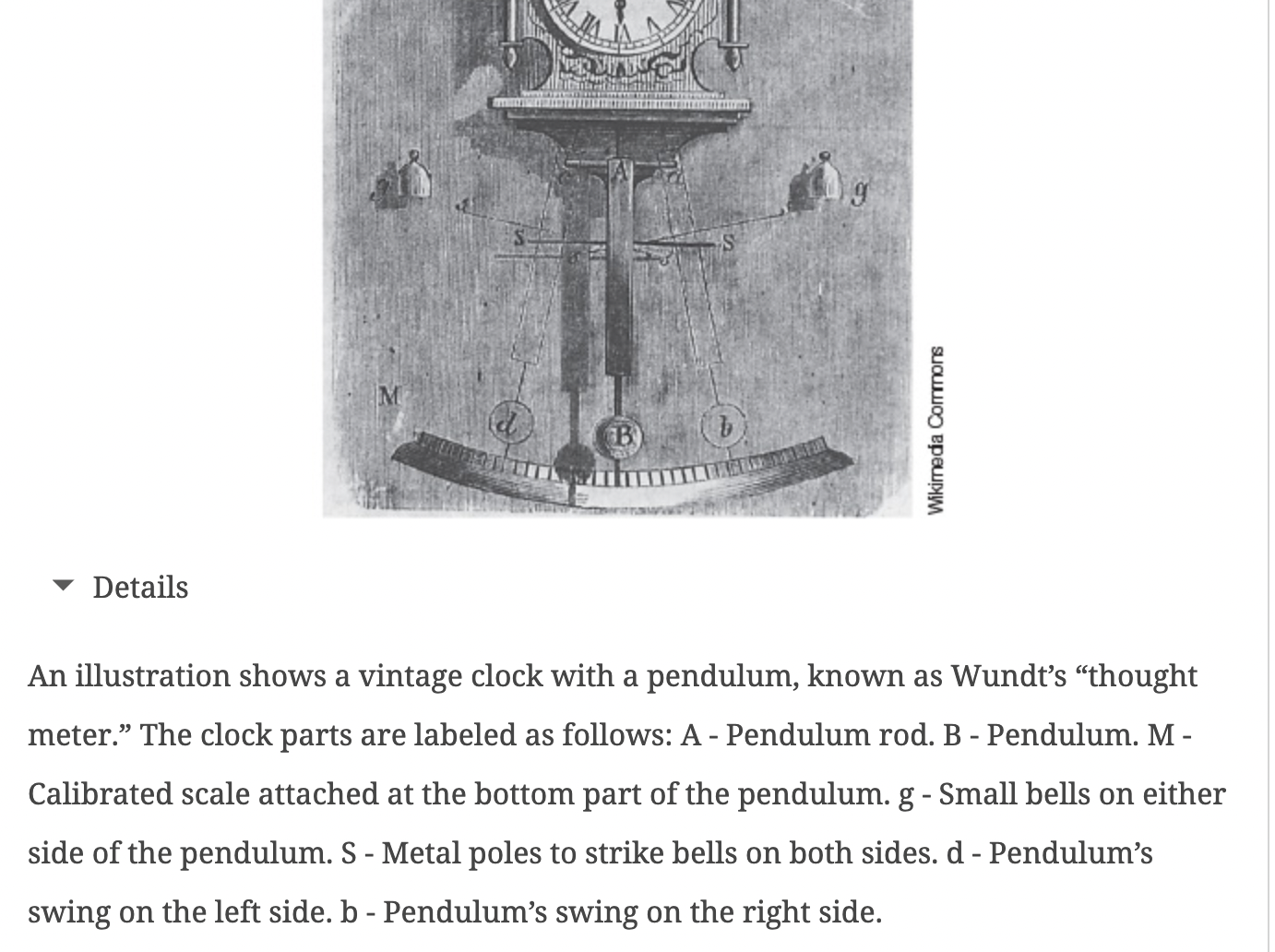
The clock was arranged so that the pendulum (B) swung along a calibrates scale (M). The apparatus was arranged so that a bell (g) was struck by the metal poles at the extremees of the pendulum’s swing (d, b), Wundt discovered that if he looked at the scale as the bell sounded, it was never in position d or b but some distance away from either. Thus, determining the exact position of the pendulum as the bell sounded was impossible. Readings were always about 1/10 of a second off. Wundt concluded that one could either attend to the position of the pendulum or to the bell, but not both at the same time.
Contributions to the theory of Sense Perception (1862)
Wundt enunciated the need for a new field of experimental psychology that would uncover human consciousness
His goal was to create such a field
Physiological meant more or less the same as experimental in Wundt’s time.
School - A group of scientists who share common assumptions, goals, problems, and methods.
Voluntarism
Wundt focused on elementary structures and processes (in many way aligning with an empirical approach)
“Wundt said that Herbart was second only to Kant in terms of the debt owed for the development of his own thoughts …. But beyond Herbart and Kant, there looms the influence of Leibinz, in whose shadow Wundt clearly felt himself to be working from the beginning …. Numerous … references to Leibniz at key points in Wundt’s more theoretical works make it clear that he felt a special affinity with this philosopher.” (Danziger, 1980a, pp. 75-76)
Wundt opposed materialism & aspects of empiricism
stating “Materialistic psychology … is contradicted by .. the fact of consciousness itself, which cannot possibly be derived from any physical qualities of material molecules or atoms”
lacking in empiricism were central volitional processes that act on the elements of thought giving them forms, qualities, or values not found in either external stimulation or the elemental events themselves
Wundt’s goal was to understand
consciousness as it is experiences
understand the mental laws that govern the dynamics of consciousness.
concept of will as it was reflected in attention and volition
Will - According to Wundt, that aspect of humans that allows them to direct their attention anywhere they wish. Because of his emphasis on will, Wundt’s version of psychology was called voluntarism.
Wundt believed humans can decide what is attended to and thus what is perceived.
Voluntarism - The name given to Wundt’s school of psychology because of his belief that, through the process of apperception, individuals could direct their attention toward whatever they wished
this was psychology’s first school - not structuralism
Wilhelm Maximilian Wundt
Wilhelm Maximilian Wundt - The founder of experimental psychology as a separate discipline and of the school of voluntarism
Fun fact: wundt’s only friend his age when he was little was an intellectually disabled boy who could barely speak
bro had little to no friends and a family of people with respectable careers
So he daydreamed, was very in his head, (which in my personal opinion was the core reason he was able to come up with the questions and basis of his research.)
He chose experimental psychology over studying medicine
Contributions to the Theory of Sense Perception (1862)
In that book, Wundt formed the plan for psychology that he was able to follow for the rest of his life
He then published Lectures on Human and Animal Psychology