PSYCH101 - Chapter 2 Lecture notes
Lecture notes
*Chapter 2 includes Neurons, Resting vs. Action Potential, Basic Parts of The Brain Including the Lobes, and the Nervous System.
Basic Parts:
- Soma: cell body
- Is what keeps a neuron alive
- Contains the nucleus
- Axon: Responsible for sending the information
- Myelin Sheath: surrounds the axon
- Speeds up the message being sent
- Synaptic Knob (AKA Terminal Button): Hold chemicals which are called neurotransmitters (neurotransmitters float across the synaptic gap)
- Also holds vesicles that have fluid in them (neurotransmitters). They are released and float across the synaptic gap to the dendrites of the next neuron
- Dendrite: Receive information (opposite of what the axon does)
- Synaptic Gap (AKA Synapse): The space (gap) between a synaptic knob (the end of the axon) of one neuron to the dendrite of the next neuron
Resting Potential vs. Action Potential
Questions to consider: What are they? What is their function? How does it work?
- When at rest – nothing is happening (yet)
- Action Potential – something is happening
- In other words, with a neuron, that something is the Electrical Neural Impulse/Signal (a signal is being sent)
- It operates either all or none
- Either resting (none) or all (something is happening). There's no in between.
- Ex: Turning a light switch on or off.
Parts of the Human Brain
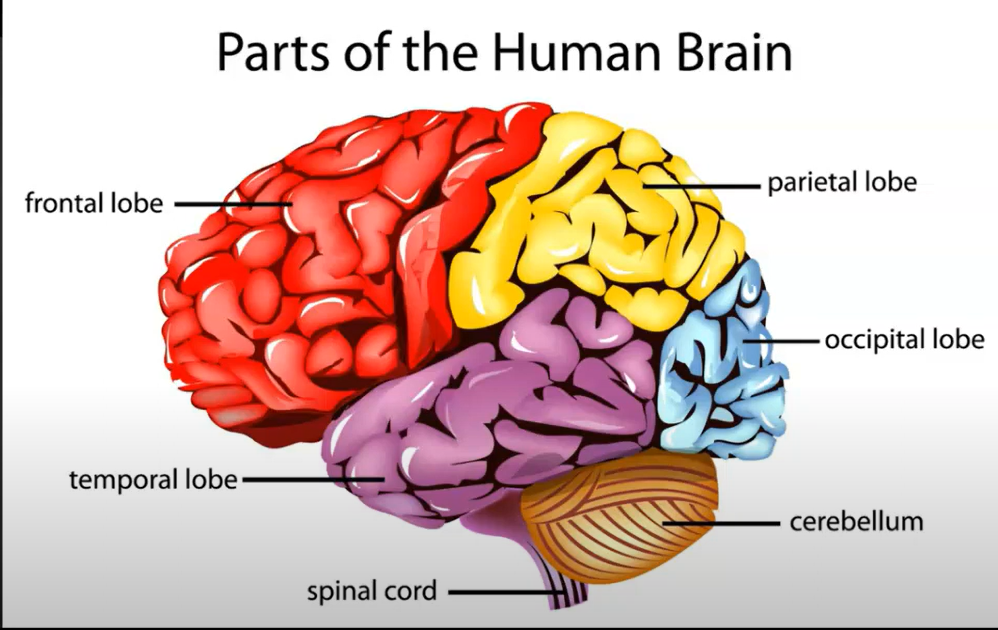
- Frontal Lobe: personality, planning, decision making.
- Left side: Houses the Broca’s area. Where you cannot produce speech. (even if you understand it, you may have a problem producing the language.
- Parietal Lobe: touch, temperature, position of your body
- Occipital Lobe: visual information.
- A way to remember this: the eye doctor (optometrist) also starts with an O
- This part of the brain deals with visual information
- Cerebellum: balance and coordination.
- Spinal Cord (Brain Stem): involuntary functions
- Temporal Lobe: auditory/auditory information
- Left side houses the Wernicke’s Area
- Wernicke’s Area: understanding speech
- Broca’s Area: Producing speech. (you can understand it but the problem is producing speech)
- Temporal Lobe/Wernicke’s Area: you can produce speech but understanding it is the problem.
The Nervous System

- The nervous system is broken down into two main areas:
- The Central Nervous system (CNS) and Peripheral Nervous system (PNS)
- The Central Nervous system (CNS): is made up of the Brain and Spinal Cord
- Peripheral Nervous system (PNS): is a complex system that is broken down into Somatic Nervous System and Autonomic Nervous System.
- Somatic Nervous System: intentional behaviors, voluntary. The stuff that you know you are controlling.
- Autonomic Nervous System: Automatic stuff that’s automatically happening; isn’t intentional.
- Ex: Your heart is automatically beating while you are sitting down.
- The Autonomic Nervous System is broken down into 2 additional things: the Sympathetic nervous system and Parasympathetic nervous system.
- Sympathetic Nervous System: your body automatically kicking in and helping you in situations
- Ex: adrenaline kicking in which helps you
- Parasympathetic Nervous System: helps you calm down and deal with situations
- Ex: A parachute slowly lowers you down which helps you calm down.