activity 1 - cell fh
yhussain
Cells come in two types: prokaryotic & eukaryotic
Karyo means “nucleus” of a cell
Pro means “before”
Eu means “true” or “good”
Prokaryotic → “before a nucleus”
Eukaryotic → “ possessing a true nucleus”
Nucleus is a protective compartment for DNA & is usually in the center of eukaryotes
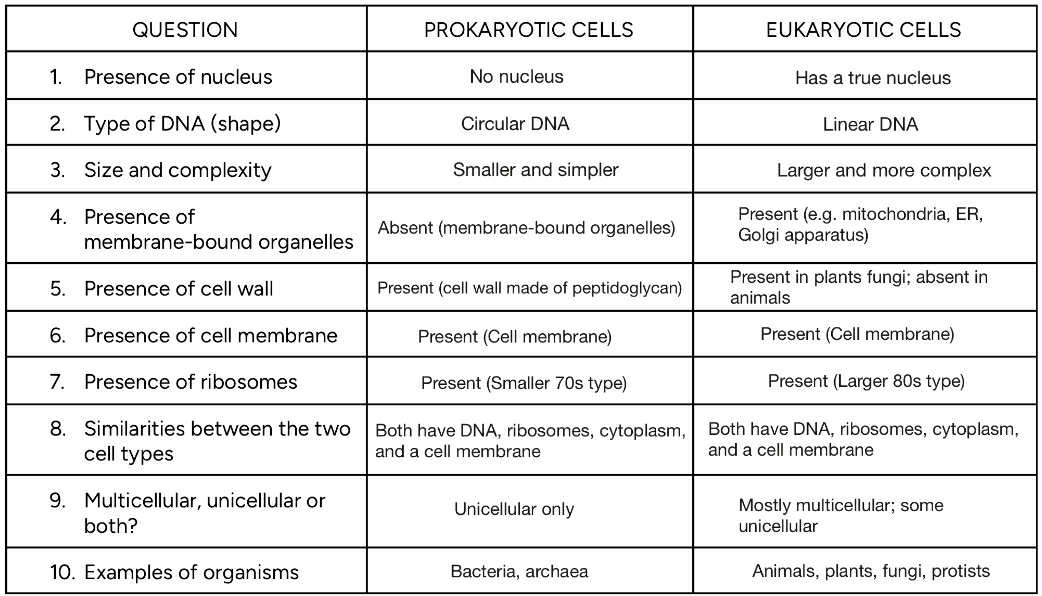
Prokaryotic cells are the simplest type of cells.
Many one-celled organisms are prokaryotes
Prokaryotes are mostly bacteria
They do not have membrane-bound organelles
Lack “membrane-bound organelles”
DNA sits in a “nucleoid” → an irregular region, not a membrane-bound nucleus
They have no nuclei & their DNA is circular (has no ends)
Cell envelope - collective term for the layers that surround a prokaryotic cell
includes: cell wall, outer membrane, & plasma membrane
Have cytoplasm - the soup where materials necessary for proper functioning float inside the cell
Have cell wall made of “peptidoglycan”
Eukaryotic cells are unicellular or multicellular organisms
Include animals, plants, fungi, & protists (many are unicellular, but some are multicellular like algae)
Have “membrane-bound organelles”
Have true nucleus, bound by a double membrane
Their DNA is linear & lives in nucleus (packaged with histones & enclosed by a nuclear membrane)
Similarities of both cell types:
Both contain DNA (carries the archived instructions for operating the cell)
Both are enclosed by a plasma membrane aka cell membrane (protective barrier that controls the movement of things in & out of the cell)
Have ribosomes for protein building
Have DNAs of the exact same kind
Have genetic codes of the same type as well
PROKARYOTIC CELLS VS. EUKARYOTIC CELLS
ANIMAL CELLS & HOW THEY WORK
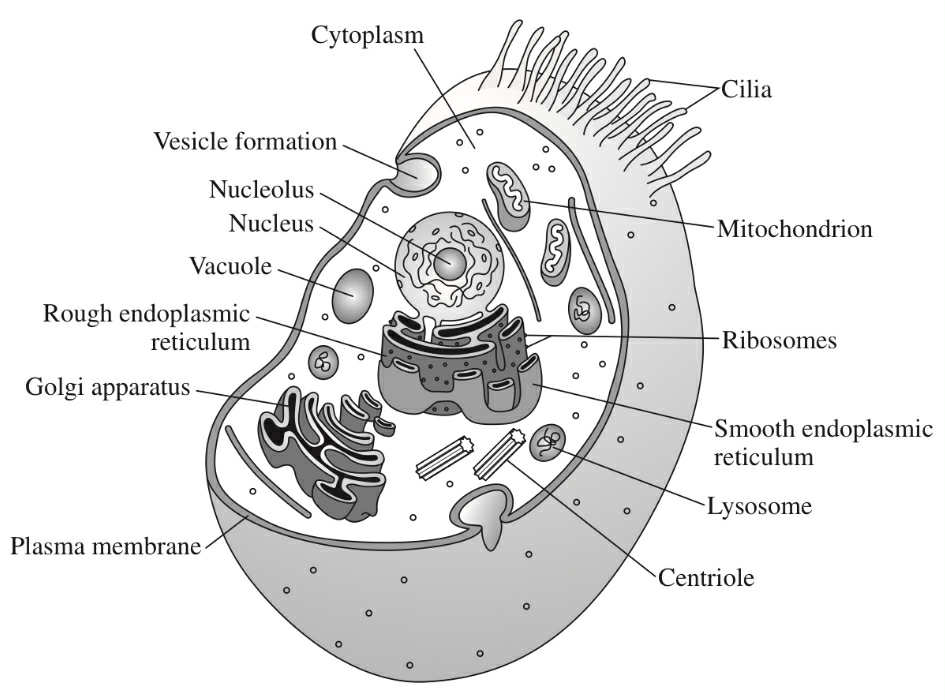
Organelles:
Cell Membrane
Separates the material inside the cell from everything outside the cell.
The plasma or cytoplasm is the fluid inside the cell
Transport through the membrane may be active or passive
Active transport requires that a price be paid for a ticket to enter (or leave) the cell.
The cost of the ticket is energy
Passive transport doesn’t require a ticket
include diffusion, osmosis, and filtration.
Centrioles
These behave as the cell’s “train conductors.”
They organize structural components of the cell like microtubules, which help move the cell’s parts during cell division.
Endoplasmic Reticulum
The cell can be thought of as a smoothly running factory. The endoplasmic reticulum is the main part of the cell factory.
This structure has two basic regions: Rough ER & Smooth ER
the rough ER, which contains ribosomes, is the factory’s assembly line
the smooth ER, which does not, is more like the shipping department, which ships the products of the reactions that occur within the cell to the Golgi apparatus
Golgi Apparatus
Serves as the cell’s postal system
Looks a bit like a maze, and within it, materials produced by the cell are packaged in vesicles — small, membrane-enclosed sacs.
The vesicles are then mailed to other organelles or to the cell membrane for export.
The cell membrane contains “customs officers” (called channels) that allow secretion of the contents from the cell. Secreted substances are then available for other cells or organs.
Lysosomes
These are the cell’s landfills.
They contain digestive enzymes that break down substances that may harm the cell
Lysosomes also digest “dead” organelles. This slightly disturbing process, called autodigestion, is really part of the cell digesting itself.
Mitochondria
AKA “powerhouse of the cell,” “cell’s power plants", where the cell produces energy
Mitochondria (singular mitochondrion) use food, primarily the carbohydrate glucose, to produce energy, which comes mainly from breaking down adenosine triphosphate
Nucleus & Nucleolus
Each cell has a nucleus and, inside it, a nucleolus
These serve as the cell’s control center and are the root from which all future generations originate
A double layer known as the nuclear membrane surrounds the nucleus
Usually the nucleus contains a mass of material called chromatin.
If the cell is entering a stage leading to reproducing itself through cell division, the chromatin separates into chromosomes.
Nucleus produces two important molecules for the interpretation of this information: messenger ribonucleic acid (mRNA) & transfer ribonucleic acid (tRNA)
Nucleolus produces a third type of ribonucleic acid known as ribosomal ribonucleic acid (rRNA)
Ribosomes
These contain protein and ribonucleic acid subunits
In the ribosomes, the amino acids are assembled into proteins
Many of these proteins are enzymes, which are part of nearly every process that occurs in the organism.
Small Vacuoles
Also known as simply vacuoles, these serve a variety of functions, including storage and transport of materials.
The stored materials may be for later use or may be waste material that the cell no longer needs.
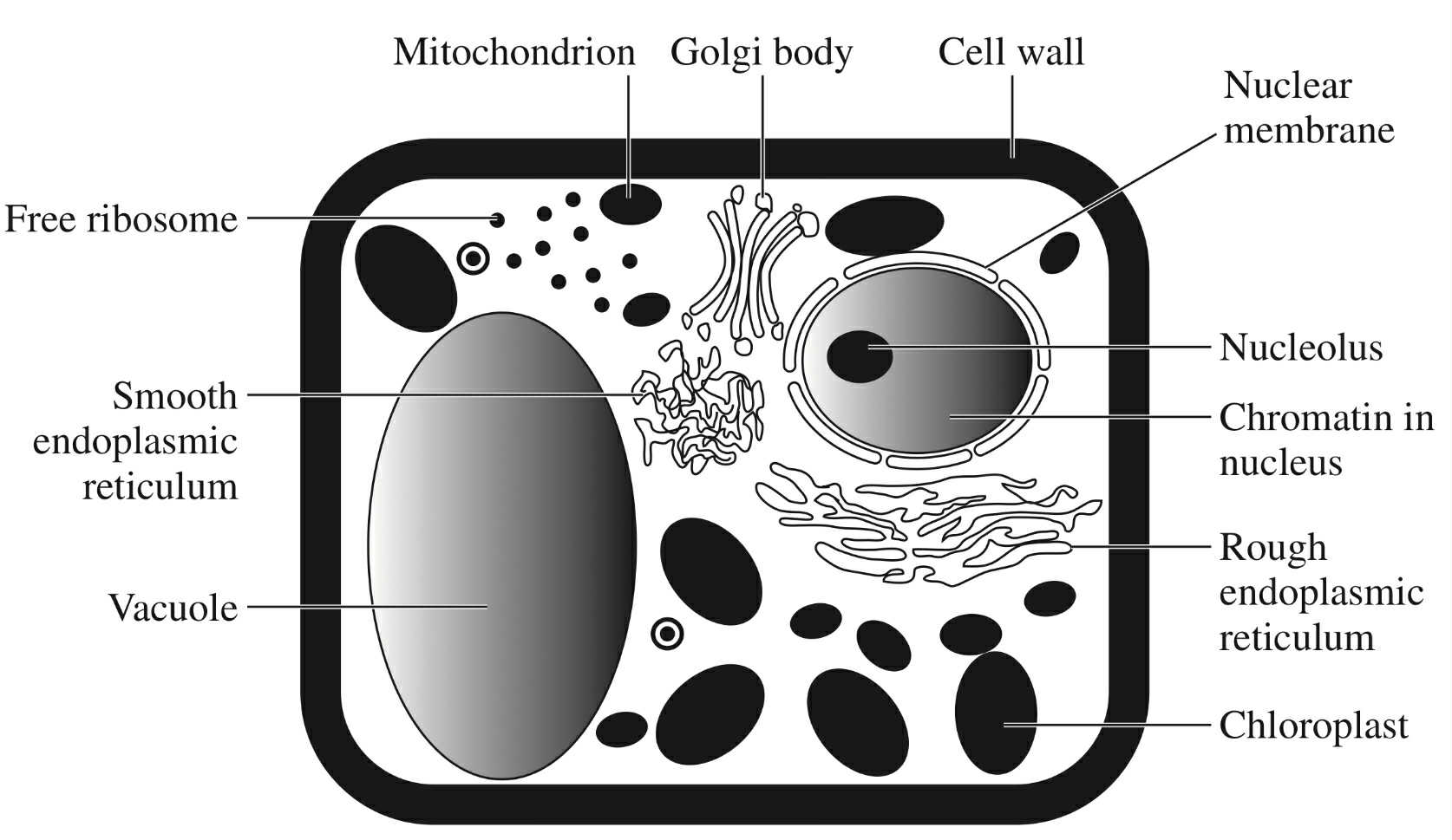
PLANT CELLS & HOW THEY WORK
Plant cells contain the same components as animal cells, PLUS, a cell wall, a large vacuole, and, in the case of green plants, chloroplasts
The cell wall is composed of cellulose
Cellulose, like starch, is a polymer of glucose
The cell wall provides structure and rigidity
The large vacuole serves as a warehouse for large starch molecules.
Glucose, which is produced by photosynthesis, is converted to starch, a polymer of glucose.
At some later time, this starch is available as an energy source
Chloroplasts, present in green plants, are specialized chemical factories.
These are the sites of photosynthesis, in which chlorophyll absorbs sunlight and uses this energy to combine carbon dioxide and water to produce glucose and release oxygen gas.
The green color of many plant leaves is due to the magnesium-containing compound chlorophyll.