CDIS 201 Module 2 Chapter 1 Notes (lecture and textbook)
American Speech-Language-Hearing Association:
- Communication: an active process of exchanging info and ideas
-involves both understanding and expression
-Forms of expression include personalized movements, gestures, objects, vocalizations, verbalizations, signs, pictures, symbols, printed words, and output from augmentative and alternative (AAC: examples: eye device, ) devices.
When individuals communicate effectively, they are able to express needs, wants, feelings, and preferences that others can understand.
What is social communication?
-Changing language for the listener or situation, such as:
-Talking differently to a baby than to an adult
-Giving more info to someone who does not know the topic. Knowing when to skip some details when someone already knows the topic
-Talking differently in a classroom than on a playground
-Following rules for conversations and storytelling such as:
-Taking turns when you talk
-Letting others know the topic when you start talking
-Staying on topic
-Trying another way of saying what you mean when someone does not understand you
-Using gestures and body language, like pointing or shrugging
-Knowing how to stand close to someone when talking
-Using facial expressions and eye contact
Social rules are highly influenced by culture.
Social Communication Difficulties
Language is the tool for social interaction and negotiation.
The inability to gauge and recognize rules of conversation
The primary problem of children with social-communication deficits
Self-Perception: The four agreements
-Everything we do is based on agreements we have made-agreements with ourselves, with other people, with God, with life.
-The most important agreements are the ones we make with ourselves
-We tell ourselves who we are, how to behave. What is possible, what is impossible.
-One single agreement is not such a problem, but we have many agreements that come from fear, deplete our energy, and diminish our self-worth
-Do any of your “agreements” have to do with how you communicate?
-Beware of “performance” agreements
-Self-limiting agreements rob us of joy and create needless suffering
Be impeccable with your word.
Speak with integrity. Say only what you mean. Avoid using your word to speak against yourself or to gossip about others. Use the power of your word in the direction of truth and love.
Don’t take anything personally.
Nothing others do is because of you. What others say and do is a projection of their own reality, their own dream. When you are immune to the opinions and actions of others, you won’t be the victim of needless suffering.
Don’t make assumptions.
Find the courage to ask questions and to express what you really want. Communicate with others as clearly as you can to avoid misunderstandings, sadness, and drama. With just this one agreement, you can completely transform your life.
Always do your best
Your best is going to change from moment to moment. It will be different when you are healthy as opposed to sick. Under any circumstance, simply do your best, and you will avoid self-judgement, self-abuse, and regret.
Communication in Relationships:
What type of communication is appropriate for a given situation (social communication skills)
Friends, family relationships, and community relationships
Learn about trust, intimacy, and reciprocity.
Clarify the variables involved in relationships, including people, verbal, and nonverbal cues.
Goal: engage in relationships with an understanding of the communication process
Communication and Advocacy:
Studying communication can help you feel confident in voicing and advocating your opinions and give voice to others.
Knowing about current issues
Speaking in conversation
Using your voice on your platform
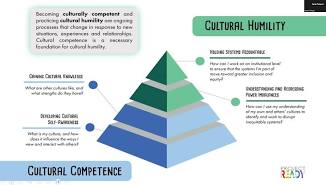
Cultural Humility and Communication:
Helping professions (psychotherapists, social workers, SLPs) should seek to produce a therapy context where clients can engage in deep discussion and analysis of clients’ cultural identities, beliefs, values, and attitudes.
How do you communicate that you value your client’s culture?
What do you do if you make a cultural mistake or commit a microaggression?
Engaging with cultural humility as an attitude can help avoid the pitfalls that would disrupt a therapeutic relationship
Communication as a process:
-To make common, to share
-Using messages to generate meaning
-Process-activity, exchange, or set of behaviors
-Can’t look at any particular communication behavior as a snapshot and fully understand what is happening
-Ongoing process
-Includes verbal and nonverbal symbols, signs, and behaviors
-Requires common meaning/understanding
Components of Communication:
People: source/receiver
Message: verbal/nonverbal
Channel: oral, written, text
Feedback: receiver’s response
Code: symbols to create meaning
Encoding (translating into code) and decoding (assigning meaning to the code)
Noise: any interference (example: a person in front of you/blocking you)
Situation: location
Communication Principles:
Begins with the self: How you see yourself can make a great difference in how you communicate
Involve others
Has content and relational dimensions
Involves choices-complicated
Quantity does not increase quality.
Is pervasive, occurring almost every minute of your life
Cannot be reversed
Irreversible words: Microaggressions
-Microaggressions: brief and commonplace daily verbal, behavioral, and environmental indignities, whether intentional or unintentional, that communicate hostile, derogatory, or negative racial, gender, sexual-orientation, and religious slights and insults to the target person or group
-Three types:
Microinsults: racialized, gendered, or sexualized demeaning comments and behaviors
Micro assaults: old-fashioned racism, sexism, or heterosexism, carried out by individuals (deliberate)
Microinvalidations: the negation of the feelings, perceptions, and people who experience racist, sexist, and gendered microaggressions and micro assaults
Communication Contexts:
Context: situation/circumstances of the communication
Intrapersonal (conversation within one’s own self)
Interpersonal (communication with others)
Public
Mass
Digitally mediated
Group
Goals of Communication Study:
Understanding communication competence (effective/successful communication): requires sensitivity and responsiveness to others.
Understanding ethical communication
Understanding Communication theory and research
Set goals for yourself as a communicator
Anatomy of a conversation:
You sincerely intend to communicate.
You express behavior (verbal and/or nonverbal) that is meaningful to your partner.
You or your partner introduces a topic of conversation.
You listen and talk, taking turns.
You comment on what the other person has said; the other person acknowledges or comments on what you have said.
You say what you think to be true.
You don’t change the topic of conversation until you think the other person has finished or you ask permission to change the topic.
You don’t say more than you need to say to have your listener understand
You attempt to make your meaning understood.
You request information if you don’t understand your partner’s meaning.
You acknowledge and respond to nonverbal as well as verbal information.
You allow your partner time to respond, and you wait until your partner has finished his/her turn.
You always learn something new.
Textbook notes:
Communication: the process of generating meaning by sending and receiving verbal and nonverbal symbols and signs that are influenced by multiple contexts
Talking era → manuscript era → print era → audiovisual era → internet era
art or rhetoric: speaking well and persuasively
Arrangement: refers to organization of speech
Style: use of language
Delivery: vocal and physical characteristics of a speaker
Memory: techniques employed by speakers of era to retain and then repeat large amounts of info
Forms of communication: vary in terms of participants, channels used, and contexts
-Five main forms of communication (listed above under communication contexts)
-Public communication becomes mass communication when it is transmitted to many people through print or electronic media
-No immediate verbal and nonverbal feedback loop in mass communication
Transmission model of communication:
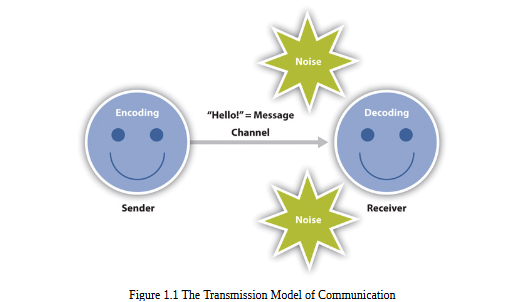
-Communication as a linear, one-way process in which a sender intentionally transmits a message to a receiver
-Model focuses on sender and message within communication encounter
-It is the sender’s responsibility to ensure that the message was successfully conveyed
-Emphasizes clarity and effectiveness but notes that there are barriers such as noise
-Noise: anything that interferes with a message being sent between participants
Interaction model of communication:
-Communication as a process in which participants alternate positions as sender and receiver and generate meaning by sending messages and receiving feedback within physical and psychological contexts
-Incorporates feedback, making communication more interactive and leading to a more complex understanding of the roles of participants in a communication encounter
-Communication isn’t judged effective or ineffective in this model based on whether or not a single message was successfully transmitted and received
-Takes physical context (environmental factors) and psychological context (mental and emotional factors) into account

Transaction model of communication:
-Process in which communicators generate social realities within social, relational, and cultural contexts
-The people in a communication encounter are referred to as communicators; simultaneously senders and receivers

Social context: stated rules or unstated norms that guide communication
Relational context: previous interpersonal history and type of relationship we have with a person
Cultural Context: various aspects of identities such as race, gender, nationality, ethnicity, sexual orientation, class, and ability
Communication is academic, personal, professional, and civic
Communication meets needs: physical, instrumental (help us get things done in everyday life and achieve short- and long-term goals), relational, and identity
Common tactics used for compliance gaining:
Offering rewards. Seeks compliance in a positive way by promising returns, rewards, or generally positive outcomes.
Threatening punishment. Seeks compliance in a negative way by threatening negative consequences such as loss of privileges, grounding, or legal action.
Using expertise. Seeks compliance by implying that one person “knows better” than the other based on experience, age, education, or intelligence.
Liking. Seeks compliance by acting friendly and helpful to get the other person into a good mood before asking them to do something.
Debt. Seeks compliance by calling in past favors and indicating that one person “owes” the other.
Altruism. Seeks compliance by claiming that one person only wants “what is best” for the other and he or she is looking out for the other person’s “best interests.”
Esteem. Seeks compliance by claiming that other people will think more highly of the person if he or she complies or think less of the person if he or she does not comply
Communication is a process, is guided by culture and context, and is learned.
-Rules and norms guide much of our communication
Communication Competence: knowledge of effective and appropriate communication patterns and the ability to use and adapt that knowledge in various contexts
-Unconscious incompetence: you are not even aware that you are communicating in an incompetent manner
-Conscious incompetence: you know what you should be doing and you realize that you’re not doing it as well as you could.
-Conscious competence: you know you are communicating well in the moment
-Unconscious competence: communicate successfully without straining to be competent
Communication apprehension (CA) is fear or anxiety experienced by a person due to actual or imagined communication with another person