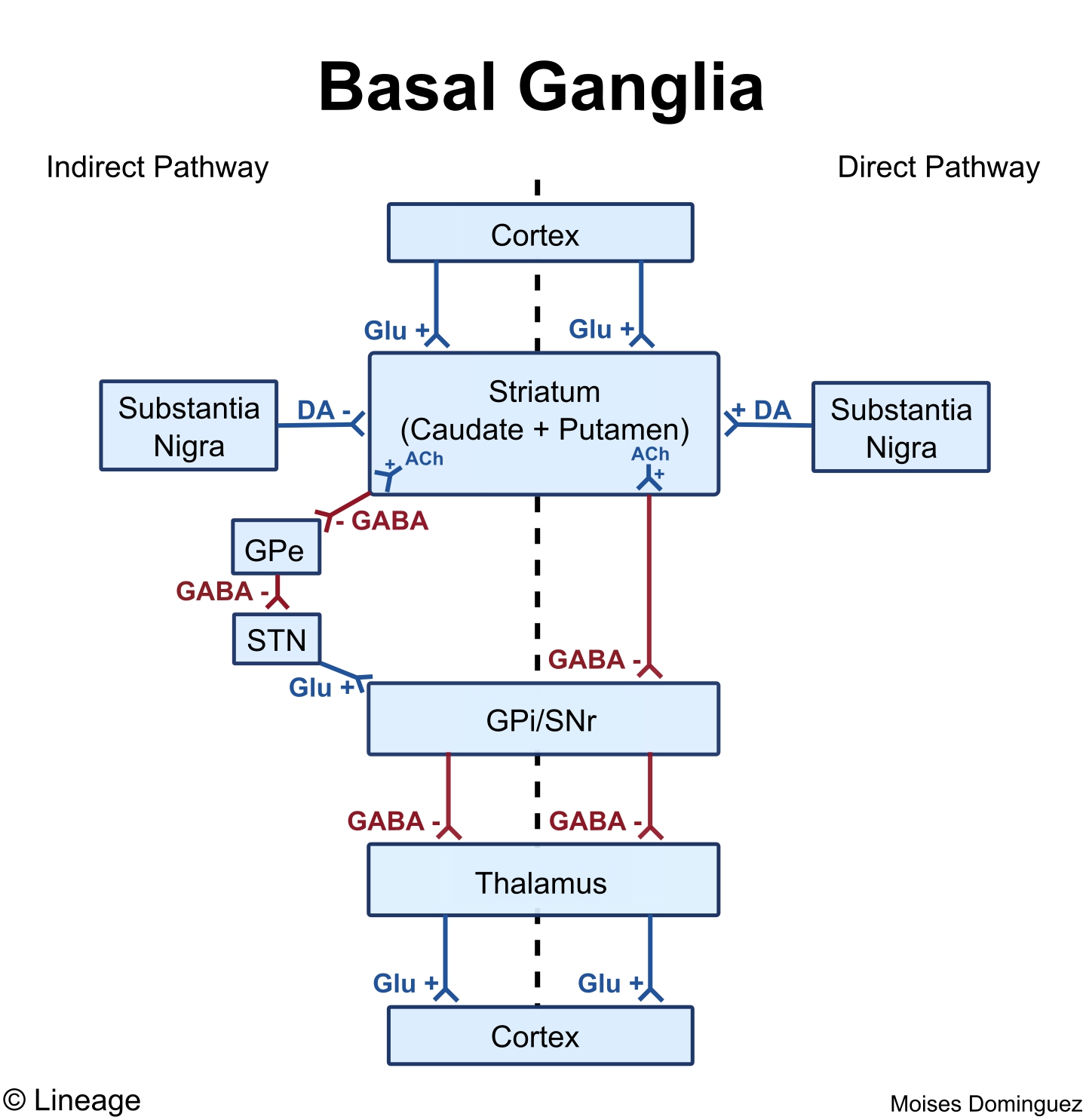
Basal Ganglia
🧠 DETAILED MULTI-PARAGRAPH SUMMARY
The basal ganglia and cerebellum are two major motor control systems that function together as “co-directors” of movement. While both are essential for smooth and purposeful motor behaviour, they have distinct but complementary roles. The basal ganglia are primarily responsible for internally generated action selection, meaning they decide whether to perform an action and which action to execute. In contrast, the cerebellum is responsible for externally guided execution, ensuring that once a movement is selected, it is carried out with proper timing, coordination, and accuracy. These systems do not directly control muscles; instead, their outputs are integrated in the thalamus, which relays the final motor command to the motor cortex.
The basal ganglia consist of four principal nuclei: the striatum (caudate nucleus and putamen), globus pallidus (internal GPi and external GPe), substantia nigra (pars compacta SNpc and pars reticulata SNpr), and the subthalamic nucleus (STN). The striatum is the main input region, receiving excitatory (glutamatergic) signals from the cortex. Approximately 90% of its neurons are medium spiny neurons (MSNs), which are inhibitory (GABAergic) and normally inactive until stimulated. The GPi and SNpr serve as the main output nuclei and are tonically active, constantly inhibiting the thalamus and preventing unwanted movements.
Movement control within the basal ganglia relies on two major pathways: the direct pathway and the indirect pathway. The direct pathway facilitates movement by disinhibiting the thalamus. When activated, MSNs inhibit the GPi/SNpr, which reduces their inhibitory output to the thalamus, allowing it to excite the motor cortex and initiate movement. In contrast, the indirect pathway suppresses unwanted movements. It involves inhibition of the GPe, leading to activation of the STN, which then excites the GPi/SNpr, increasing inhibition of the thalamus and reducing cortical activation. A third pathway, the hyperdirect pathway, acts as a rapid “emergency brake,” quickly inhibiting movement via direct cortical input to the STN.
Dopamine, released from neurons in the SNpc, plays a crucial modulatory role in these pathways. It acts on two receptor types in the striatum: D1 receptors (direct pathway) and D2 receptors (indirect pathway). Dopamine binding to D1 receptors enhances excitability (depolarization), facilitating movement, while binding to D2 receptors reduces excitability (hyperpolarization), suppressing the indirect pathway. Thus, dopamine overall promotes movement by strengthening desired actions and suppressing competing ones.
Disorders of the basal ganglia arise when this balance is disrupted. In Parkinson’s disease, degeneration of dopaminergic neurons in the SNpc leads to reduced dopamine levels. This results in decreased activity in the direct pathway and increased activity in the indirect pathway, causing excessive inhibition of the thalamus. Clinically, this manifests as hypokinetic symptoms such as bradykinesia (slow movement), akinesia (difficulty initiating movement), rigidity, and resting tremor. Treatments include L-DOPA, a dopamine precursor, and deep-brain stimulation, which modulates abnormal circuitry activity.
In contrast, Huntington’s disease is a genetic disorder characterised by degeneration of MSNs, particularly those in the indirect pathway. This leads to reduced inhibition of unwanted movements, resulting in hyperkinetic symptoms such as involuntary jerking movements (chorea). Thus, while Parkinson’s disease reflects too little movement due to excessive inhibition, Huntington’s disease reflects excessive movement due to insufficient inhibition.
📌 BULLET POINT SUMMARY
🔹 Basal Ganglia vs Cerebellum
Basal ganglia: action selection (internal decisions)
Cerebellum: execution (timing & coordination)
Both send output via the (thalamus
🔹 Functions of Basal Ganglia
Initiate voluntary movement
Select appropriate motor programs
Inhibit competing movements
Roles in cognition, emotion, learning
🔹 Main Structures
Striatum (input; GABAergic MSNs)
Globus pallidus (GPe, GPi)
Substantia nigra (SNpc dopamine, SNpr output)
Subthalamic nucleus (excitatory)
🔹 Key Properties
GPi & SNpr: tonically inhibitory
Striatum: tonically inactive
STN: only excitatory nucleus
🔹 Pathways
Direct pathway
Inhibits GPi → disinhibits thalamus → ↑ movement
Indirect pathway
Activates GPi via STN → inhibits thalamus → ↓ movement
Hyperdirect pathway
Rapid inhibition (emergency brake)
🔹 Dopamine Effects
D1 receptors → excitation → promote movement
D2 receptors → inhibition → suppress indirect pathway
Net effect: facilitates movement
🔹 Disorders
Parkinson’s disease
Loss of SNpc dopamine
↓ direct pathway, ↑ indirect pathway
Symptoms: bradykinesia, rigidity, tremor
Huntington’s disease
Loss of MSNs (indirect pathway) medium spiny neruons
Excess movement (chorea)
🧩 FILL-IN-THE-BLANK SUMMARY
Section 1: Functional Roles
The basal ganglia are responsible for _action_________ selection.
The cerebellum controls movement _excutation_________.
Both systems communicate via the __thalamus________.
Section 2: Structures
The main input nucleus is the _straitum_________.
The main output nuclei include _GPi______ and SNPr______.
Dopamine is produced in the _SNPc________.
Section 3: Pathways
The __direct________ pathway facilitates movement.
The __indirects_______ pathway inhibits unwanted movement.
The STN is the only __excitatory___ nucleus.
Section 4: Dopamine
D1 receptors cause _depolarisation______ (depolarization/hyperpolarization).
D2 receptors cause ___hyperpolarisation_______.
Dopamine overall _facillates_________ movement.
Section 5: Disease
Parkinson’s disease involves loss of __dopaminergic_____ neurons.
Huntington’s disease involves loss of __GABAerigic Medium Spiny Neurons_____ neurons.
Parkinson’s results in _hypo_____ (hypo/hyper)kinesia.
✅ ANSWERS (Fill in the blanks)
action
execution
thalamus
striatum
GPi, SNpr
SNpc
direct
indirect
excitatory
depolarization
hyperpolarization
facilitates
dopaminergic
GABAergic MSNs
hypokinesia
📝 40 MEDIUM-LEVEL EXAM MCQs
Questions
Basal ganglia primarily control:
A. Reflexes
B. Action selection
C. Vision
D. HearingCerebellum primarily controls:
A. Decision-making
B. Execution of movement
C. Memory
D. EmotionOutput from BG goes through:
A. Cortex
B. Thalamus
C. Spinal cord
D. CerebellumStriatum consists of:
A. GPi + GPe
B. Caudate + putamen
C. SNpc + SNpr
D. STN + GPiGPi neurons are:
A. Excitatory
B. Inhibitory
C. Sensory
D. MotorStriatal MSNs are:
A. Excitatory
B. Inhibitory
C. Sensory
D. ReflexGPi is:
A. Input nucleus
B. Output nucleus
C. Sensory nucleus
D. RelaySNpc contains:
A. GABA neurons
B. Dopamine neurons
C. Glutamate neurons
D. Sensory neuronsSTN is:
A. Inhibitory
B. Excitatory
C. Neutral
D. DopaminergicDirect pathway results in:
A. Inhibition of movement
B. Facilitation of movement
C. No change
D. ReflexIndirect pathway results in:
A. Facilitation
B. Inhibition
C. Excitation
D. ReflexHyperdirect pathway:
A. Slow
B. Emergency brake
C. Excitatory
D. SensoryDopamine acts on:
A. Cortex only
B. Striatum
C. Cerebellum
D. BrainstemD1 receptors:
A. Inhibit neurons
B. Excite neurons
C. Neutral
D. Block signalsD2 receptors:
A. Excite
B. Inhibit
C. Neutral
D. Activate reflexDopamine overall:
A. Inhibits movement
B. Facilitates movement
C. No effect
D. Stops movementParkinson’s disease involves loss of:
A. GABA
B. Dopamine
C. Glutamate
D. SerotoninParkinson’s symptoms include:
A. Hyperactivity
B. Bradykinesia
C. Chorea
D. SeizuresHuntington’s disease causes:
A. Reduced movement
B. Excess movement
C. Paralysis
D. BlindnessHuntington’s affects:
A. Direct pathway
B. Indirect pathway
C. Cortex
D. CerebellumThalamus function:
A. Sensory input
B. Relay motor signals
C. Vision
D. HearingSNpr is:
A. Input nucleus
B. Output nucleus
C. Sensory
D. MotorGPe function:
A. Output
B. Internal regulation
C. Sensory
D. MotorDirect pathway inhibits:
A. Cortex
B. GPi
C. STN
D. GPeIndirect pathway activates:
A. Cortex
B. GPi
C. GPe
D. StriatumSTN excites:
A. Cortex
B. GPi
C. Striatum
D. CerebellumMSNs are:
A. Tonically active
B. Tonically inactive
C. Sensory
D. ReflexGPi is:
A. Tonically inactive
B. Tonically active
C. Neutral
D. ReflexBG output is:
A. Excitatory
B. Inhibitory
C. Neutral
D. SensoryDopamine loss leads to:
A. Increased movement
B. Decreased movement
C. No change
D. ReflexChorea is seen in:
A. Parkinson’s
B. Huntington’s
C. Stroke
D. EpilepsyBradykinesia means:
A. Fast movement
B. Slow movement
C. No movement
D. Jerky movementAkinesia means:
A. Excess movement
B. No movement
C. Fast movement
D. ReflexDeep brain stimulation targets:
A. Cortex
B. STN
C. Eye
D. EarL-DOPA:
A. Blocks dopamine
B. Increases dopamine
C. Reduces dopamine
D. NeutralBG and cerebellum both:
A. Directly control muscles
B. Use thalamus
C. Control vision
D. Control hearingBG loop involves:
A. Cortex only
B. Cortex–BG–thalamus
C. Cerebellum only
D. Spinal cordDirect pathway uses:
A. D2
B. D1
C. Both
D. NoneIndirect pathway uses:
A. D1
B. D2
C. Both
D. NoneNet BG function:
A. Stop movement
B. Select appropriate movement
C. Control vision
D. Control hearing
✅ MCQ ANSWERS
B
B
B
B
B
B
B
B
B
B
B
B
B
B
B
B
B
B
B
B
B
B
B
B
B
B
B
B
B
B
B
B
B
B
B
B
B
B
B
B