Chapter 5 - Lipids, Membranes, and the First Cells
Biological evolution began with a molecule that could replicate itself
as offspring of this molecule multiplied natural selection would have favored versions that reproduced most frequently
Plasma Membrane/Cell Membrane: a membrane that surrounds a cell, separating it from the external environment and selectively regulating passage of molecules and ions into and out of the cell
allows entry of substances needed by the cell
reactants collide more frequently allowing the chemical reactions necessary for life to occur more efficiently
6.1 - Lipid Structure and Function
Lipid: any organic substance that does not dissolve in water, but dissolves well in non-polar organic solvents; includes fatty acids, fats, oils, waxes, steroids, and phospholipids
carbon-containing compounds that are characterized by a physical property - insolubility in water
high proportion of non-polar C—C and C—H bonds
do dissolve in organic solvents consisting of nonpolar compounds
Hydrocarbons are nonpolar because electrons shared equally in C—H bonds owning to the similar electronegativities of carbon and hydrogen
C—-H bonds form no partial charges, hydrocarbons don’t dissolve in water
so lipids are mostly hydrophobic because they have a significant hydrocarbon component
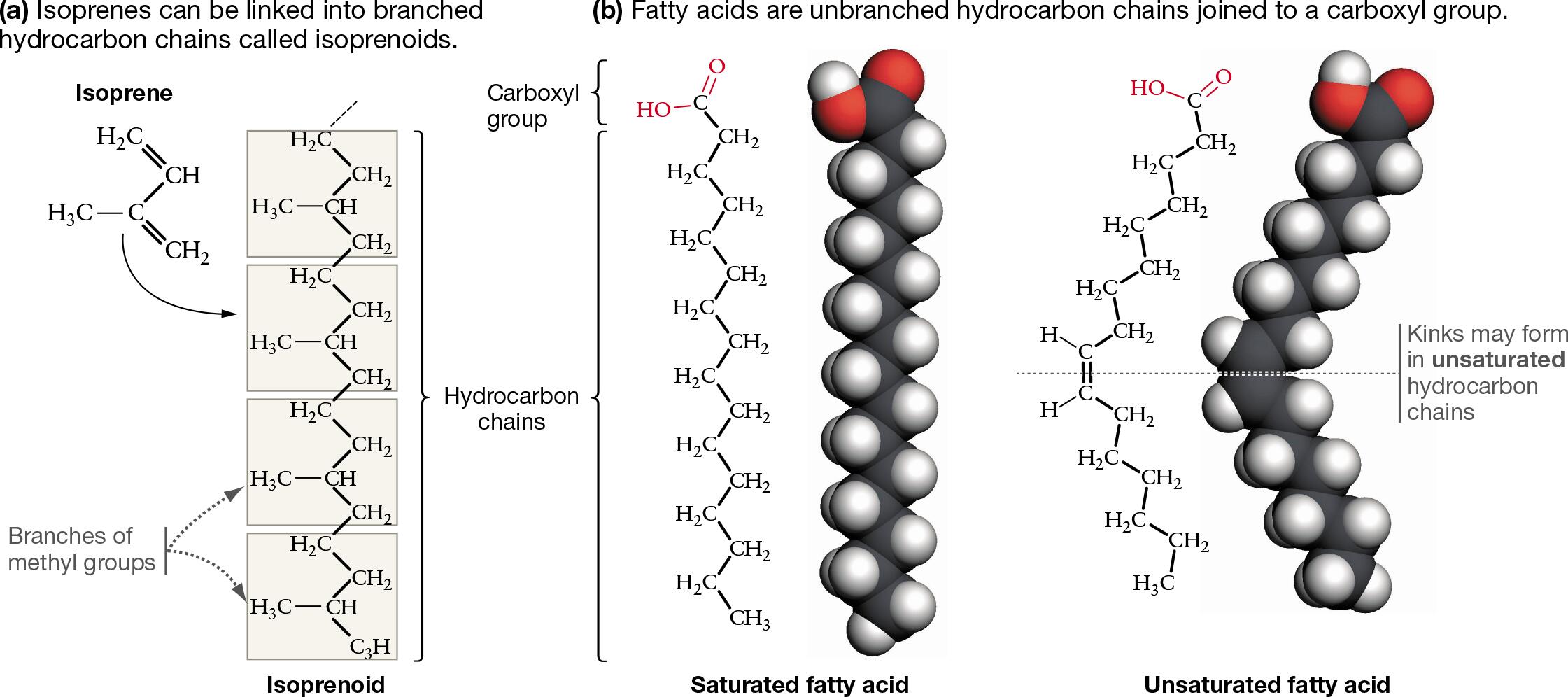
Isoprenes or isoprenoids serve a wide range of functions in organisms which can include pigments from scents to vitamins aNd precursors of some hormones
Fatty Acid: a lipid consisting of a hydrocarbon chain bonded at one end to a carboxyl group; used by many organisms to store chemical energy; a major component of animal and plant fats and phospholipids
bonded to a polar carboxyl functional group (—COOH)
contain a total of 14-20 carbon atoms most found in their long nonpolar hydrocarbon “tails”
subtle differences in the orientation of hydroxyl (—OH) groups can lead to dramatic effects in the structure and function of sugars, the type of bond between carbons in hydrocarbon chains
When two carbon atoms form a double bond the attached atoms are found in a plane instead of a three-dimensional tetrahedra
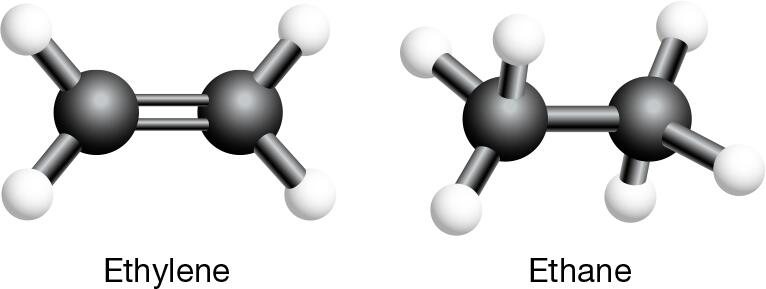
carbon atoms involved in double bonds are locked into place'
can’t rotate freely as can carbons in C—C single bonds
certain double bonds between carbon atoms (cis bonds) produce a “kink” in a straight line hydrocarbon chain
Saturated: lipids in which all the carbon-carbon bonds are single bonds; such compounds have relatively high melting points
Unsaturated: lipids in which at least one carbon-carbon bond is a double bond; double bonds produce links in hydrocarbon chains and decrease the compound’s melting point
Saturation affects molecular and profoundly changes physical state
if lipids are composed of straight chains many of these interactions will form along the chains and allow the lipids to pack together tightly to form a solid
if hydrocarbons are bent the unsaturated fatty acid
will have fewer interactions, move freely, and form a liquid
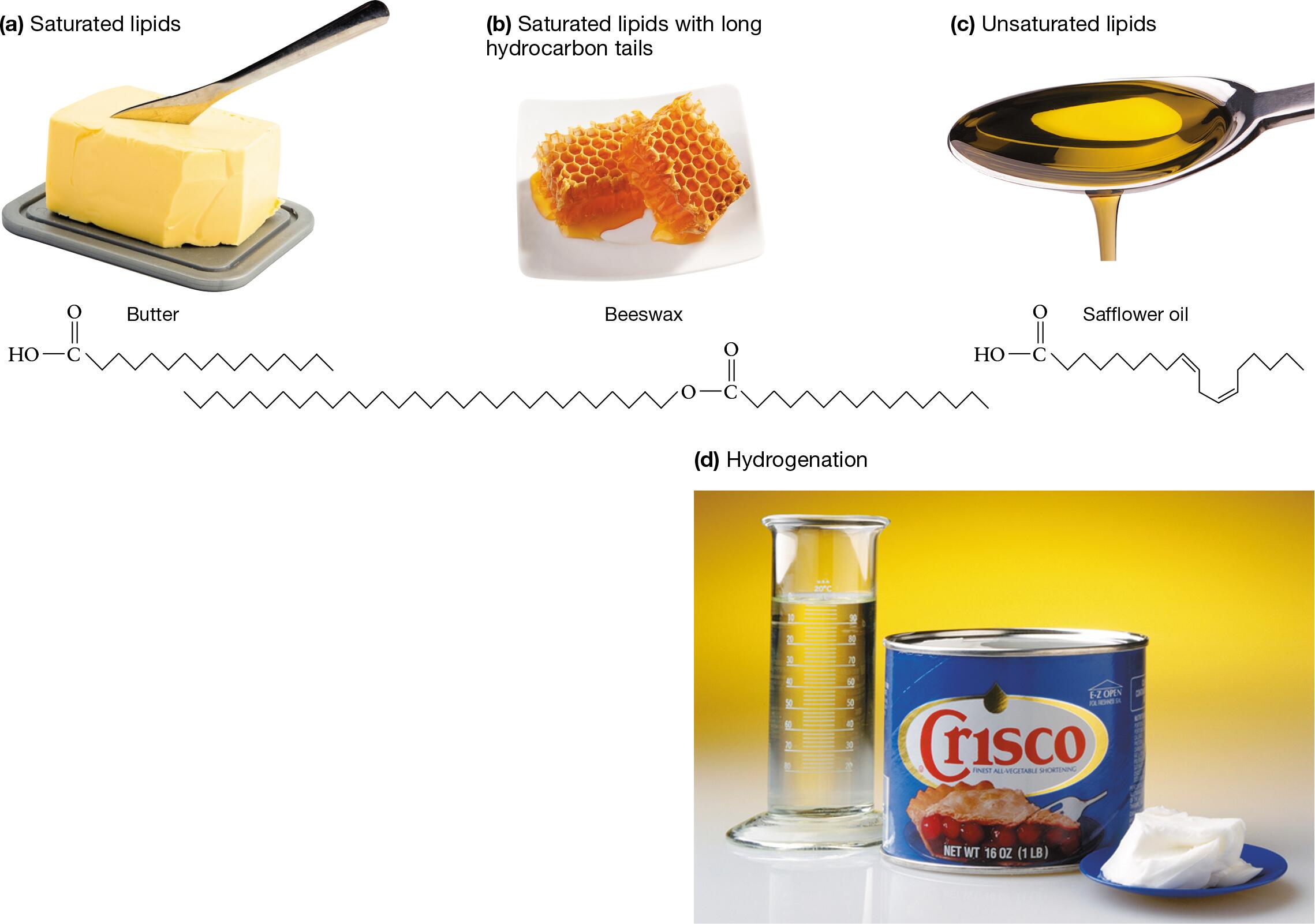
highly saturated lipids have relatively high melting points and are solid at room temperature (20-22 degrees Celsius)
have extremely long hydrocarbon tails like waxes form particularly stiff solids at room temperature
waxes: a class of lipid with extremely long saturated hydrocarbon tails, harder and less greasy than fats
highly unsaturated lipids are liquid at room temperature and called oils
oils: a polyunsaturated fat that is liquid at room temperature
unsaturated lipids can be converted to saturated lipids by breaking double bonds and adding hydrogen atoms via hydrogenation
Unlike amino acids, nucleotides, and monosaccharides, lipids don’t have a shared chemical structure
structure varies since hydrocarbon skeletons can be put together in many different ways (ex: steroids, fats, phospholipids)
steroids: class of lipid with a characteristic four-ring hydrocarbon structure
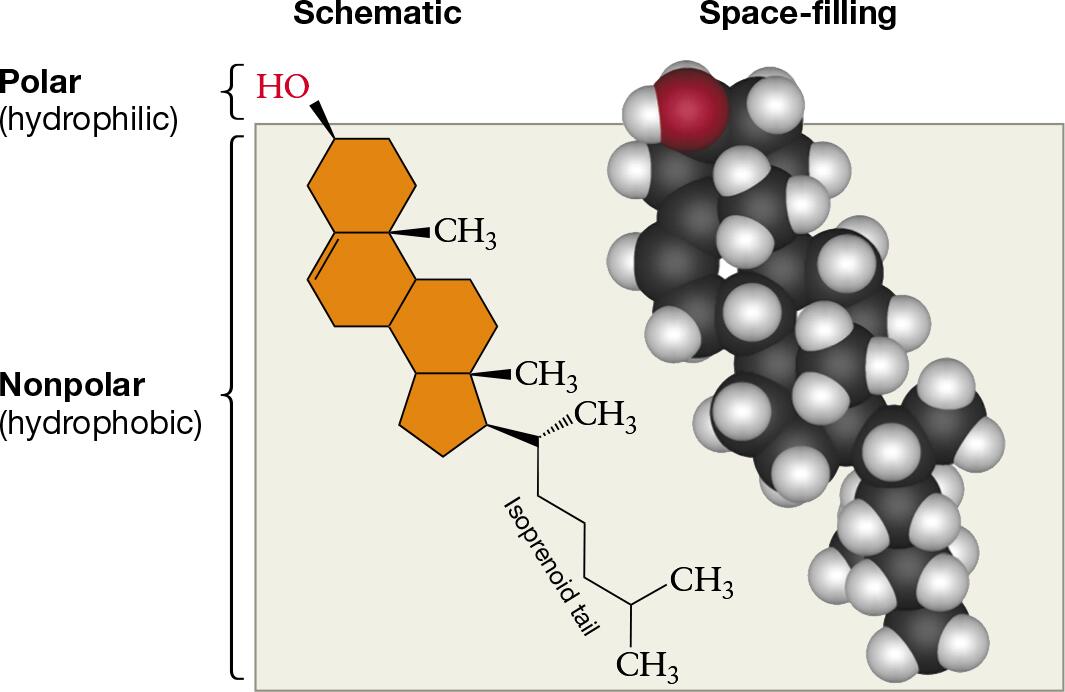
Fats: class of lipid consisting of three fatty acid molecules joined by ester linkages to glycerol molecule; also called triacylglycerol or triglyceride
nonpolar molecules
Glycerol: a three-carbon molecule that forms the “backbone” of phospholipids and most fats
in organisms storage is the primary role of fats
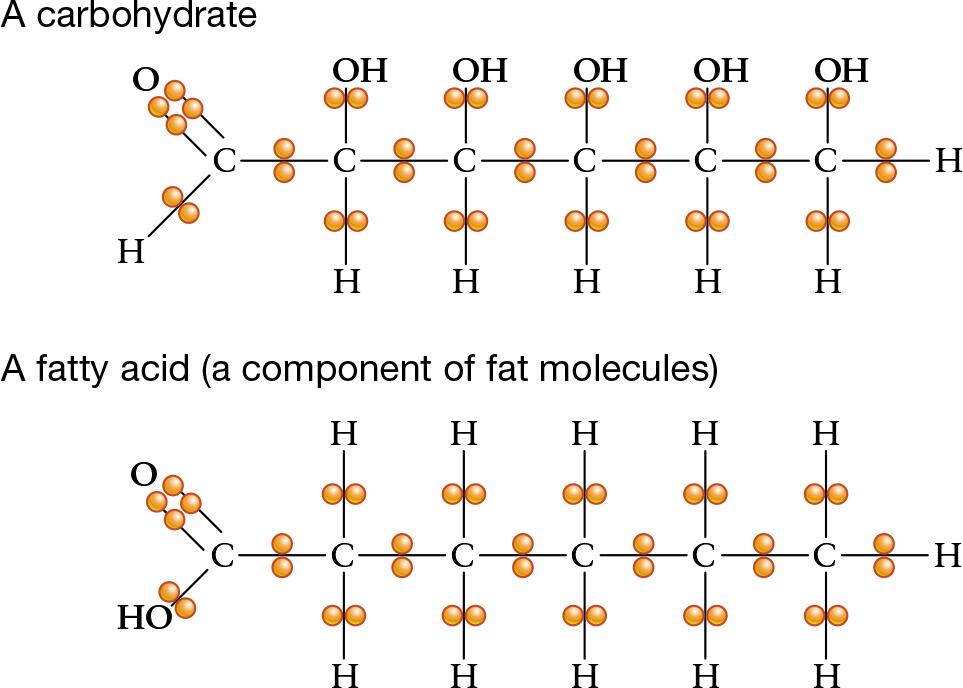
When fats aren’t attached to other molecules they are called free fatty acids
glycerol and fatty acid molecules become joined by an ester linkage
ester linkage: covalent bond formed by a condensation reaction between a carboxyl group and a hydroxyl group; join fatty acids to glycerol to form fat or phospholipid
when two atoms are linked together by an oxygen)
fatty acids aren’t linked into chains they aren’t considered monomers so fats are not polymers
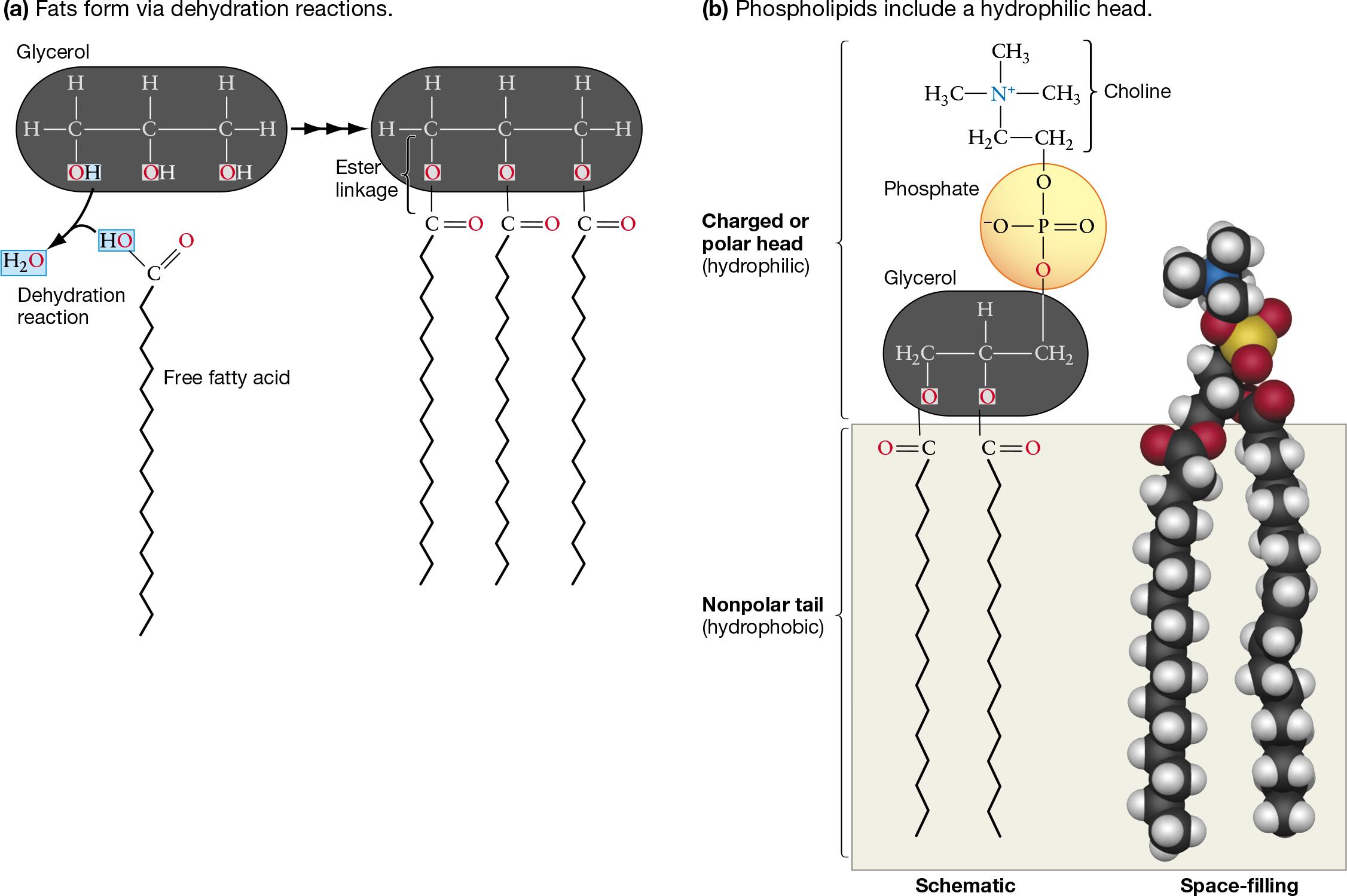
Phospholipids: a class of lipid having a hydrophilic head (including a phosphate group) and a hydrophobic tail (consisting og two hydrocarbon chains); major components of the plasma membrane and organelle membranes
phosphate group is bonded to a small organic molecule that is charge or polar
Lipids act as pigments that capture or respond to sunlight, serve as signals between cells, form waterproof coatings on leaves and skin, and act as vitamins used in many cellular processes
most prominent is role in cell membranes even though not all lipids can form membranes
Membrane forming lipids have a polar hydrophilic region
molecule has a “head” region containing a negatively charged phosphate group attached to a polar group
charges and polar covalent bonds in the head region interact with water molecules when a phospholipid is placed in a solution
long hydrocarbon tails of a phospholipid are nonpolar and hydrophilic
Amphipathic: containing hydrophilic and hydrophobic regions
phospholipids are amphipathic
6.2 - Phospholipid Bilayers
Amphipathic lipids don’t dissolve in water
hydrophilic heads interact with water but their hydrophobic tails don’t
assume one of two structures: micelles or lipid bilayers
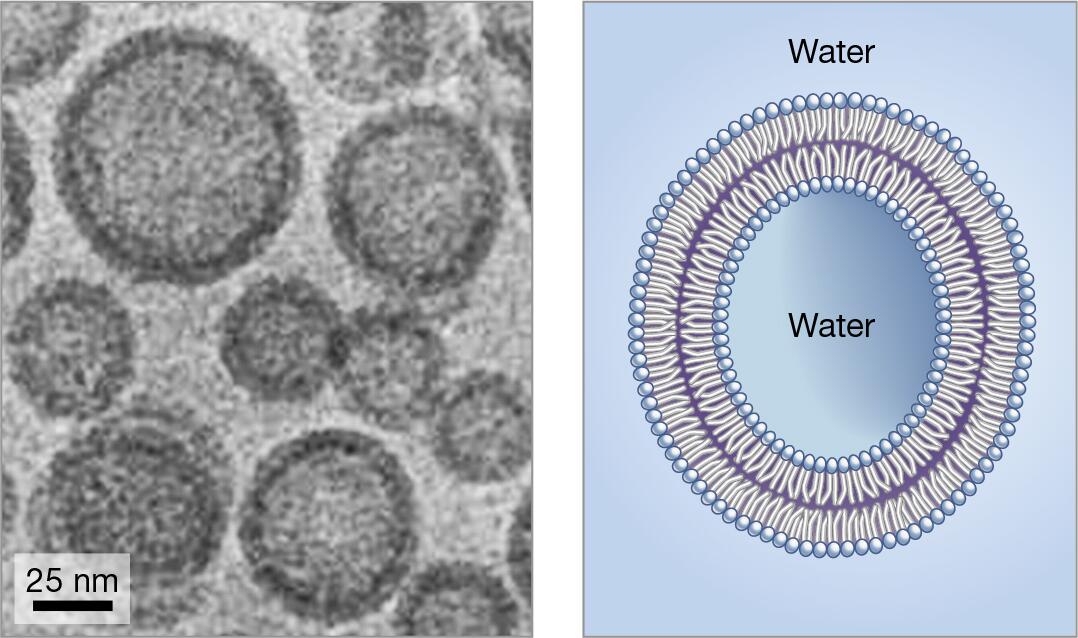
micelles: tiny spherical aggregates created when the hydrophilic heads of a set of lipids face outward and interact with the water while the hydrophobic tails interact with each other in the interior away from each other
lipid bilayer: basic structural element of all cellular membranes; consisting of a two-layer sheet of phospholipid molecules with their hydrophobic tails oriented toward the inside and their hydrophilic heads towards the outside; also called phospholipid bilayer
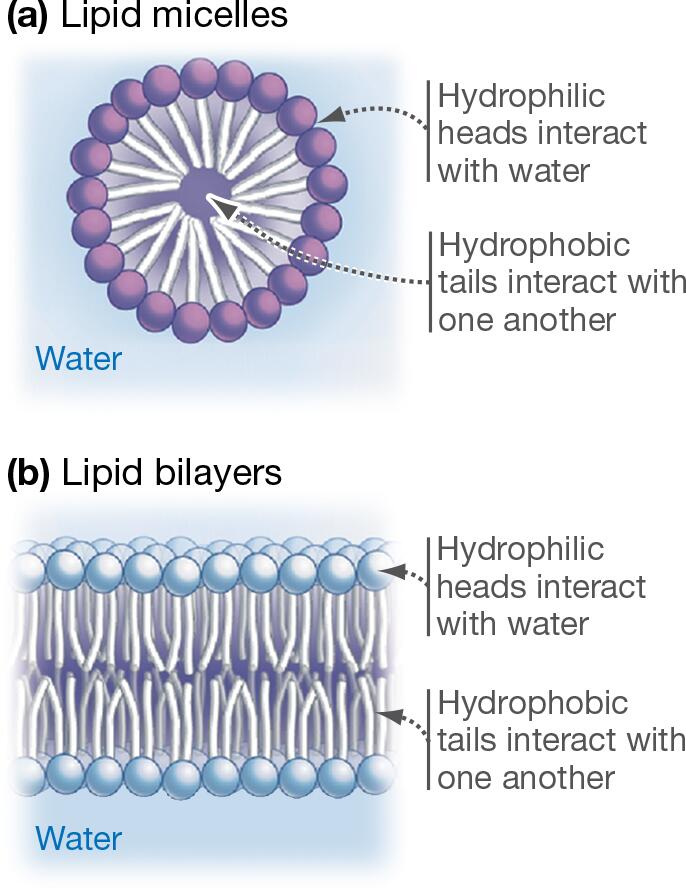
Micelles
tend to form free fatty acids or other simple amphipathic lipids with single hydrocarbon chains
phospholipids have bulkier nonpolar regions consisting of two hydrocarbon tails form bilayers
micelles and phospholipid bilayers form spontaneously in water, no input of energy is required
Vesicles: a membrane-enclosed compartment with an aqueous interior that is often used in cells to transport cargo between organelles or to the plasma membrane for secretion
Liposomes: an artificial vesicle formed by mixing amphipathic lipids, such as phospholipids, together in an aqueous solution
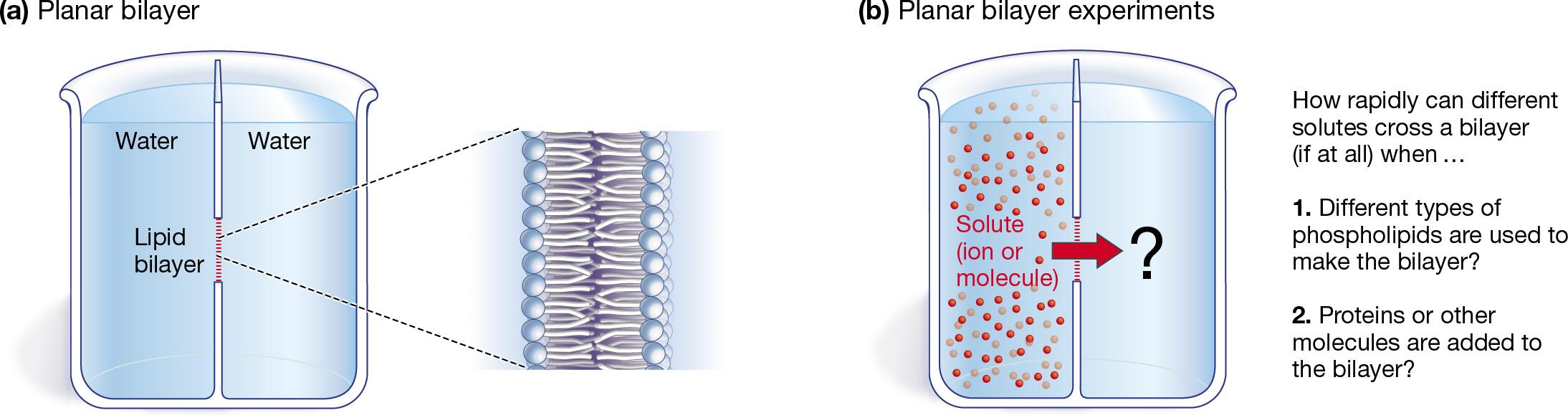
Planar Bilayer: artificial membrane used in experiments, provides a model unlike a vesicle,
Permeability: tendency of a structure such as a membrane to allow a given substance to diffuse across it
Lipid bilayers are highly selective
Selective Permeability: the property of a membrane that allows some substances to diffuse across it much more readily than other substances
small nonpolar molecules (ex: oxygen) move across bilayers quickly
if the small molecules are polar but uncharged (ex: H20) the rate of transportation decreases
larger polar molecules cross the membrane even slower
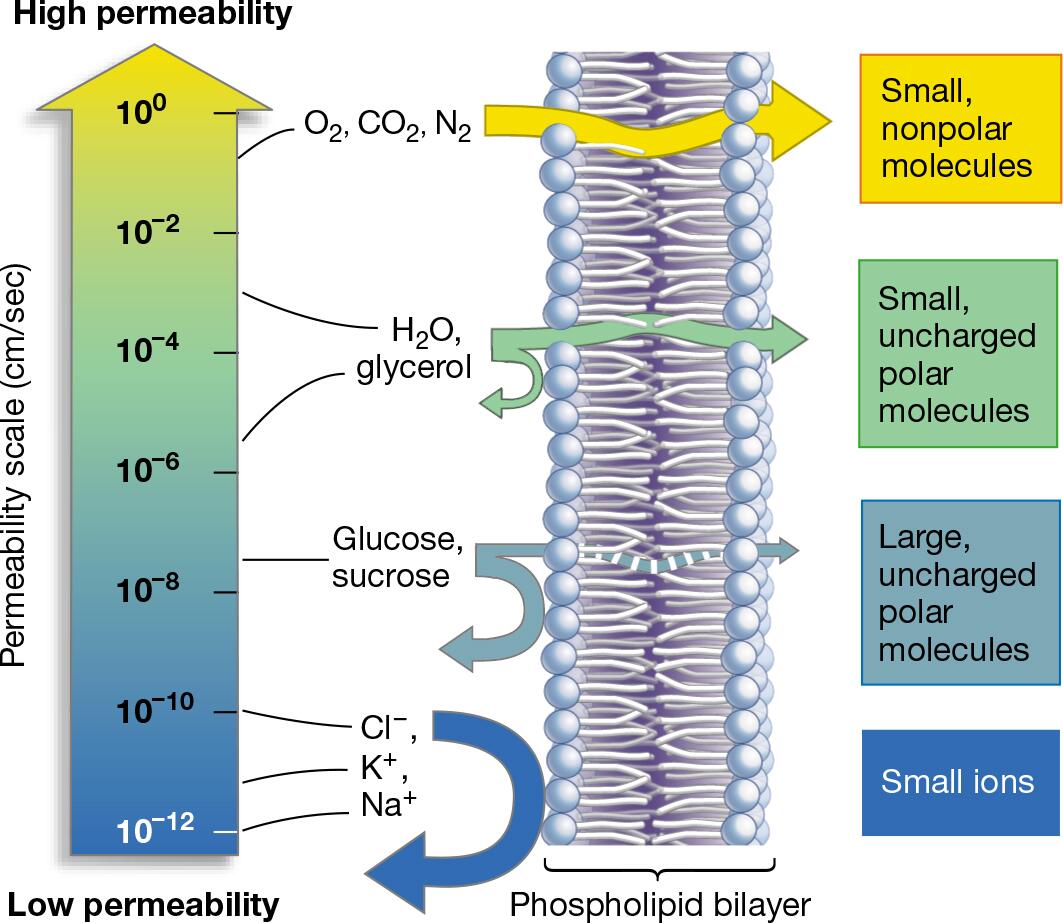
Charged solutes and even tiny ions don’t effectively cross lipid bilayers without “help” from membrane proteins
without these proteins sodium ions would cross the membrane a billion times slower than water
pattern of permeability - changed substances and polar molecules above a certain size are more stable dissolved in water (polar environment) than they would be in the nonpolar interior of membranes
Amphipathic nature of phospholipids causes them to spontaneously form into bilayers consisting of two lipid sheets held together by hydrophobic interactions
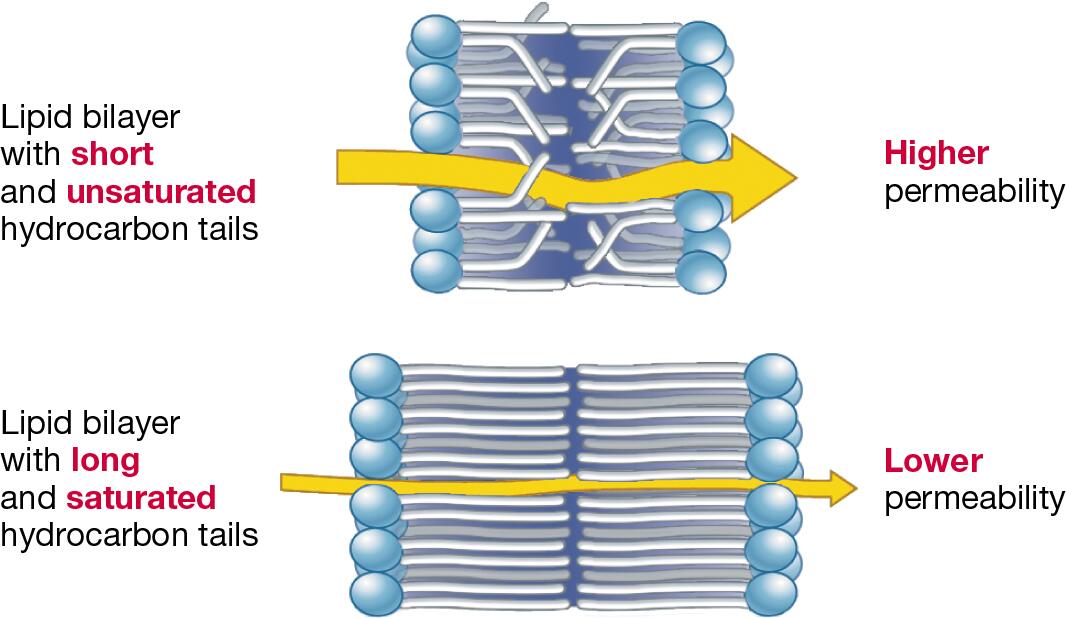
length and saturation state of the hydrocarbon tails and presence of cholesterol molecules influences the physical properties of a membrane and its permeability
A phospholipids degree of saturation and length of its hydrocarbon tails affects aspects of its behavior in a membrane
when unsatured hydrocarbon tails are packed into a lipid bilayer, kinks created by double bonds produce spaces among tails — spaces reduce number of van der Waals interactions that help hold hydrophobic tails together weakening the barrier to solutes
packed saturated hydrocarbon tails have fewer spaces and more van der Waals interactions
A largely unsaturated membrane allows more materials to pass since its interior is held together less tightly
bilayers containing mostly long, straight, saturated hydrocarbon tails are much less permeable
Cholesterol
adding cholesterol molecules to artificial membranes dramatically reduces their permeability
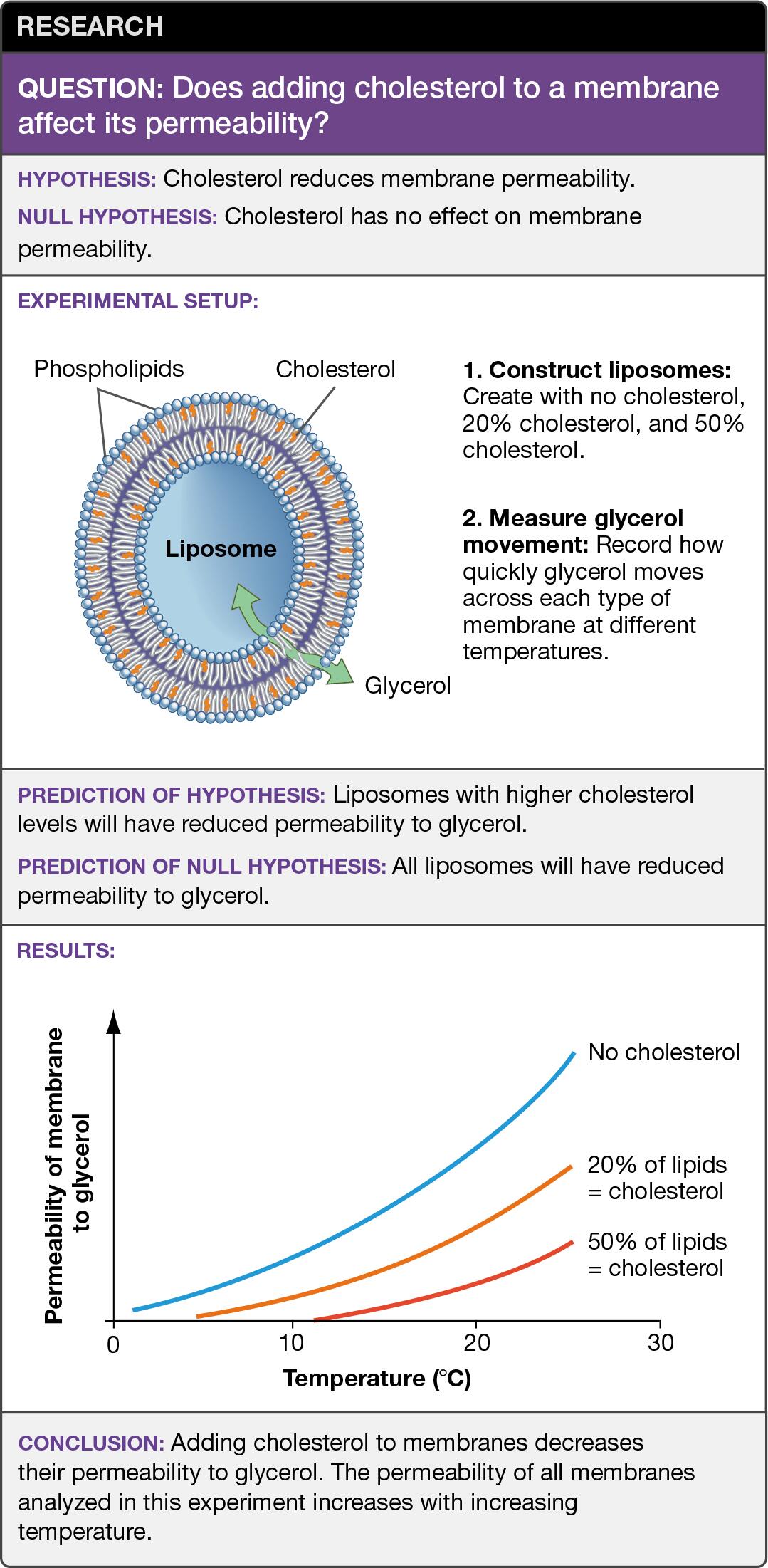
Bulky cholesterol rings force phospholipid tails closer to each other, increasing their packing density
Fluid state of phospholipids allows individual lipid molecules to move laterally within each layer
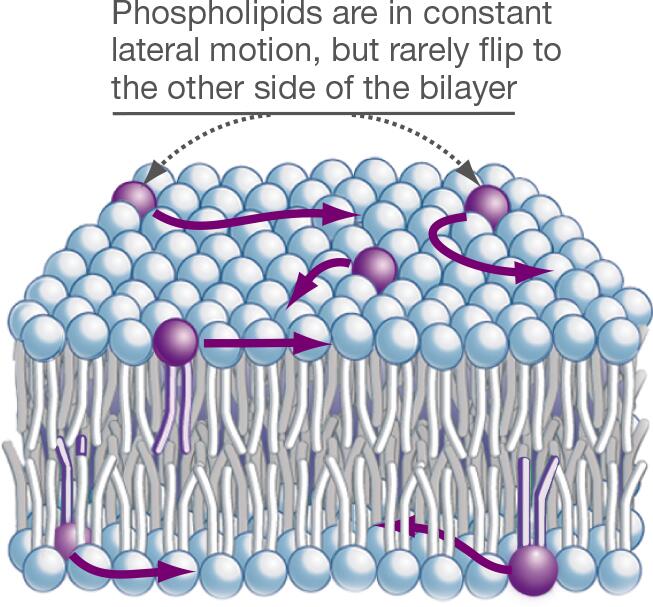
A membrane’s permeability is related to its level of fluidity which measures molecular mobility
as temperature drops molecules in a bilayer move more slowly and become less fluid
hydrophobic tails in the interior of membranes pack together more tightly
6.3 - How Substances Move Across Lipid Bilayers: Diffusion and Osmosis
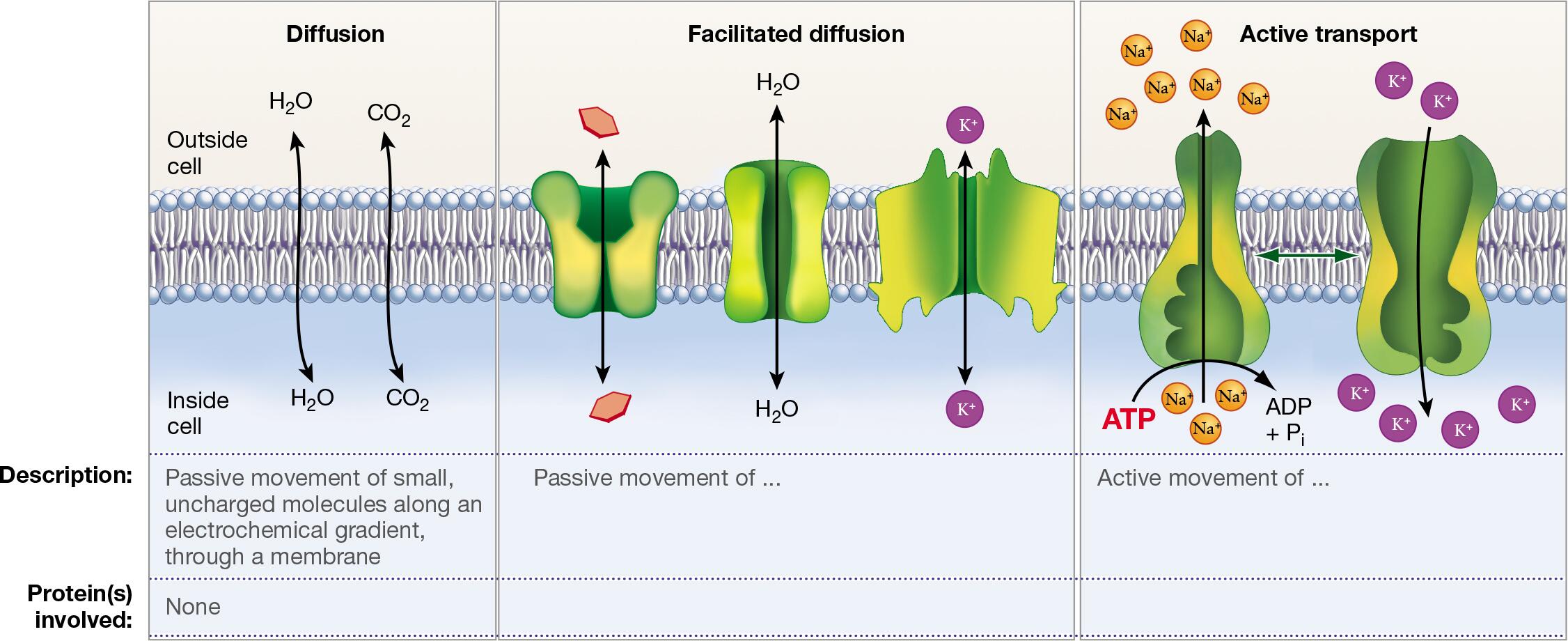
Small uncharged polar and nonpolar molecules can cross membranes readily and spontaneously without an input of energy
Diffusion: spontaneous movement of a substance from one region to another, often with a net movement from a region of high concentration to one of low concentration (ie down a concentration gradient)
Concentration Gradient: difference across space (ex: across a membrane) in the concentration of a dissolved substance
difference in solute concentrations
when concentration gradient exists a greater number of solutes move away from regions of high concentrations than solutes moving in the opposite direction
directional transport is the net movement of a solute
diffusion down a concentration gradient or away from the higher concentration is a spontaneous process because it results in an increase in entropy
Once molecules/ions are randomly distributed throughout a solution, an equilibrium is established
Passive Transport: diffusion of a substance across a membrane; when this event occurs with the assistance of membrane proteins it is facilitated diffusion
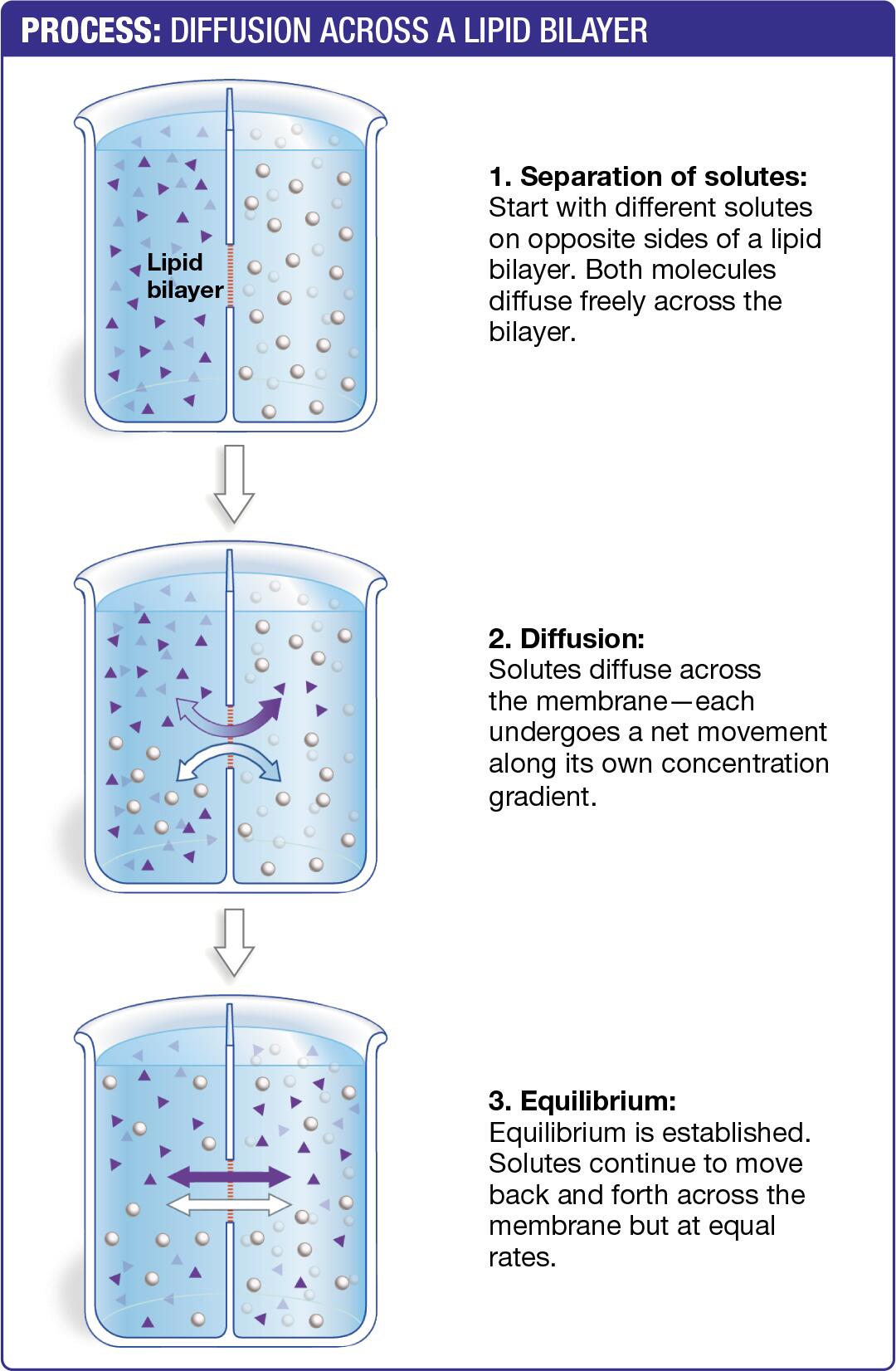
At equilibrium movement across the membrane doesn’t stop and these solutes continue to move back and forth across the membrane due to the constant random motion
no longer a net movement of solutes across the membrane because they are equally likely to move in any direction
Osmosis: diffusion of water across a selectively permeable membrane from a region of lower solute concentration (higher water concentration) to a region of higher solute concentration (lower water concentration); in cells the effect of osmosis is often observed when the solute is not able to pass through the membrane
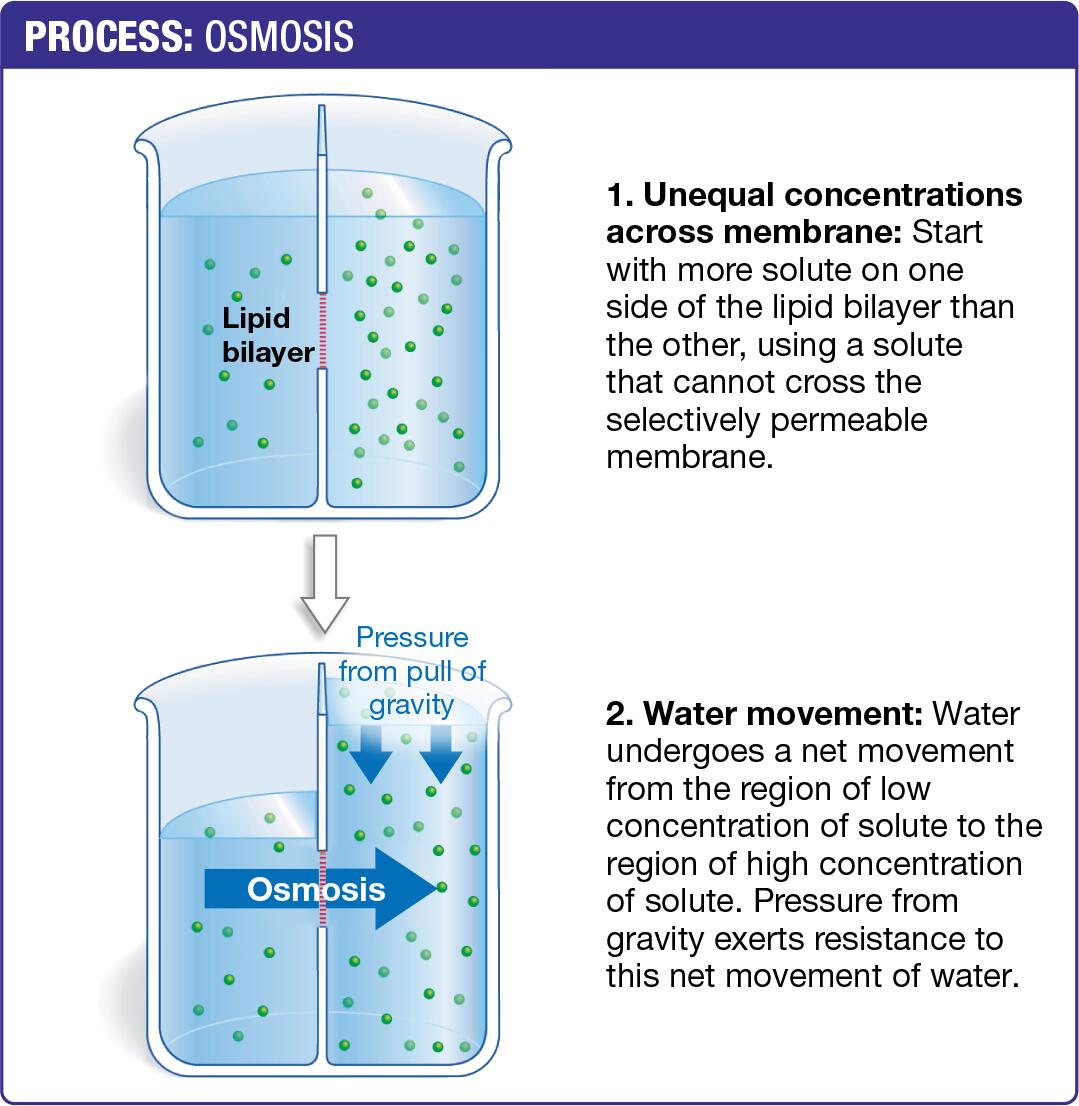
If a solute can’t easily cross the membrane, then any associated water moleculles are3 prevented from crossing
only unbound water molecules are able to diffuse across the membrane during osmosis
directional movement is spontaneous because entropy will increase as the difference in solute concentrations decreases
When water moves by osmosis the solutions on both sides of the membrane experience a change in volume and solute concentration
greater the initial difference in solute concentration the greater the volume change will be
In cells a rapid change in amount of water can be catastrophic
Hypertonic: comparative term designating a solution that if outside a cell or vesicle results in the loss of water and shrinkage of the membrane-bound structure; this solution has a greater solute concentration than the solution on the other side of the membrane; used when the solute is unable to pass through the membrane
Hypotonic: comparative term designating a solution that if outside the cell or vesicle results in the uptake of water and swelling or even bursting of the burstng of the membrane-bound structure; this solution has a lower solute concentration taht the solution on the other side of the membrane; used when the solute is unable to pass through the membrane
Isotonic: comparative term designating a solution that if inside a cell or vesicle results in no net uptake or loss of water and thus no effect on the volume of the membrane bound structure; this solution has the same solute concentration as the solution on the other side of the the membrane
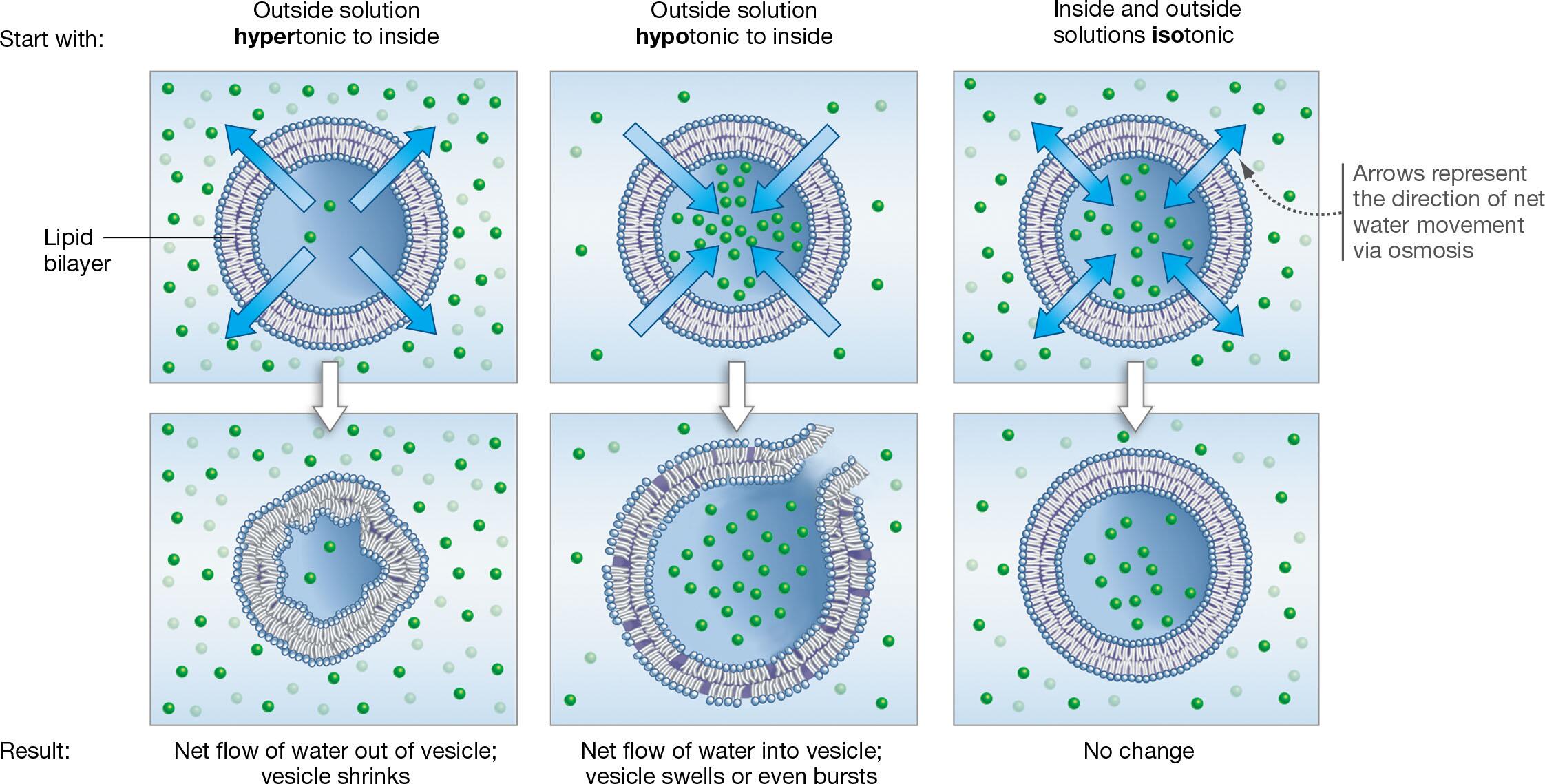
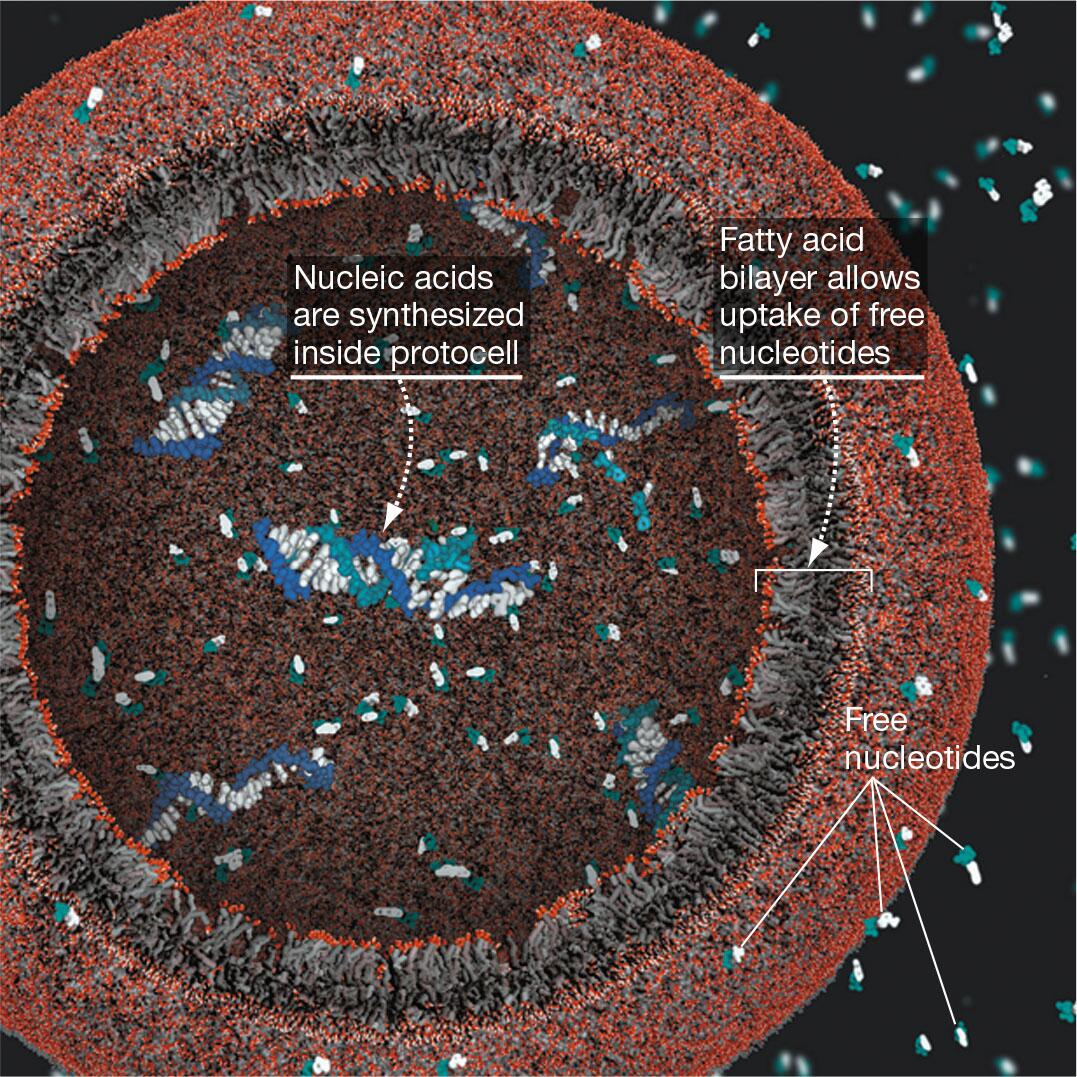
Diffusion and osmosis tend to reduce the differences in chemical composition between the inside and outside of membrane bound compartments
Protocells: a hypothetical pre-cell structure consisting of a membrane compartment that encloses replicating macromolecules
6.4 - Proteins After Membrane Structure and Function
Proteins consist of amino aids, which have side chains that range from highly nonpolar to highly polar or charged
A protein could have a series of nonpolar amino acids residues in the middle of its primary structure flanked by polar or charged amino acid residues
nonpolar resides would be stable in the interior of a lipid bilayer, while the polar or charged residues would be stable alongside the polar lipid heads and surrounding water
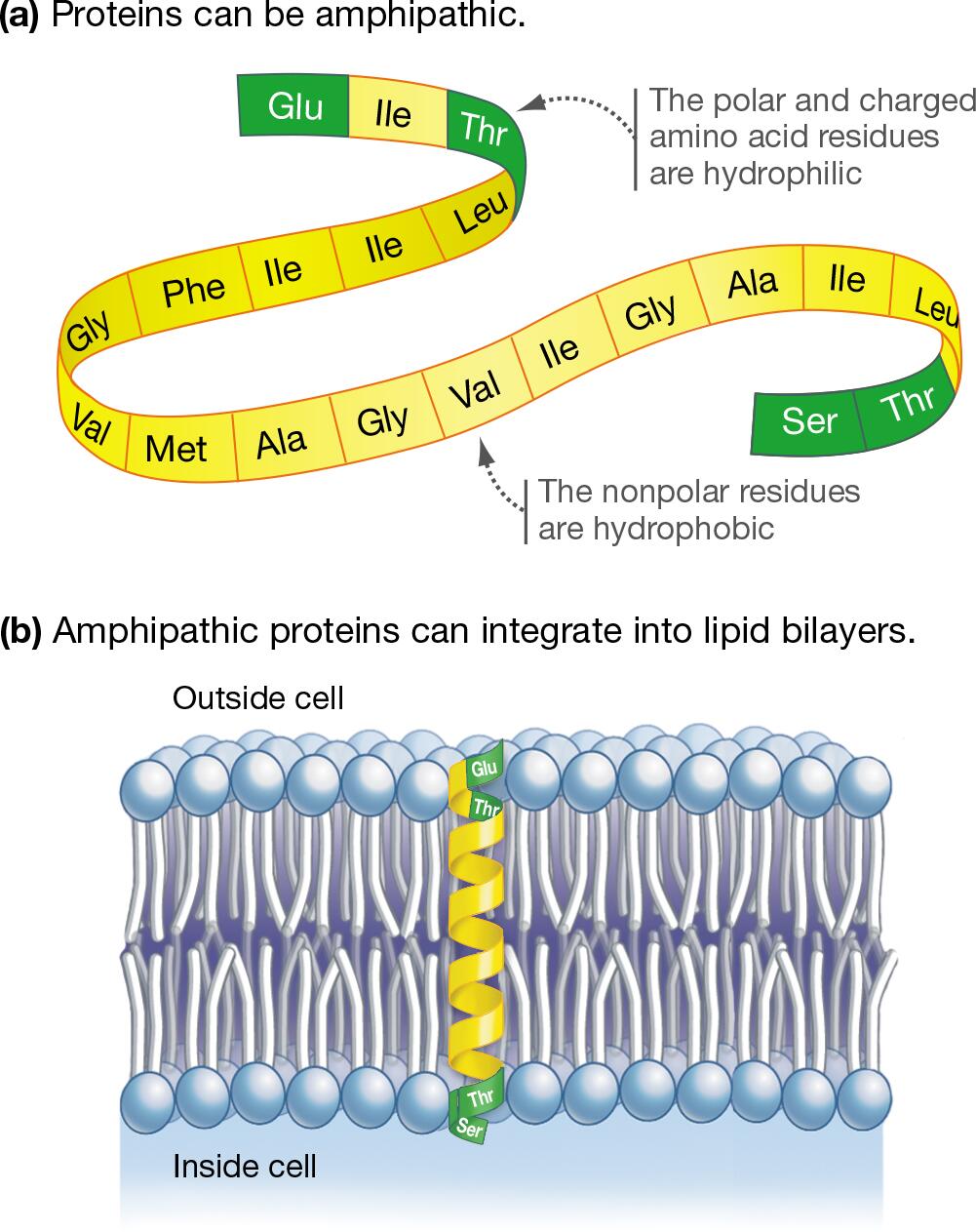
Since the secondary and tertiary structures of proteins are almost limitlessly variable, it is possible for proteins to form openings and function as a selective passageway across a lipid bilayer
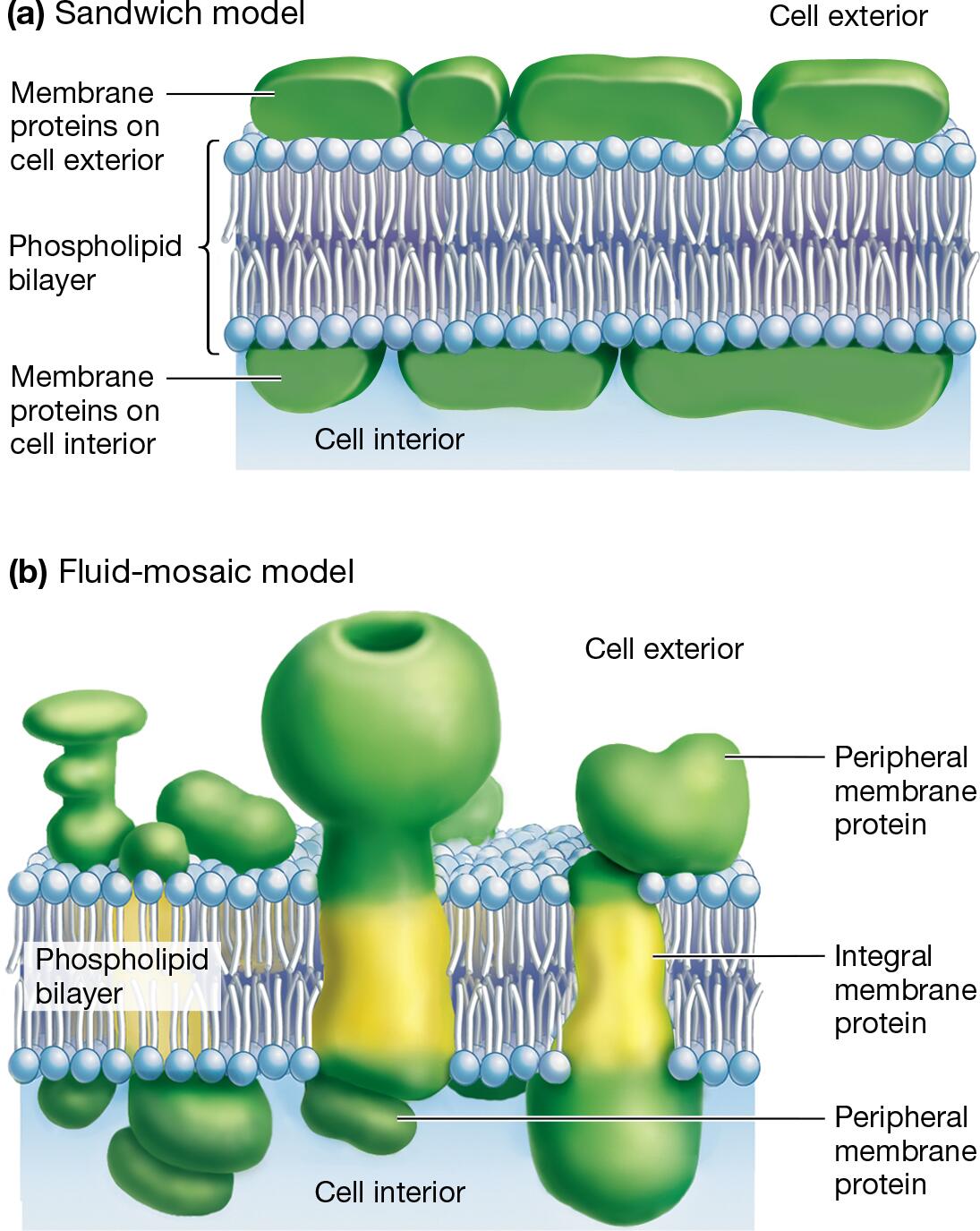
Development of Fluid-Mosaic Model
Fluid-Mosaic Model: the widely accepted hypothesis that cellular membranes consist of proteins embedded in a fluid phospholipid bilayer
Scanning Electron Microscope (SEM): a microscope that produces surface images by reflecting electrons off a specimen coated with a layer of metal atoms
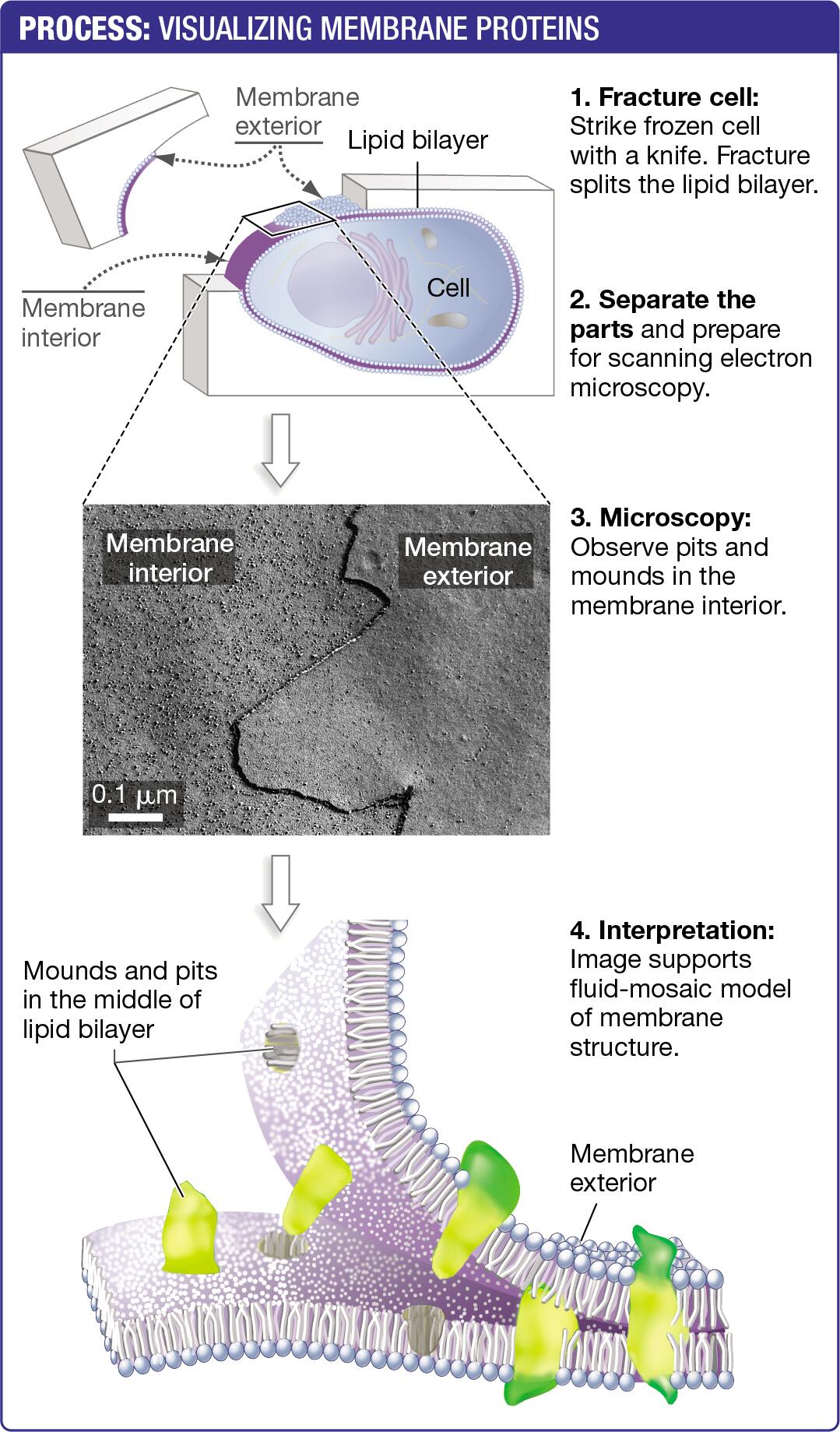
Integral Membrane Proteins: any membrane protein that spans the entire lipid bilayer
Peripheral Membrane Proteins: any membrane protein that doesn’t span the entire lipid bilayer but instead binds to only one side of the bilayer
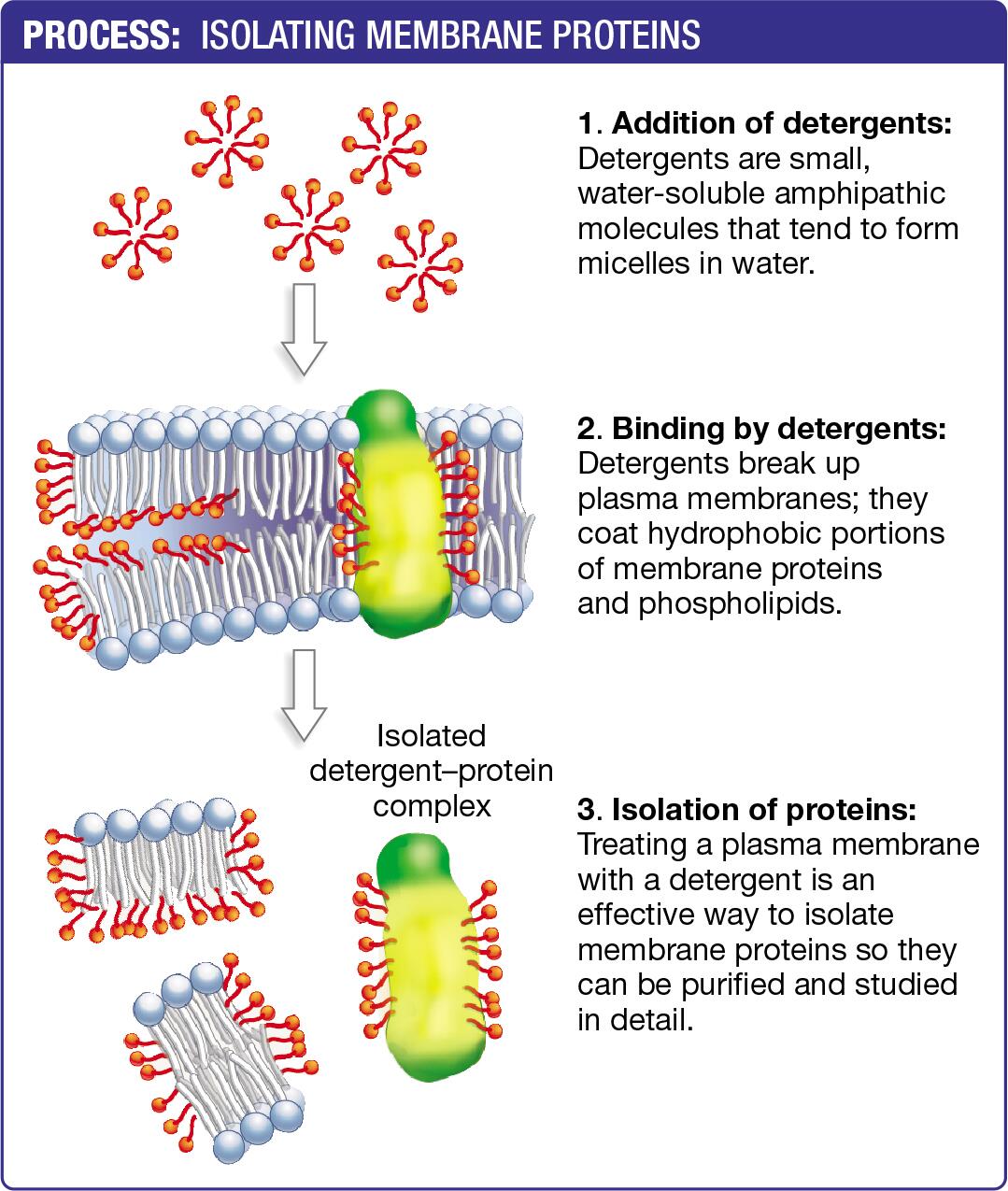
Channel Proteins Facilitate Diffusion
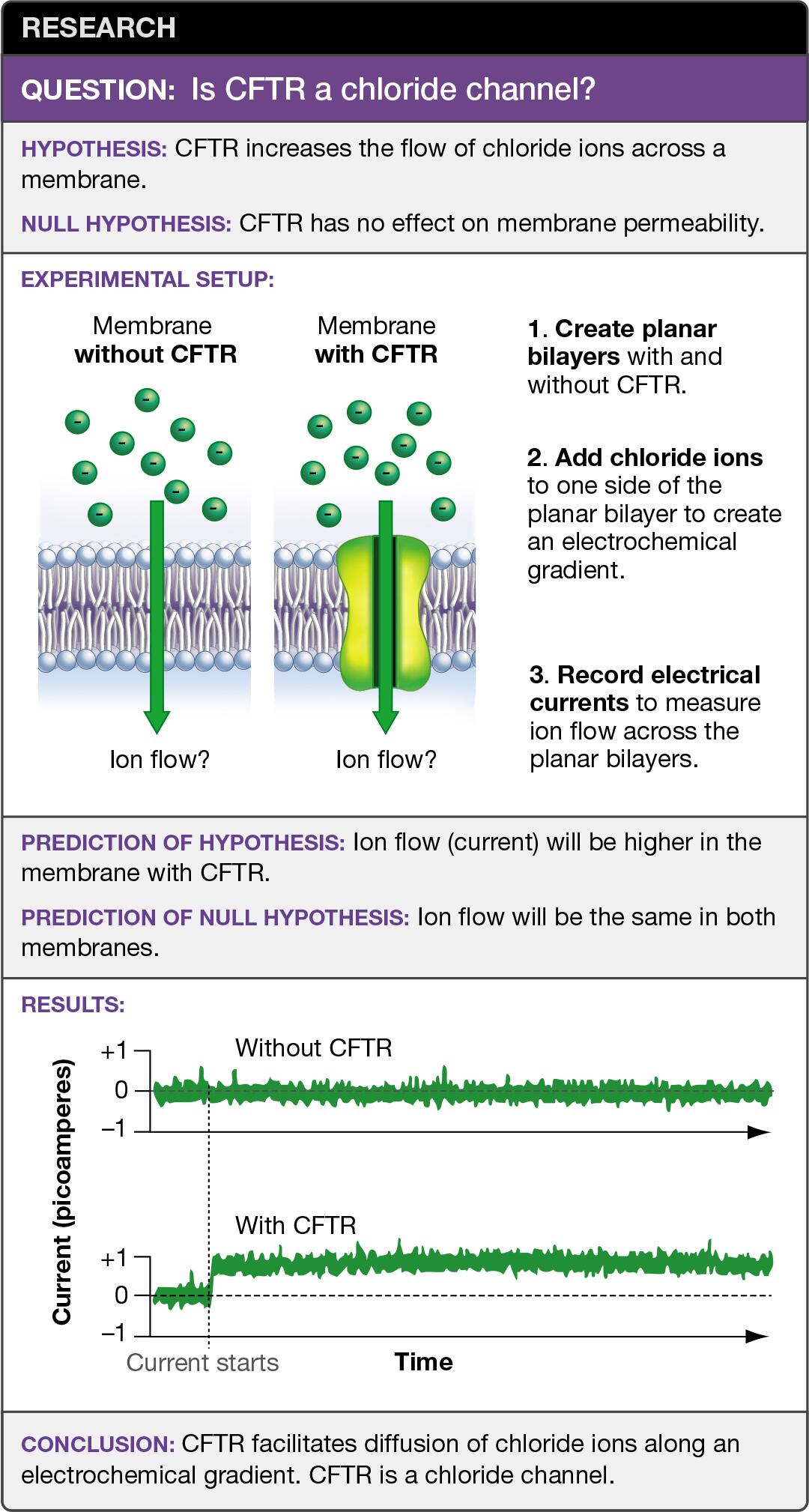
Ion Channels: a type of channel protein that allows certain ions to diffuse across a plasma membrane down an electrochemical gradient
form pores, or openings in a membrane
ions diffuse through these pores in a predictable direction from regions of high concentration to regions of low concentration and areas of like charge to areas of unlike charge
Electrochemical Gradient: the combined effect of an ion’s concentration gradient and electrical (charge) gradient across a membrane that affects the diffusion of ions
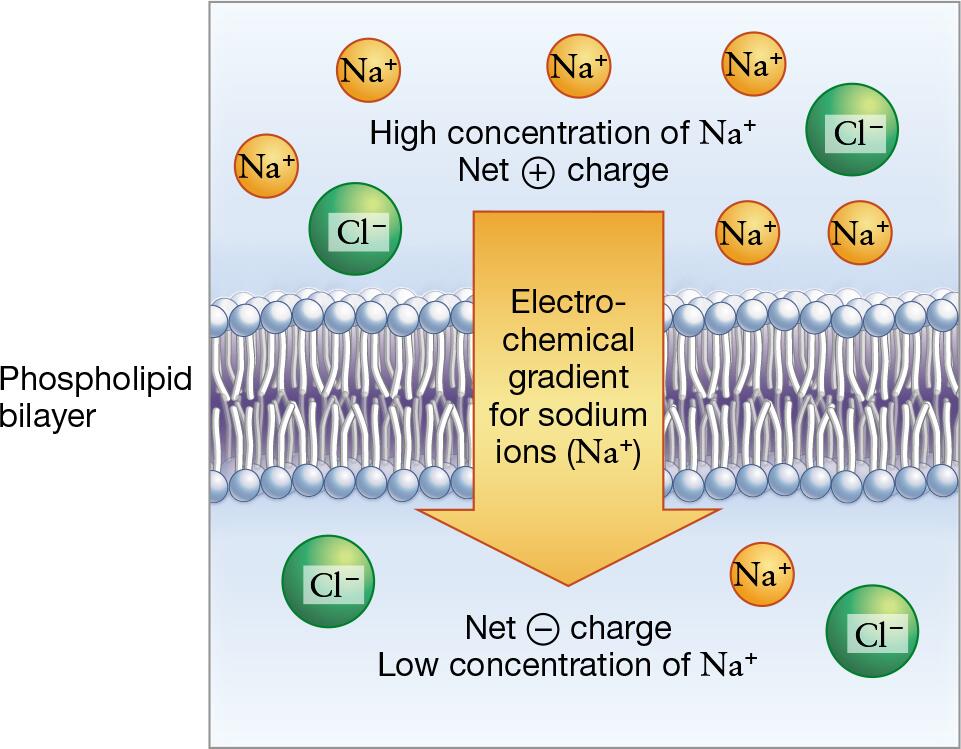
In response to electrochemical gradient, ions will diffuse in a directional manner if an appropriate channel exists
Protein Structure Determines Channel Selectivity
Channel Protein: a transmembrane protein that forms a pore in a cell membrane, which may open or close in response to a signal; the structure of most channels allows them to admit just one or a few types of ions or molecules
some are for ions and others are for small polar molecules
each channel protein has a structure that permits only a particular type of ion or small molecule to pass through it
amino acid residues that line a channel’s pore are hydrophilic relative to those facing the hydrocarbon tails of the membrane
doesn’t require an input of energy
Aquaporin: a type of protein that facilitates the movement of water (osmosis) across a plasma membrane
allow water to cross the plasma membrane but excludes other molecules and most ions
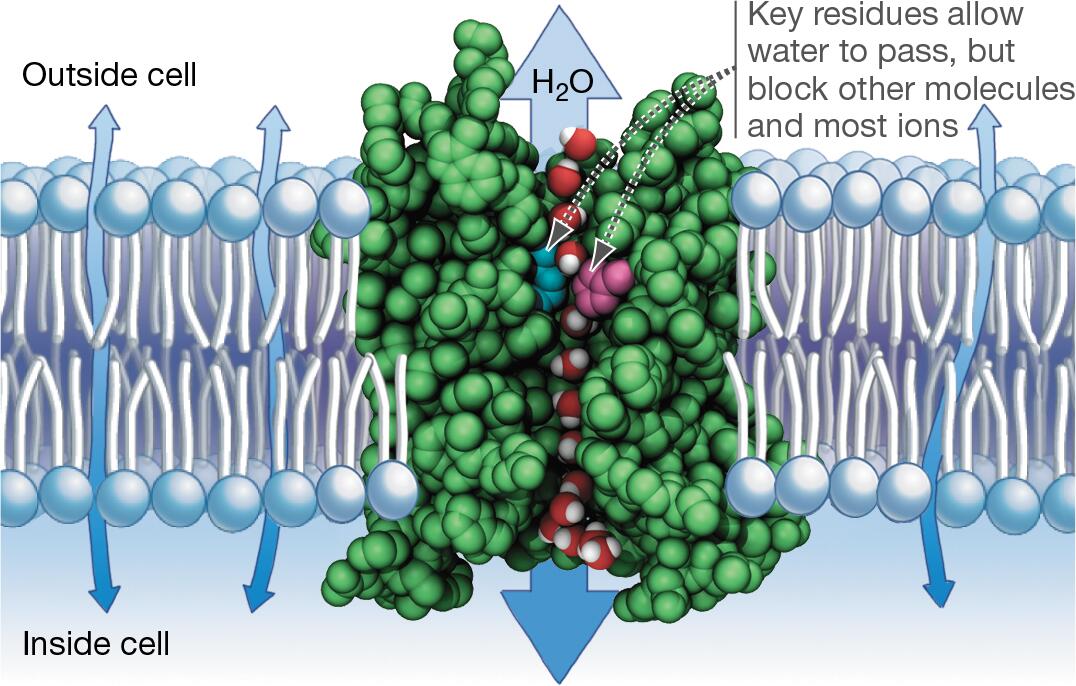
Movement Through Many Membrane Channels is Regulated
Gated Channels: a channel protein that opens and closes in response to a specific stimulus, such as the binding of a particular substance or a change in voltage across the membrane
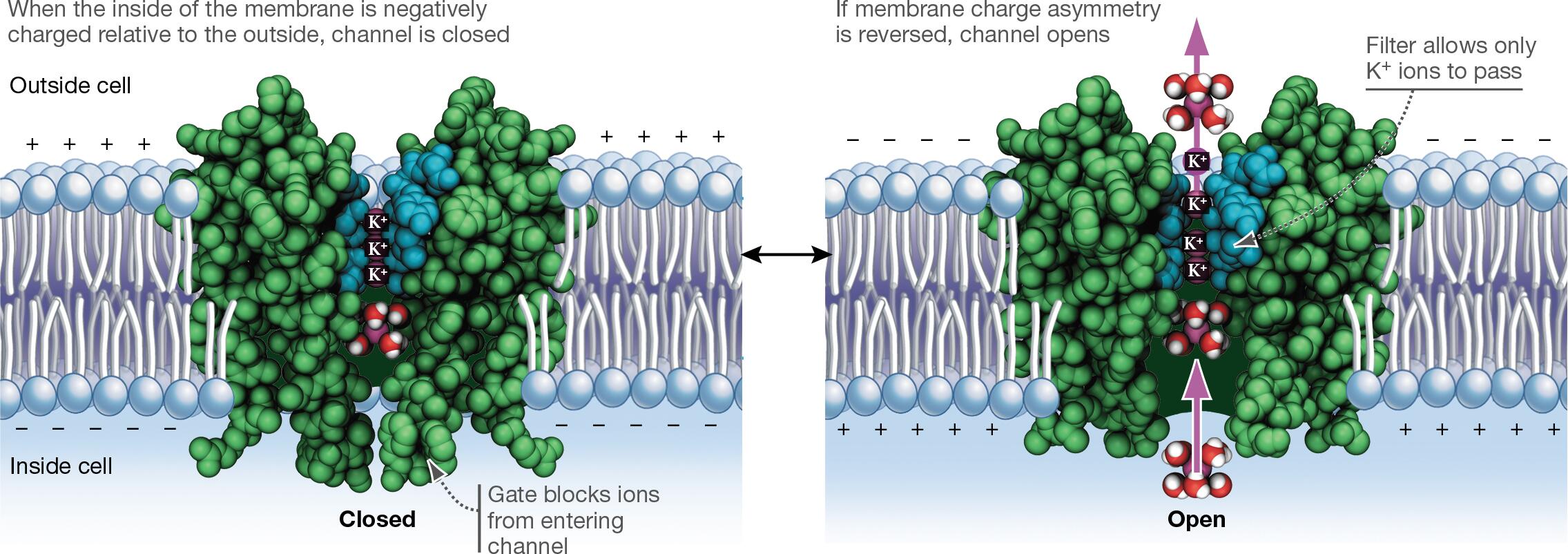
Facilitated Diffusion: passive movement (diffusion) of a substance across a membrane with the assistance of transmembrane carrier proteins or channel proteins
Carrier Proteins Facilitate Diffusion
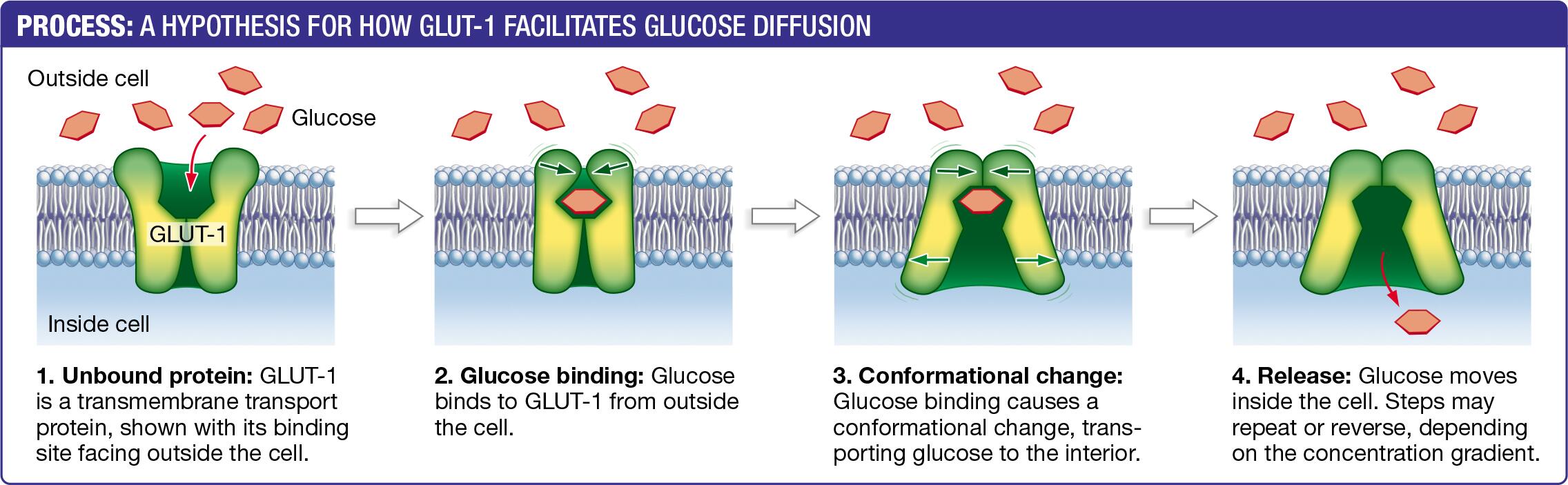
Carrier Protein: a transmembrane protein that facilitates diffusion of a small molecule (ex: glucose) across a membrane by a process involving a reversible change in the shape of the protein; also called carrier or transporter
Difference between channels and carrier proteins is the mechanism of transport
channels allow movement through a selective pore
carrier proteins selectively pick up a solute on one side of the membrane, then drop it off on the other side
Pumps Perform Active Transport
Diffusion is an passive process that moves substances in either direction across a membrane to make the cell interior and exterior environments more similar
Cells can move molecules or ions in a directed manner often against an existing gradient
requires an input of energy to counteract the decrease in entropy that occurs when molecules or ions are concentrated
Active Transport: the movement of ions or molecules across a membrane in a single direction often against a gradient; requires energy (ex: from hydrolysis or ATP) and assistance of a transport protein (ex: pump)
In cells ATP molecules provide energy for active transport by transferring a phosphate group to an active transport protein called a pump
Pump: any membrane protein that uses energy to change shape and power the active transport of a specific ion or molecule across a membrane in a single direction, often against its gradient
when a phosphate group is transferred from ATP to a pump, its negative charges interact with charged amino acid residues in the protein —» the pump’s PE increases and its shape changes
The Sodium-Potassium Pump
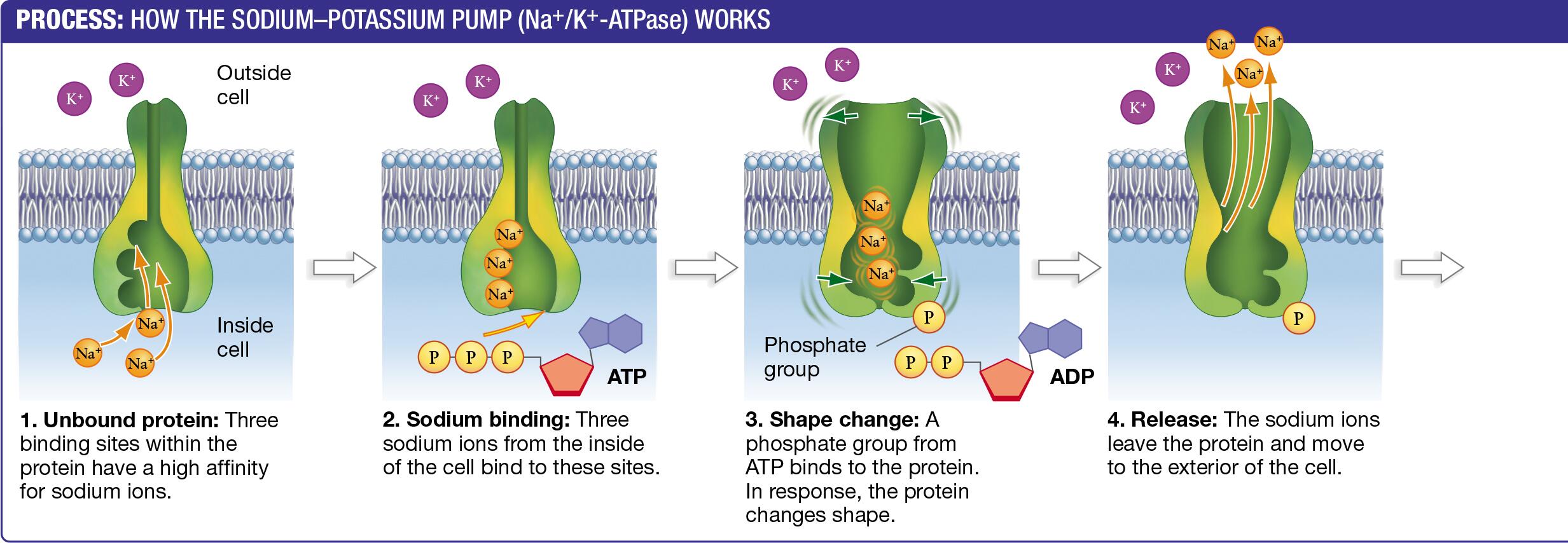
Sodium-Potassium Pump: a transmembrane protein that uses the energy of ATP to move sodium ions out of the cell and potassium ions into the cell, normally against their electrochemical gradients
1. When Na+/K+-ATPase is in the conformation shown here, binding sites with a high affinity with sodium ions are available.
2. Three sodium ions diffuse from the inside of the cell, bind to these sites, and activate the ATPase activity in the pump
3. A phosphate group from ATP is transferred to the pump. When the phosphate group attaches, the pump changes its shape in a way that opens the ion-binding pocket to the external environment and reduces the pump’s affinity for sodium ions.
4. The sodium ions exit the protein and diffuse to the exterior of the cell.
5. In this conformation, the pump has binding sites with a high affinity for potassium ions facing the external environment.
6. Two potassium ions from outside the cell bind to the pump
7. When the potassium is bound, the phosphate group is cleaved from the protein and its structure changes in response—back to the original shape with the ion-binding pocket facing the interior of the cell.
8. In this conformation, the pump has low affinity for potassium ions. The potassium ions exit the protein and diffuse into the interior of the cell. The cycle then repeats
Other types of pumps move protons (H+), calcium ions (Ca2+), or other ions or molecules across membranes in a directed manner, regardless of the existing gradient
cells can import and concentrate valuable nutrients and ions inside the cell despite their relatively low external concentration, expel molecules or ions, even when a gradient favors diffusion of these substances into the cell
Secondary Active Transport: transport of an ion or molecule in a defined direction made possible by the transport of another ion or molecule being moved along its gradient
Intracellular Environment
Biological membranes combine the selective permeability of the lipid bilayer and the specificity of proteins involved in passive and active transport
characteristics enable cells to create an internal environment that is much different from teh external one