Systematic Approach
System (FP Making of Powers) | Power - Central to IR - Power/ knowledge relationship National Attributes & FP - Size: Large states may be more active in FP & harder to defeat in war+ Small states constrained in what they can achieve - Natural Resources: availability/ scarcity can generate FP behaviours - Geography: access to water, land features, borders/ proximity to neighbouring states - Political System: distribution of political power, DEM peace thesis - Military Capabilities: defence $, hardware, manpower, innovation - Econ Capabilities & Interactions: globalisation, import/ export dependencies International Recognition - Membership of UN Security Council - Other IGO membership | Great Powers - States with large power capabilities & willingness to use when necessary - Hegemonic powers - E.g: US, China, Russia Middle Powers - Engage with int mediation, peacekeeping consensus building within int orgs - Form of self-identification - See themselves as protectors of int order -> based on states that are internally stable, peaceful, peaceful, externally cooperative - May be vulnerable to changes in GP relations - E.g: CAN, AUS, NOR Small Powers - Suffer from internal/ external legitimacy problems - May engage in clientelist relationships with GP: Patron-client - E.g: JORD, SYR | 1. Holistic Perspective - View of how int system influence state behaviour, role of power dynamics, alliances & institutions - Explains why states may side with powerful actors - E.g: CW, US/USSR FP influenced by bipolar structure 2. Predictive Power - Predict state behaviour based on distribution of power & systemic constraints - E.g: rise of China suggests potential conflict with US 3. Focus on Structural Constraints - How states’ actions constrained by global system’s structure - E.g: small states like FIN adopt neutral FP due to position in system dominated by GP 4. Explains Recurring Pattern - Recurring phenomena: security dilemma/ cycles of war + peace - E.g: Arms race between US + USSR= product of security dilemma | 1. Ignores Domestic Factors - Overlooks importance of dom pol, culture, leadership in shaping FP - E.g: US decision to invade Iraq can’t be explained fully by systemic factors alone-> dom considerations played critical role 2. Limited Agency for Individual Actors - Downplays role individual leaders & D-M - FP is often shaped by personalities, beliefs - E.g: Cuban Missile Crisis influenced by JFK & Khrushchev 3. Deterministic Approach - Suggests states have little choice but to act according to systemic pressures - E.g: offensive realism posits all states seek power maximisation, SWITZ does not 4. Inability to Explain Change - Can’t explain sudden shifts in int system - E.g: can’t explain collapse of USSR & unipolar US system that followed 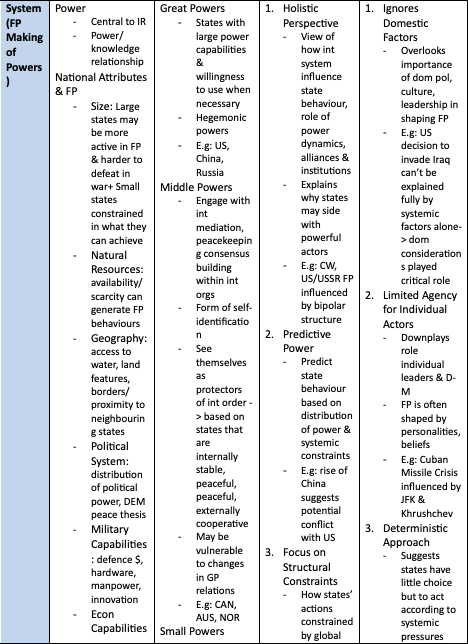 |