Summary Notes for Cellular respiration
Respiration
Aerobic respiration is by using a respiratory substrate to be broken down to produce ATP for cellular reactions like Active transport. It releases Co2 as waste whilst anaerobic respiration doesn’t use O2
Glycolysis is the first stage of both aerobic and anaerobic respiration so it doesn’t require oxygen and it occurs in the cytoplasm of the cell. Glucose is phosphorylation to produce 2 pyruvate, 4 ATP, 2 NADH but the net production of ATP is 2.
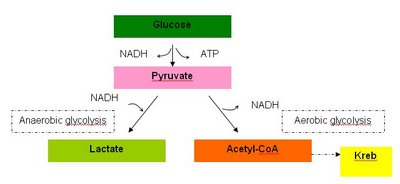
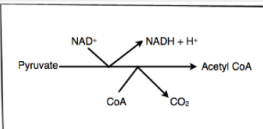
The Link reaction happens in the matrix of the mitochondria where pyruvate is converted into acetate then binds with a coenzyme CoA to form Acetyl CoA in this reaction 2 NAD are reduced and decarboxylation happen as pyruvate is decarboxylated
The Krebs cycle is also in the matrix of the mitochondria acetyl CoA combines with oxaloacetate to form citrate the cycle continues by removing hydrogen and carbon forming 2 FADH, 3 NADH and 1 ATP per turn of the cycle, the ATP is produced by substrate level phosphorylation
Oxidative phosphorylation
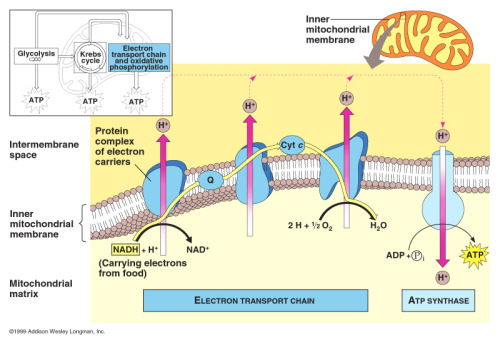 ATP is made by using an electron transport chain and is between the matrix and inter-membrane space
NADH and FADH are oxidased and release hydrogen ions and electrons into the matrix
Electrons go along the ETC losing energy to the proteins which allows Hydrogen ions in the Matrix to actively transport into the intermembrane space, in the intermembrane space there is a high concentration of H+ ions so they diffuse into the matrix by ATP synthase which creates ATP (Chemiosmosis)
Electrons reach the last protein and bind to oxygen which acts as the last electron acceptor and hydrogen to form water
Overall there is 38 ATP made excluding the active transport of pyruvate into the mitochondria and left over H+ Ions in oxidative phosphorylation
Respiratory substrates are molecules which can be broken down for respiration like carbohydrates proteins and lipids which each release different amounts of energy (C- 15, P- 17, L- 39) depending on the amount of hydrogens they have
The respiratory quotient (RQ) can be measured to determine which respiratory substrate is being used and to determine if the organism is undergoing anaerobic respiration.
RQ = carbon dioxide produced / oxygen consumed
Different respiratory substrates have different RQ values e.g. carbohydrates have a value of 1.0, lipids – 0.8 and proteins 0.9.
Anaerobic Respiration
This is when oxygen is not present, if can be lactate fermentation in mammals or ethanol fermentation in plants.
In mammals Pyruvate is converted into lactate by enzyme lactate dehydrogenase, NADH is oxidased by pyruvate being reduced this means glycolysis can happen again as NAD can take a hydrogen in glycolysis remaking 2 ATP.
Lactate can be converted into glucose by liver cells by gluconeogenesis as lactate is toxic for the body
Plant and yeast convert pyruvate into ethanal by removing a carbon and then to ethanol by removing a hydrogen this produces NAD for glycolysis and used two enzymes:
Pyruvate decarboxylase and ethanol dehydrogenase