Atomic chemistry
Atomic chemistry
What is a proton?
A proton is a positively charged subatomic particle that has a relative mass of 1 and is located in the nucleus of an atom.
What is a neutron?
A neutron is a subatomic particle that has a relative mass of 1 and is located inside the nucleus.
What is an electron?
An election is a negatively charged particle that has a relative mass of 1/1836 and is located on the outside of the nucleus in shells/electron cloud.
What is an isotope?
Isotopes are atoms of the same element with the same number of protons and electrons but different numbers of neutrons meaning an isotope has the same atomic number but a different atomic mass due to the change in neutrons. For example carbon-12 is an isotope of carbon-14 as they still have the same proton and electron count but different neutron count (atomic mass).
What is an atomic number?
An atomic number is the proton count of an element.
What is an atomic mass?
The atomic mass is the count of protons + neutrons together. The amount of protons in the atomic mass is the same as the atomic number.
So in a stable atom when there is 11 protons what will be the number of electrons? And why?
11 electrons because otherwise it would be unstable which would lead to a chemical reaction/exploding.
The electron count is the same as what in an element?
The electron count is the same as the proton count in a stable/neutral element.
What will happen if number of electrons only increase, while proton remain same? Why?
It becomes an unstable atom and the charge becomes negative because the electron count went up, overriding the proton count.
How an ion is formed?
An ion is formed during a chemical reaction when an element loses/gains electrons which changes the charge, making it an unstable ion. For example if an element was to lose electrons then it would become positively charged because the proton count overrides the electron count.
What happens to an atom when the neutron number is greater or smaller than normal (unstable)?
It becomes radioactive
Why are their chemical reactions similar?
The chemical reactions are similar because the electron count doesn’t change.
same proton count → same electron count → same chemical reactions.
What is radio active decay?
Radioactive decay is the random spontaneous nuclear change that makes the nucleas more stable and releases radiation
Why can a nucleus be unstable?
imbalance between protons and neutrons
Very large nucleus
Excess nuclear energy
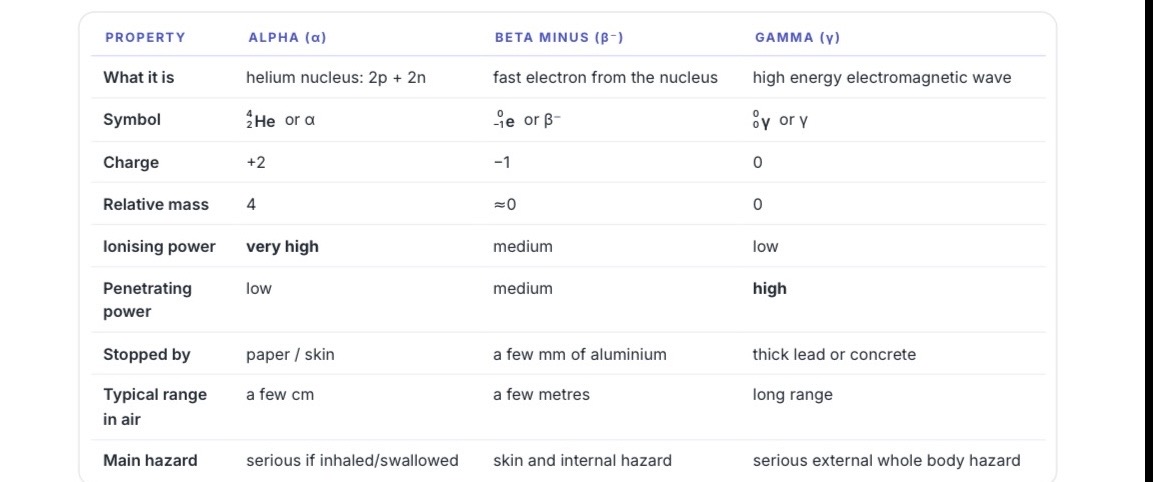
What is ionising radiation?
Ionising radiation is the product of energy release through radioactive decay that causes electrons to removed by surrounding atoms or molecules causing ions to form thereby cause cell and DNA damage which leads to mutation, cancer or cell death.
Nuclear equations
Alpha- mass number decreases by 4 and atomic number decreases by 2
238. 234. 4
U —> Th + He
92.. 90. 2
238. _ 4
U —> X + He
92.. _ 2
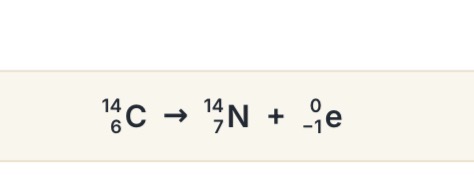
Beta- mass number stays the same but atomic number increases by 1 (new element)
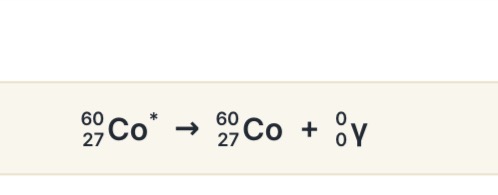
Gamma- mass number and atomic number stay the same
Half life
What is a half life?
A half life is the time taken for half the radioactive nuclei in a sample to decay.
Half life equation:
Remaining amount = initial amount × (½)n where n = time ÷ half life
Example:
Half life = 10 years; starting mass = 80 g; time = 30 years. Three half lives pass: 80 → 40 →
20 → 10 g. Answer: 10 g.
A sample has a half life of 6 years and a starting mass of 240 g. What mass remains after 18 years?
Half life: 6 years, starting mass: 240g, time: 18 years. Three half lives: 240g -> 120g -> 60g -> 30g
Answer: 30 g
Cobalt-60 has a half life of 5.27 years. Starting from 8.0 g, what mass remains after 21.08 years?
Half life: 5.27 years, starting mass: 8g, time: 21.08 years. 4 half lifes: 8g -> 4g -> 2g -> 1g -> 0.5
Answer: 0.5g
Q: Which type of radiation is a helium nucleus?
A: Alpha (α)
Q: Which type of radiation is a fast electron from the nucleus?
A: Beta minus (β⁻)
Q: Which type of radiation is a high-energy electromagnetic wave?
A: Gamma (γ)
Q: Which type of radiation has the highest ionising power?
A: Alpha (α)
Q: Which type of radiation has the highest penetrating power?
A: Gamma (γ)
Q: Which type of radiation is stopped by paper or skin?
A: Alpha (α)
Q: Which type of radiation is stopped by a few millimetres of aluminium?
A: Beta minus (β⁻)
Q: Which type of radiation is stopped by thick lead or concrete?
A: Gamma (γ)
Q: Which type of radiation has a charge of +2?
A: Alpha (α)
Q: Which type of radiation has a charge of −1?
A: Beta minus (β⁻)
Q: Which type of radiation has no charge?
A: Gamma (γ)
Q: Which type of radiation is the biggest internal hazard if inhaled or swallowed?
A: Alpha (α)