Final Head-to-Toe Assessment Script
BEFORE CHECKOFF: Be in uniform, use equipment properly, maintain professional communication and privacy, verbalize ALL findings, and maintain proper body mechanics. 12 minutes to complete.
Make sure you have your watch, stethoscope, and reflex hammer.
Knock before entering room.
Close door/curtain.
“Hi, my name is Emma. I will be your student nurse today.”
Wash hands (for 20 seconds) and clean stethoscope/reflex hammer.
Wash hands: Turn on the water, wet hands with water, apply soap, rub hands with 20 seconds, rinse hands, dry with paper towel, turn off water with new paper towel and throw away.
Hand sanitizer: Maintain wetness for 20 seconds
When to clean hands: as needed, such as when going from below the waist to above the waist, & wash hands after assessing patient completed
“Can you tell me you name and date of birth?” (Check armband against MAR)
“Today I will be doing a modified head-to-toe assessment on you.”
Ask yourself and verbalize: Is there are tubes, drains, IV fluids, or oxygen connected to the patient?
Get material ready at bedside (alcohol pads, hand sanitizer)
“Where are you right now? What time is it? What are we doing today"?”
“Patient is AAOx4”
“Are you in any pain today?” If so, ask, “Where is your pain located? When did this start? What makes it better? What makes it worse?”
“Are you experiencing any other symptoms?”
Assessment A (Cardiovascular)
Scenario: You completed a brief, general bedside assessment with vital
signs on your patient admitted with intermittent cardiac arrythmias and
left to check on another patient. You are returning to the room to perform a focused cardiovascular assessment.
“Skin color of head and neck is even and appropriate for ethnicity. Skin is the color _____ (if colored). Patient has _____ (What lesions? Macules, acne pustules?).”
“I am going to have you lay down. I am going to raise the head of the bed 45 degrees and pull out the extension table for your legs.”
Looking for: jugular vein distention (where the neck veins appear full)
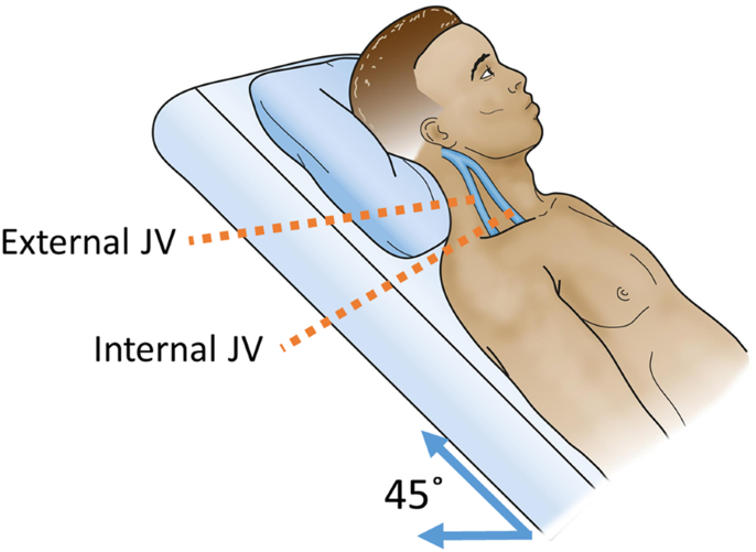
“Patient appears to have/not have jugular vein distention as jugular veins are/aren’t full.”
“I am going to touch the sides of your neck with my hands, is that okay?” ONLY TOUCH ONE CAROTID ARTERY AT A TIME!
“Carotid pulses are _____ (What grade?)”
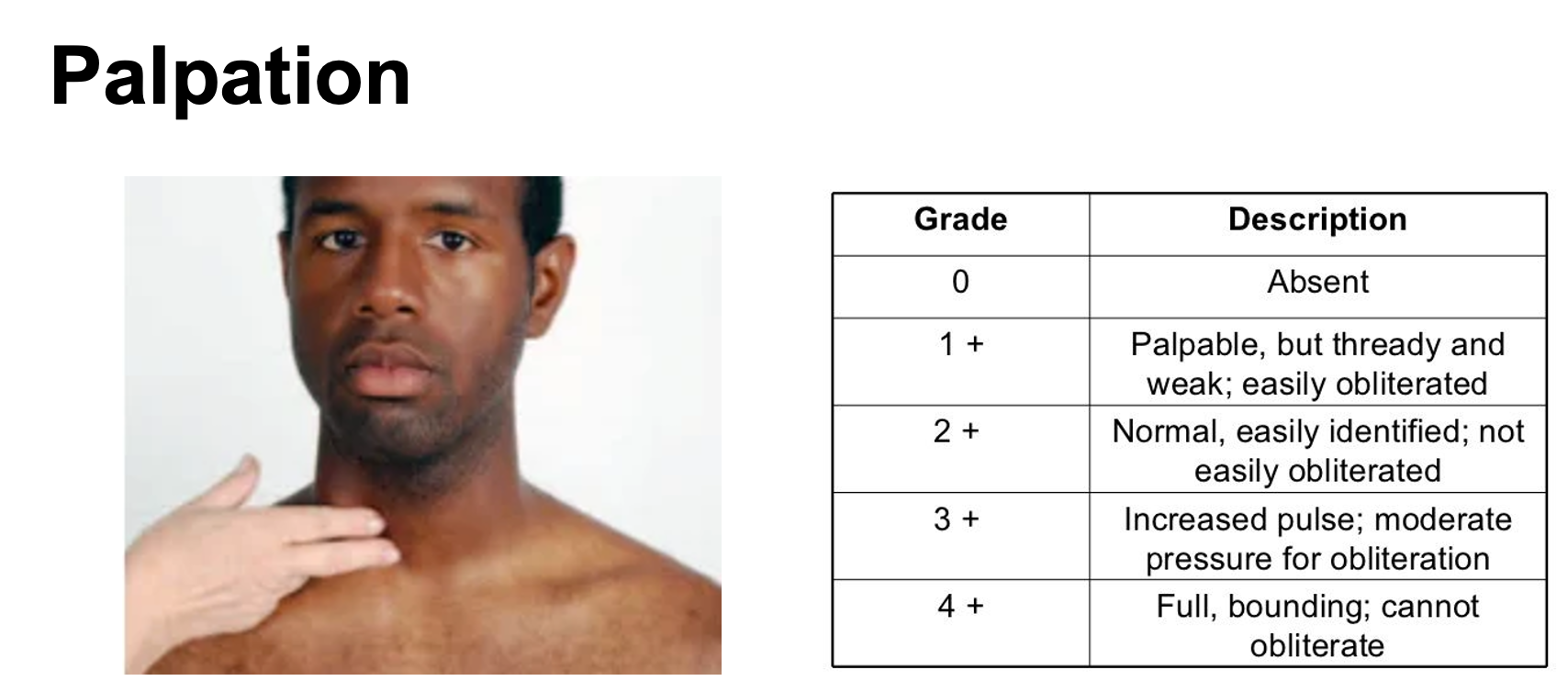
“Now, I am going to place my stethoscope on both sides of your neck. Please hold your breath while I do this. You may breathe in between when my stethoscope isn’t touching you.”
Use bell of stethoscope to auscultate patient carotid arteries on both sides of their neck.
“Patient has no bruits (NORMAL; bruits are a blowing, swishing sound indicating blood flow turbulence).”
—-
“Skin color of chest and back is even and appropriate for ethnicity. Skin is the color _____ (if colored). Patient has _____ (What lesions? Macules, acne pustules?).”
MAKE SURE PATIENT IS STILL IN A 45 DEGREE POSITION WITH LEGS EXTENDED.
“Precordium is free from heaves and moisture and has an AP to transverse ratio of 1:2.”
“Next, I am gong to feel for pulsations in your chest if that is okay with you.”
“Aortic, pulmonic, Erb’s point, tricuspid, and mitral/apical.”
“Patient has no pulsation felt on chest.” (if patient did… verbalize the grade of the pulse)
“Next I am going to listen to your heart sounds.”
USE DIAPHRAGM THEN BELL
“Aortic, pulmonic, Erb’s point, tricuspid, and mitral/apical.”
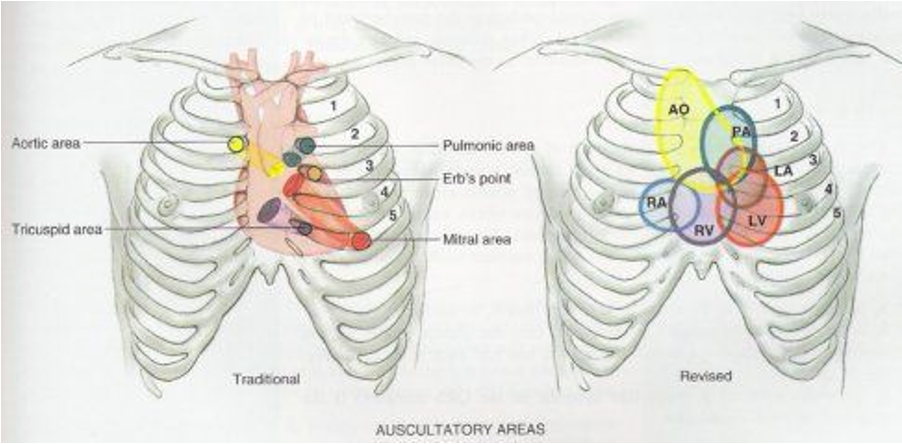
“Heart sounds are regular S1 and S2 with no murmur.”
—-
“Skin color of upper extremities is even and appropriate for ethnicity. Skin is the color _____ (if colored). Patient has _____ (What lesions? Macules, acne pustules?).”
“Next I am going to press on your forearms.”
“Patient has no edema in upper extremities.” (if patient did, grade the edema)
1+ → mild pitting, slight indentation, no perceptible swelling
2+ → moderate pitting, indentation subsides rapidly
3+ → deep pitting, indentation remains, leg looks swollen
4+ → very deep pitting, indentation lasts long time, leg very swollen
“I am going to feel for your pulses on your wrists and outer elbow if thats okay.”
PALPTE PULSES AT THE SAME TIME
“Patients radial pulse is _____ (grade), equal bilaterally.” Patients brachial pulse is _____ (grade), equal bilaterally.”
4+ → bounding
3+ → increased, full
2+ → normal
1+ → weak
0 → absent
“Next, I am going to press on your fingers at the same time.”
“Patients capillary refill returns in less than 3 seconds bilaterally.”
—-
“Can you bend each leg please?”
“Skin color of lower extremities is even and appropriate for ethnicity. Skin is the color _____ (if colored). Patient has _____ (What lesions? Macules, acne pustules?).”
“Next I am going to press on your lower legs.”
“Patient has no edema in lower extremities.” (if patient did, grade the edema)
1+ → mild pitting, slight indentation, no perceptible swelling
2+ → moderate pitting, indentation subsides rapidly
3+ → deep pitting, indentation remains, leg looks swollen
4+ → very deep pitting, indentation lasts long time, leg very swollen
“I am going to feel your pulses behind your knees and on your ankles and feet.”
PALPTE PULSES AT THE SAME TIME (EXCEPT POPLITEAL)
“Patients popliteal pulse is _____ (grade), equal bilaterally.” (if unable to find, note that). Patients posterior tibial pulse is _____ (grade), equal bilaterally.” Patients dorsalis pedis pulse is _____ (grade), equal bilaterally.”
4+ → bounding
3+ → increased, full
2+ → normal
1+ → weak
0 → absent
“Next, I am going to press on your toes at the same time.”
“Patients capillary refill returns in less than 3 seconds bilaterally.”
Assessment B (Thorax + Abdomen)
Scenerio: You completed a brief, general bedside assessment with vital
signs on your patient admitted with complaints of difficulty breathing
and vomiting. After leaving to check on another patient, you are
returning to the room to perform a focused thorax and abdominal
assessment.
“Skin color of thorax is even and appropriate for ethnicity. Skin is the color _____ (if colored). Patient has _____ (What lesions? Macules, acne pustules?).”
“Scapulae and vertebra is/isn’t straight and symmetrical.”
“The anterior, lateral, and posterior thorax has a 1:2 AP to transverse ratio, is symmetrical, and has no abnormalities.”
“Patient work of breathing is unlabored as there as no retractions, accessory muscle use, or nasal flaring.”
“i am going to feel the front, back, and side of your thorax. Let me know if you feel any pain.”
PALPATE POSTERIOR CHEST. “Take a deep breath for me.”
Posterior Chest:
Place hands on posterior chest wall with thumbs at level of T9 or T10
Slide hands medially to pinch up a small fold of skin between thumbs
Ask person to take deep breath
As person inhales, the thumbs should move apart symmetrically
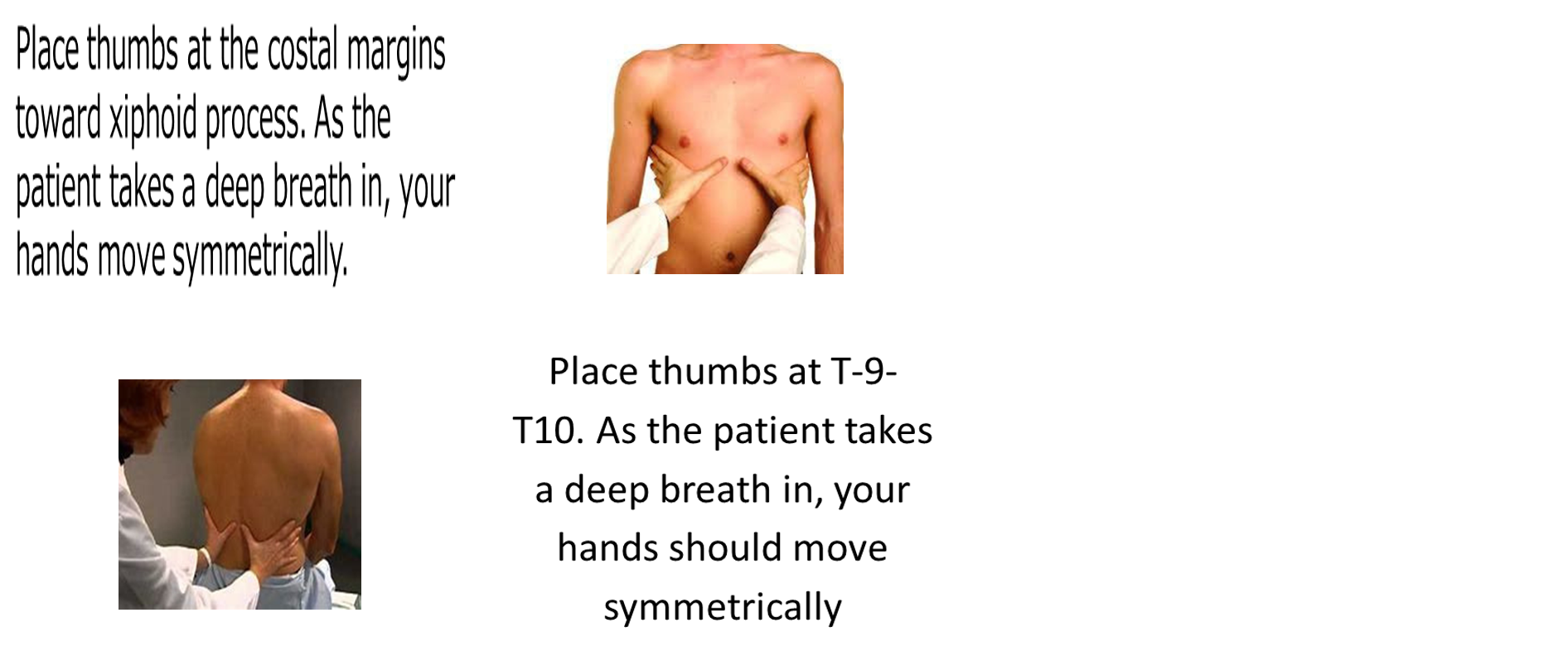
“Patient has no tenderness or masses on anterior, posterior, or lateral thorax. Skin is warm and dry to the touch. Thumbs moved symmetrically on the posterior thorax as the patient took a deep breath.”
“I am now going to listen to your breath sounds. Breathe slowly and deeply as I move my stethoscope across your front and back thorax.”
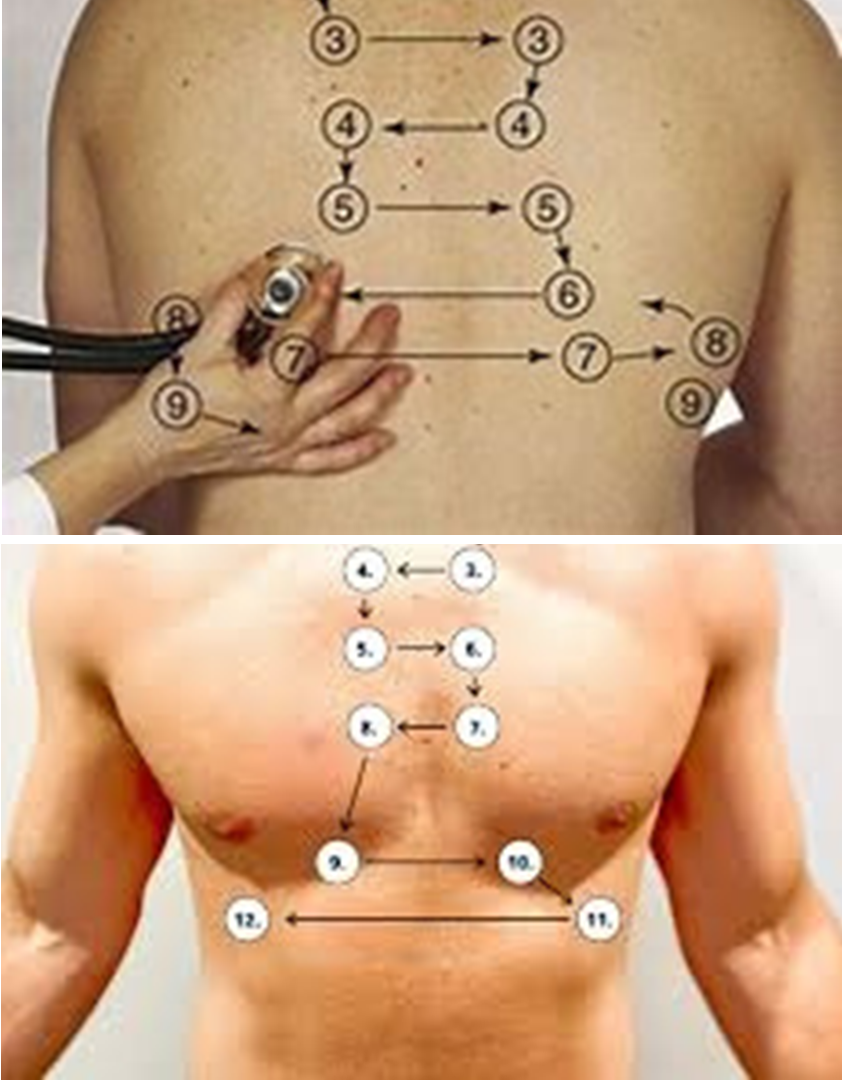
“Patients lungs sounds are clear across both lobes and not coarse, wheezes, absent, or decreased.”
—-
“I am going to have you lay down and I will pull out a table for you to place your legs on.”
“Patients abdomen is _____ (describe shape).”
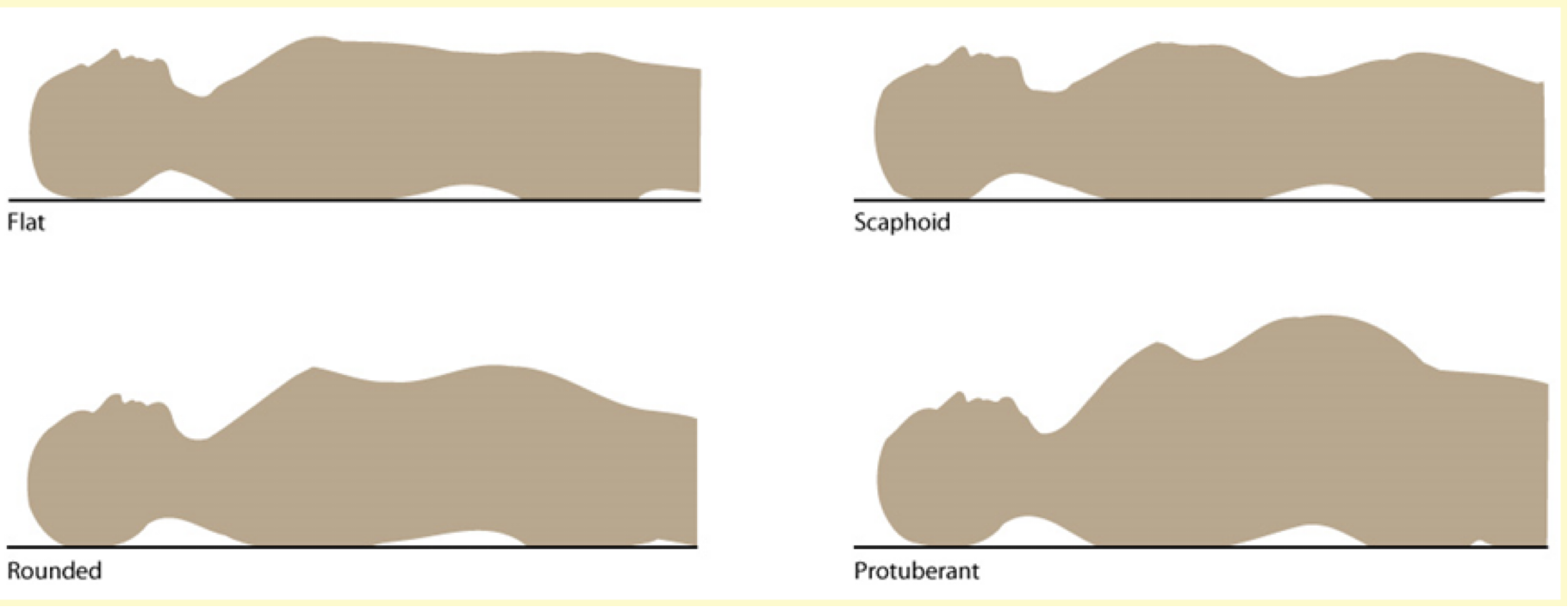
“Patient has no hernias. I can see the aortic pulsation in the epigastric region.”
“Skin color of abdomen is even and appropriate for ethnicity. Skin is the color _____ (if colored). Patient has _____ (What lesions? Macules, acne pustules?).”
“Umbilicus is… inverted/everted and midline with no drainage.”
“I am going to listen to your bowel sounds.”
START IN RLQ.
“Patient is normative/hyperactive/hypoactive across all four quadrants.”
“I am going to listen again.”
USE BELL OF STETHOSCOPE (ONLY AORTA, RENAL, AND ILIAC ARTERIES).
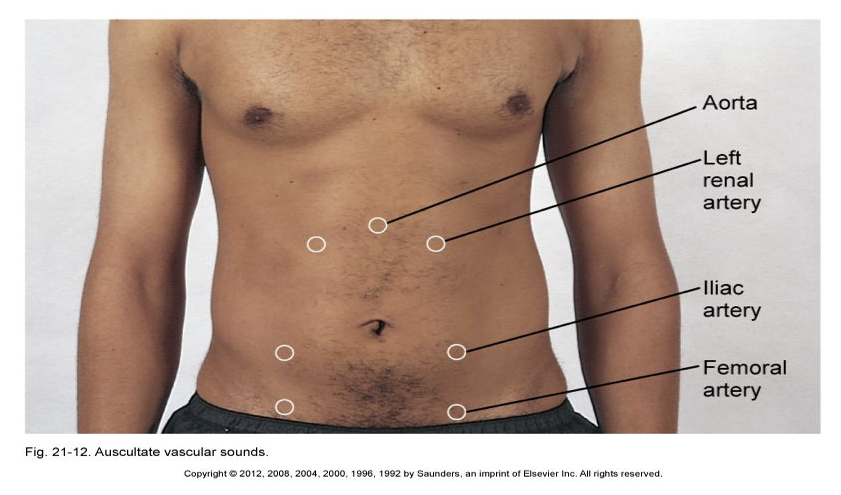
“Patient has no bruits across all four quadrants.”
“Next, I am going to feel your abdomen. Let me know if you feel ant pain.”
USE ONE HAND, CIRCULAR MOTION IN ALL 4 QUADRANTS
“Patient has no tenderness or masses across all four quadrants.”
Assessment C (Neuro)
Scenerio: You completed a brief general head to toe bedside assessment
with vital signs on your patient admitted with occasional mental
confusion. After leaving to check on another patient, you are returning to
the room to perform a neurological assessment.
“What did you eat for breakfast? (Recent memory) When is your birthday? (Remote memory)”
“Patient has intact recent and remote memory.”
“Can you smile, frown, close your eyes tightly, and puff out cheeks?
“Patient has facial symmetry and strong muscles as cranial nerve VII (facial nerve) is intact.”
“Next I am going to shine a light in each of eyes one at a time.”
Shine light on one eye
Shine light on one eye and observe other eye
Reverse to other eye
“Pupils constrict bilaterally both directly and consensually.”
“Focus on my finger.”
HOLD FINGER 3 INCHES AWAY FROM PATIENTS FACE AND MOVE FINGER TOWARDS THEIR NOSE. LOOKING FOR CONSTRICTION AND CONVERGENCE.
“Patients pupils are equal, round, reactive to light, and accommodation. Cranial nerve III (oculomotor) is intact.”
“Next I am going to press down on your shoulders and I am going to have you push up against my hands with your shoulders.”
“Can you move your chin to your chest like this?”
“Muscle strength is 5/5 equal bilaterally. Cranial nerve XI (accessory) is intact.”
“Next I will have you stick out your tongue.”
“Patient’s tongue is midline, meaning cranial nerve XII (hypoglossal) is intact.”
“Now, open your mouth and say “ah”.”
“Uvula is midline when “ah” is vocalized. Cranial nerve XI (accessory) and X (vagus) are intact.”
“Now, I will have you walk in a straight line here and back.”
“Gait is even and patient doesn’t loose balance.”
“Next I am going to use my reflex hammer, just relax as much as possible as you can.”
“First, I am going to assess your bicep reflex.”
Assesses the C5-C6 spinal level’
Place thumb over front of elbow (thumb will move)
“Bicep reflex is 2+ equal bilaterally, and biceps contracts and forearm flexes.”
“Next, I am going to asses your triceps reflex.”
Assesses the C6-C7 spinal level
Place pt arm in yours, hit back of arm
“Tricep reflex is 2+ equal bilaterally, and triceps contracts and forearm extends.”
“Next, I am going to asses your brachioradialis reflex.”
Assesses the C5-C6 spinal level
Strike about 2-3cm above the radial styloid process to elicit this reflex
Notch in front of thumb move up an inch (where watch band is) - hand will move
“Brachioradialis reflex is 2+ equal bilaterally, and forearm flexes and supinates.”
“Next, I am going to assess your patellar reflex.”
Assesses L2-L4 spinal level
Hit on front of knee, below knee cap
If can’t get, ask pt to hold hands and pull apart
“Patellar reflex is 2+ equal bilaterally, and lower leg extends.”
“Next, I am going to assess your achilles reflex.”
Assesses L5-S2 spinal level
Lay pt on table feet out straight, pull foot up, hit back on ankle, foot should go down
“Achilles reflex is 2+ equal bilaterally, and feet plantar flex.”
“Next, I am going to assess your planter reflex.”
Assesses the L4-S2 spinal level
When an upside down J is stroked across the lateral sole of the foot and across the ball of the foot
Make upside down J starting at heel moving towards toes
“Planter reflex is 2+ equal bilaterally, and feet plantar flex and toes curl in.”
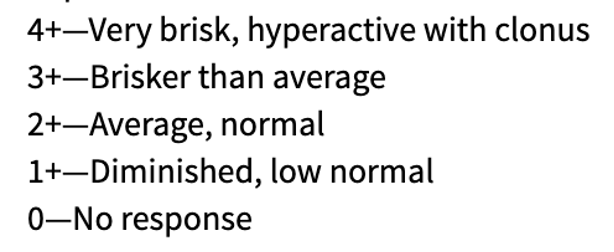
“Next, I am going to assess you clonus response. Relax as I let your feet go.”
LOOKING FOR SHAKING (ABNORMAL).
“Clonus response is absence as there is no muscle contractions seen.”
“Now, squeeze my hands are hard as you can.”
CROSS HANDS, GIVE PATIENTS TWO FINGERS.
“Patients strength of hands is 5/5 and equal bilaterally.”
“Lastly, push your feet up as best as you can as I press down.”
“Patients strength of feet is 5/5 and equal bilaterally.”
Conclusion
WASH HANDS.
“Thank you for your time. Is there anything else I can do for you?”
*Must score 75/100 to pass assessment