2.7 Satellite Motion and Kepler's Third Law
Satellites
- any objects that orbits another
- nautral (moon oribiting a planet, a planet orbiting a start)
- artificial (used for communication, weather forecasting, navigation, survelliance, expoliration, research)
Newton’s experiment
- at a certain velocity, a cannon will go all the way around the Earth and return to its orginial position
- ignore air resistance and get cannon out of the way
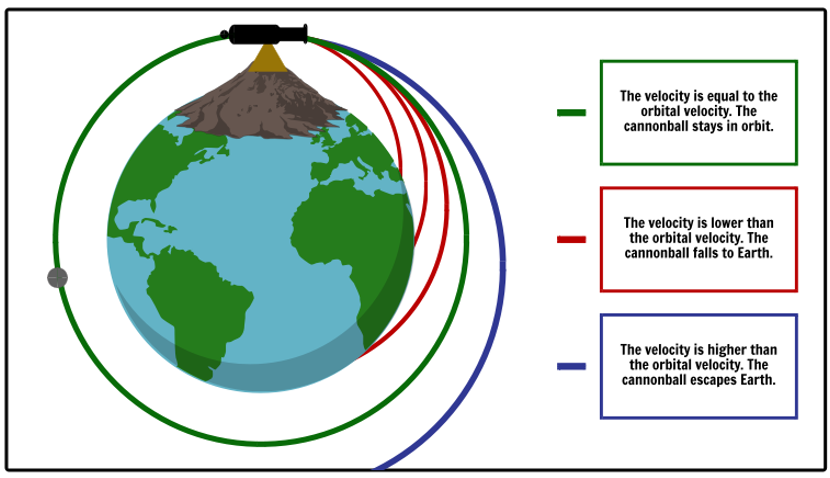
- satellites are constantly falling
Satellite Motion
- mass doesn’t affect speed
- air resistance prevents satellites from orbiting Earth within its atmosphere
- yet away from the atmosphere, any object at the right altitude and with the right velocity will orbit the Earth as long as the speed stays constant
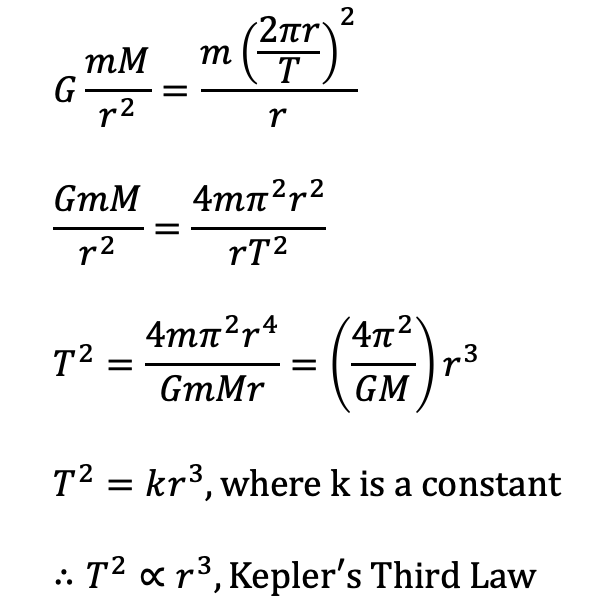
- gravity acts a centripetal force
Satellite Types
- Orbits can be classified according to their altitude
- Low Earth orbit (LEO): 160-1000 km: used for ISS, satellite imaging, communicaitons
- Geosynchronous orbit (GSO): 37,786 km: orbital period of exactly one day (24 hours) - time period - orbits same speed the Earth rotates
- Geosynchronous equatorial orbit (GEO) aka geostaniary orbit: a GSO above the equator, resulting in a satellite that satys above a certain point on the Earth’s surface
- Medium Earth orbit (MEO)