Topic 3 waves
The basics
All waves have diffrent properties
Wavelengths is the distance from one peak to the next
Frequency is how many complete waves there are per second passing a certain per its measured in Hz
Amplitude is the height of the wave from the rest to the crest
The speed for velocity is how fast the wave goes
The period is the time it takes for one complete wave to pass a point
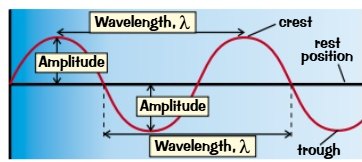

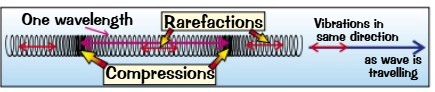
Waves can be transverse or longitudinal
Transvers waves |
|
Longitudinal waves |
|

Waves carry and transfer energy in their direction, like microwaves heating food and sound waves causing vibrations. They also transmit information, as seen with light in optical fibers and radio waves in the air.
Wave behavior and EM waves
Two or more waves moving togther have a wavefronts
Waves approaching an obstacle can be described using wavefronts, which are imaginary planes connecting points on adjacent waves that vibrate together. The distance between wavefronts equals one wavelength, indicating the same point in the cycle.
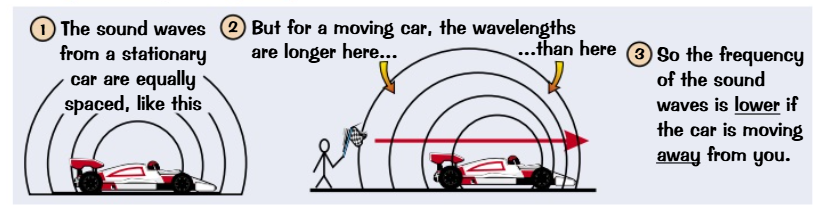
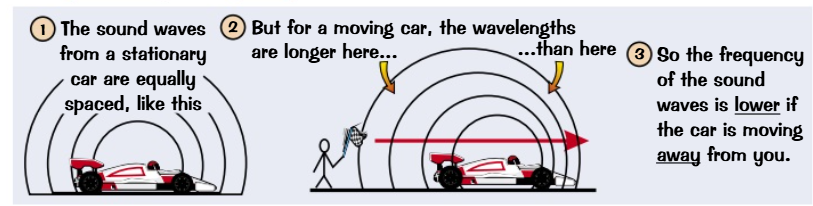
The doppler effect makes waves longer or shorter
Moving sources produce waves with different wavelengths than stationary sources.
If a source moves toward an observer, wavefronts bunch up, increasing frequency and shortening wavelength.
If a source moves away, frequency decreases and wavelength lengthens.
The faster a wave is moving away from you the longer its wavelength will be
There are seven types of electromagnetic EM waves
Electromagnetic waves with diffrent wavelengths have diffrent properties they’re grouped seven types
All types of Em radiation are transvers waves and travel at the same speed through free space
The diffrent colors of visible lights depend on the wavelengths red has the longest violet has the shortest.
Uses of electromagnetic waves
Radio waves
Radio waves have wavelengths longer than 10 cm.
Long-wave radio (1–10 km) can bend around the Earth.
Short-wave radio (10 m–100 m) reflects off the ionosphere for long-distance transmission.
TV and FM radio use shorter wavelengths; direct line of sight to the transmitter is required.
Microwave
Microwaves have a wavelength of about 1–10 cm and can be used for communication.
Satellite communication (e.g., TV and phones) uses microwaves.
For satellite TV, signals are transmitted to a satellite, which relays them to Earth.
Mobile phone calls also use microwaves to reach the nearest transmitter.
Microwaves are used for cooking; they penetrate food and are absorbed by water molecules, transferring energy.
Infra-red
Infrared radiation (IR) is also known as heat radiation; used by heaters for warmth and grills for cooking.
All objects emit IR; hotter objects give off more IR.
IR can be detected in the dark using night-vision equipment, which converts it into an electrical signal displayed on a screen.
Light signals
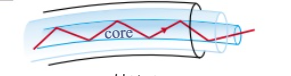
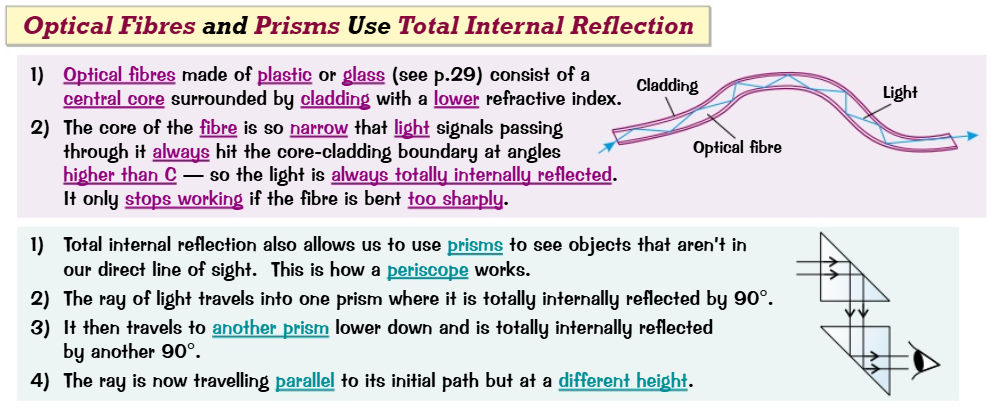
Visible light can be used to look at things and for communication via optical fibers, transmitting data as pulses of light.
Light enters the fiber at a certain angle, reflecting back and forth until it exits at the other end.
Optical fibers are used for telephone and broadband internet cables and for medical purposes to "see inside" the body without surgery.
Visible light
Photography relies on visible light; without it, capturing images would be difficult.
Cameras use a lens to focus visible light onto a light-sensitive film or sensor.
The aperture controls the amount of light entering the camera.
Shutter speed determines how long the film or sensor is exposed to light.
By adjusting the aperture and shutter speed, photographers can control light exposure in their images.
Ultraviolet
Fluorescence occurs in certain chemicals, emitting visible light when exposed to ultraviolet (UV) radiation.
Fluorescent lights use UV radiation to produce visible light, absorbing nearly all UV radiation with a special coating inside the glass.
Fluorescent lamps are more energy-efficient than traditional filament bulbs.
X-Rays
X-rays reveal the internal structure of objects and materials, making them useful in medicine.
X-rays are directed through an object onto a detector plate, creating a negative image where brighter areas indicate fewer X-rays.
Radiographers use X-ray images to diagnose conditions, as X-rays pass through flesh but not through denser materials like bones.
Exposure to X-rays can cause mutations leading to cancer, so protective measures like lead aprons and shields are used to minimize radiation.
Gamma
Gamma rays are used to sterilize medical equipment by killing all microbes, avoiding damage from high temperatures.
Food can also be sterilized similarly, eliminating microbes and keeping it fresh longer without freezing or cooking.
Sterilized food is not radioactive afterward, making it safe to eat.
Dangers of electromagnetic waves
Some Em radiation can be harmful to people
Some em radiation can past through soft tissues
Other tyes are absorbed and cause heating of cells
Some racdiation can cause cancerous changes in living cells
Higher radiation is usually more dangerous
Microwaves have a similar frequency to molecular vibrations, generating internal heat in substances, including human tissue.
Infrared radiation excites molecules, causing heat. Higher frequencies provide more energy, which can harm human skin.
Ultraviolet (UV) radiation can damage cells and cause blindness; it can also lead to skin conditions through ionization.
Gamma rays have high frequencies and are more damaging, causing cell mutation and tissue damage; precautions are necessary to limit exposure.
Reflections and refraction of waves
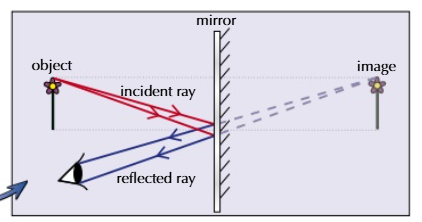
Reflection of light is essential for vision, as it enables us to see objects when visible light bounces off their surfaces.
Light reflecting off an uneven surface scatters, resulting in a diffuse reflection, while smooth surfaces create a clear and defined reflection.
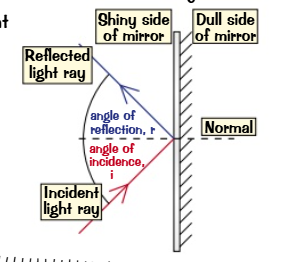
The principle of reflection states that the angle of incidence (the angle at which light strikes a surface) is equal to the angle of reflection (the angle at which light leaves the surface).
In the context of mirrors, virtual images are formed when light rays diverge, giving the illusion of an image appearing behind the mirror. This phenomenon is particularly evident in plane mirrors, which create a mirror image of the object in front of them.
waves can be refracted
Waves trabel at diffrent speeds in substances which have diffrent densites. EM waves travel more slowly in denser media. Sound waves travel faster in denser substances though
So when a wave crosses a boundary between two substances from glass to air, say it changes speed
More about refraction of waves
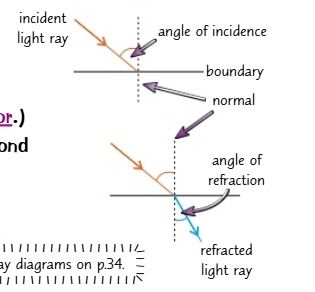
Draw a ray diagram for a refracted wave
Draw the boundary between two materials, indicating the normal line at a 90-degree angle to the boundary.
Draw an incident ray that meets the boundary at a specific angle of incidence.
Label the angles: identify the angle between the incident ray and the normal.
On the opposite side of the boundary, draw the refracted ray. The angle of refraction will depend on the second material's properties.
If the second material is less dense than the first, the angle of refraction will be larger than the angle of incidence.
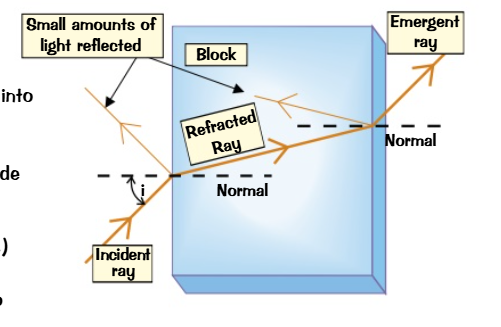
Practical glass block
Setup: Place the block on paper and draw the boundary.
Shine a light ray at an angle into the block; note the reflected and refracted light.
Trace the rays: Draw the incident ray entering and the emergent ray exiting the block.
Light slows down in the denser medium (the block) and bends towards the normal. When exiting to a less dense medium, it speeds up and bends away from the normal.
The emergent ray should be parallel to the incident ray, showing the direction of light after passing through the block.
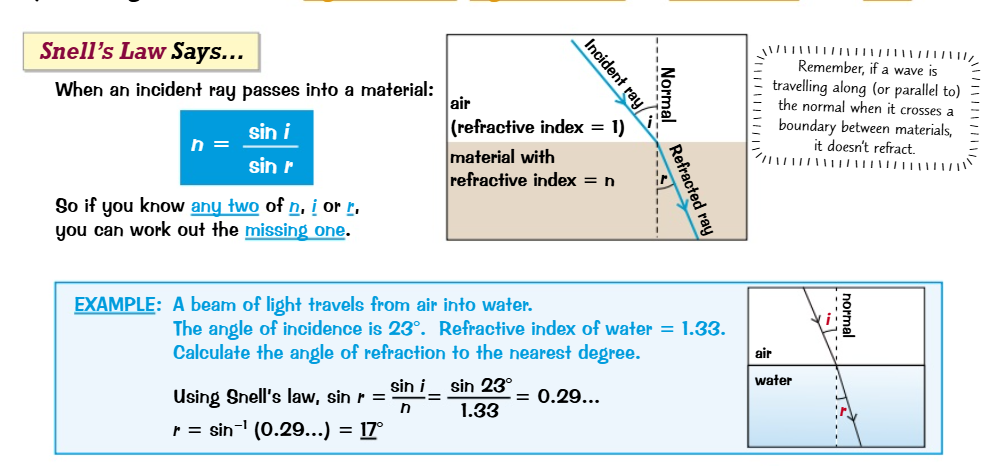
Refractive index and snell’s law
The refractive index of a transparent material tells you how fast light travels in the material

Light slows down a lot in glass so the refractive index of glass is high. The refractive index in water is a bit lower.
The speed of light in air is about the same as in a vaccum.
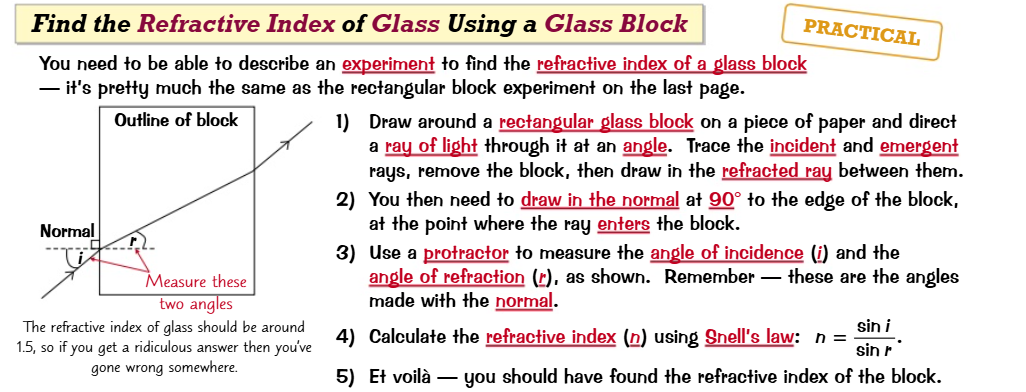
Practical find refractive index
Critical angles
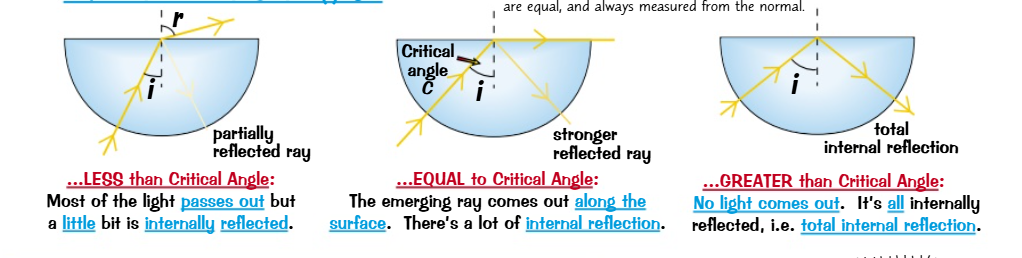
Light transitioning from a material with a higher refractive index to one with a lower index speeds up and bends away from the normal, following Snell's Law.
When light reaches a critical angle (90 degrees), it reflects entirely at the boundary.
Below this angle, some light refracts, while above it, total internal reflection occurs.
To investigate this, use a semicircular block: aim the incident light ray at the curved edge to maintain a consistent angle.
Record the angles of incidence and refraction in a table to analyze the relationship.
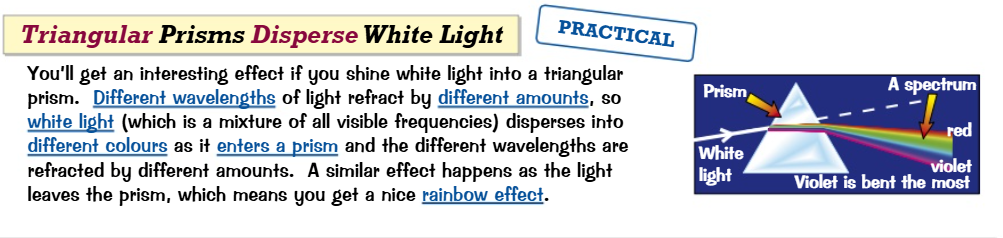
Optical fibers and prisims
Sound waves
Sound waves are longitudinal waves
The human ear can detect sounds between 20 Hz and 20,000 Hz; higher frequencies may be inaudible.
Sound travels faster in denser materials and can even move through a vacuum where there are no particles.
Sound waves reflect off surfaces, such as carpets and curtains, which absorb sound rather than reflecting it.
Sound also refracts when passing through different media, altering its speed and direction in the process.
An oscilloscope can display sound waves
Loudness increases with amplitude: the greater the amplitude of a wave, the more energy it carries, making the sound louder.
Frequency refers to the number of vibrations per second, measured in Hertz (Hz). Higher frequency sounds have a higher pitch, while lower frequencies produce lower pitches.
You can compare sound frequencies on an oscilloscope by analyzing the waveforms displayed.
Tracing these waveforms helps visualize the differences in loudness and pitch, illustrating how sound varies based on amplitude and frequency.