PR 2 QUIZ
QUALITIES OF QUANTITATIVE RESEARCH
Quantitative Research
Deals with numerical values and how they can describe a phenomenon or infer a relationship.
It is the go-to approach for scientific inquiry because of its ability to test hypotheses.
The basis of formulating and testing hypotheses are variables,
which are traits that numerically describe or give meaning to an object, phenomenon, group of people.
Variables
are the ones that are usually identified, examined, described, or correlated to answer a scientific inquiry.
TYPES OF VARIABLES
INDEPENDENT VARIABLE
is the variable that is manipulated, especially in experiments.
DEPENDENT VARIABLE
Depends on the independent variable.
The results or the outcome
CHARACTERISTICS OF QUANTITATIVE RESEARCH (C.G.O.R)
Controllability
Quantitative research should be in an environment where all variables are identified and can be controlled.
Generalizability
Generalizability is from larger sample sizes that the results are based on as a representative of the population.
Objectivity
The results of the data are observable and measurable using structured instruments.
Replicability
The research study should be replicable by other teams of researchers that will eventually come up with similar outcomes.
STRENGTHS OF QUANTITATIVE RESEARCH
Analysis of data is assisted with statistical methods.
Large-scale research can be undertaken.
Data can be presented in graphical or tabular form.
WEAKNESSES OF QUANTITATIVE RESEARCH
A large sample size requires a lot of time and effort.
Statistical analysis of data requires an expert to perform.
Quantifying and reducing observations to numerical values makes it too simplistic.
QUANTITATIVE RESEARCH HAS ITS STRENGTHS AND WEAKNESSES. IT IS IMPORTANT THAT WE ARE AWARE OF BOTH. (#f6ef86)
TYPES OF QUANTITATIVE RESEARCH
Quantitative research may be either experimental or nonexperimental.
Experimental
True experimental research (random samples)
The primary objective of a true experimental research design is to identify a cause-effect relationship between the variables where the samples are randomized.
Example:
To find out if sunlight affects the growth of plants, we have three setups:
Set A is to grow a seed that will receive ample amount of sunlight.
Set B is a seed that will be placed where sunlight is limited.
Set C is a seed that will be placed completely in the dark.
All of the will be planted in the same type of soil and will be given equal amounts of water, and the results will be recorded after days of observation.
Nonexperimental (D.CM.CR.Q)
Descriptive research (descriptive of factor, variables, or phenomena)
A nonexperimental research design focuses on the description of factors, variables, or phenomena that occur in nature.
Example:
To identify the factors that contribute to the spoilage of food, a survey is conducted to know about food spoilage.
You can use descriptive statistics (mean, median, or mode) in the survey.
From the result of that survey conducted, for example, you observed that the frequency for temperature as a factor is the highest. This means that temperature contributes to food spoilage the most.
Comparative research (comparison for difference)
Also called causal-competitive research, its primary objective is to compare two variables in order to identify whether there exists a causative relationship between them.
This kind of research usually involves two or more groups and one independent variable.
Example:
You want to know if attendance to the school’s summer program is the cause of students’ increased class participation.
You identified two groups of students who enrolled in the summer program and those who did not.
You collected data on their individual class participation.
After analyzing the data, you concluded that the summer program helped the students in participating more in class.
Correlational Research (identify relationship)
Its primary objective is to compare two variables then identify the relationship between them.
Example:
You want to know if there is a significant relationship between the length of sleep and student productivity.
Data on length of sleep is based on the bedtime and waking up time of the students.
Data on student productivity is based on the number of activities being finished everyday.
Data analysis shows that the closer the length of sleep to eight hours, the higher the number of activities done.
You concluded that there exists a direct relationship between the length of sleep and student productivity.
Quasi-experimental research (assigned samples)
mirrors experimental research but it is not true experimental research where a causal relationship can be determined with the use of dependent and independent variables.
It does not use random samples but ASSIGNED SAMPLES.
Example:
You wish to know the effect of height on milk brand preference.
True experiments would have to randomly assign respondents to groups where they would be subjected to taste tests in order to know which brand they prefer.
Because height is an innate characteristic of a person, respondents cannot be randomly assigned to groups.
Instead, group respondents are assigned groups based on their heights.
The experimental and nonexperimental types of quantitative research depend on the topic and the nature of the problem being investigated.
The word effect is indicative that the research study aims to understand a cause and effect relationship attributed to comparative, experimental, or quasi-experimental research.
The word relationship or correlation is a clue that the research study is either comparative or a correlational study.
Quantitative research tests hypotheses, which are based on variables that can either be independent or dependent.
Quantitative research may be experimental (true experimental) or nonexperimental (descriptive, comparative, correlational, and quasi-experimental).
DEVELOPING A RESEARCH PROBLEM
Statement of the Problem
An integrative but brief discussion of the research problem, its context, and the questions of the study.
MAIN GOAL: (#d83737)
PROVIDE A CONCISE OVERVIEW of the topic in relation to the research questions.
The Process:
GENERAL STATEMENT OF THE PROBLEM → SPECIFIC RESEARCH QUESTIONS → ADDRESS THE RESEARCH PROBLEM
Research Questions
Identifies the specific aspects of the topic that the current study seeks to investigate.
MAIN GOAL:
Continuously guide the researcher throughout the research process.
WRITING A RESEARCH STATEMENT: CATEGORIES OF RESEARCH QUESTIONS (D.C.E/V.E/X)
SUMMARY:
Descriptive = What is/What are?
Comparative = What is the difference?
Evaluative = How good/effective/satisfactory?
Explanatory = Why/How does X affect Y?
Descriptive
Nature of Questions:
What are the characteristics or descriptions of the variables?
Examples:
How frequent is the production of essential oils for herbal medicines?
What criteria are considered by customers in choosing a store?
Comparative
Nature of Questions:
What are the similarities or differences between the variables
Examples:
What is the difference between the quality of natural and synthetic ink?
How do Gen Z and millennials differ in terms of dating attitudes?
Evaluative
Nature of Questions:
What is the current state of a certain phenomenon?
How do we assess the phenomenon?
Examples:
How satisfied are you with the implementation of the K-12 curriculum?
Did the art therapy program work for the patients with post-traumatic stress disorder?
Explanatory
Nature of Questions:
What are the effects of one variable on the other?
What changes can be produced in the relationship between the variables?
Examples:
How does nurse intervention affect a patient’s pre-surgery stress level?
How does employment tenure contribute to the productivity of workers?
DRILL:
What are the reasons given for the absences from work among information technology workers
Evaluative Question
Descriptive Question
Explanatory Question
Do the subjects young people study at school differentially increase the probability of higher chance of employment?
Comparative Question
Explanatory Question
Evaluative Question
What are the differences in attitudes towards online banking between millennial adults and older people?
Descriptive Question
Comparative Question
Explanatory Question
WRITING A RESEARCH STATEMENT: CHARACTERISTICS OF GOOD RESEARCH QUESTIONS
RESP CAM:
RE-LEVANT
SP-ECIFIC
C-LEAR
A-NALYTICAL
M-EASURABLE
WRITING A RESEARCH STATEMENT: WRITING THE RESEARCH STATEMENT
Finalize the Research Topic!
Identifies the specific aspects of the topic that the current study seeks to investigate.
Example:
Terumi needs help in writing her Research questions.
She is interested about the effect of Facebook photo ‘likes’ and self-esteem of Female Senior High School Students in Statefields School.
INDEPENDENT: Facebook photo ‘likes’
DEPENDENT: Self-esteem
Write the General Problem Statement
The general problem statement helps the authors establish the overall goal and direction of the research.
Example:
This study aims to find out the effect of Facebook photo ‘likes’ on the level of self-esteem of female senior high school students in Statefields School.
Draft the Research Questions
Draft the research questions that reflect the aspects of topic, which the current study seeks to investigate.
Example:
Explanatory: How do Facebook photo ‘likes’ affect the self-esteem of female students
Descriptive: What are the factors that affect the number of facebook photo ‘likes’?
Refine the Statement of the Problem
Incorporate the research questions and the potential contributions of the study to the refined statements of the problem.
Sample:
This study aims to find out the effect of Facebook photo ‘likes’ on the level of self-esteem of female senior high school students in Statefields School. Specifically, this study investigates the factors that influence the number of Facebook photo ‘likes’ and its respective impact on the self-esteem of teenagers, especially female adolescents. An explanatory study on the relationship between Facebook photo ‘likes’ and the self-esteem of teenagers can potentially inform the public about the possible gains and dangers of social media activities on self-perceptions of adolescents.
The Process:
Finalize the Topic → Write the General Problem Statement. → Write the Research Questions → Refine the Statement of the Problem`
CONSTRUCT A RESEARCH FRAMEWORK (CONCEPTUAL & THEORETICAL FRAMEWORK)
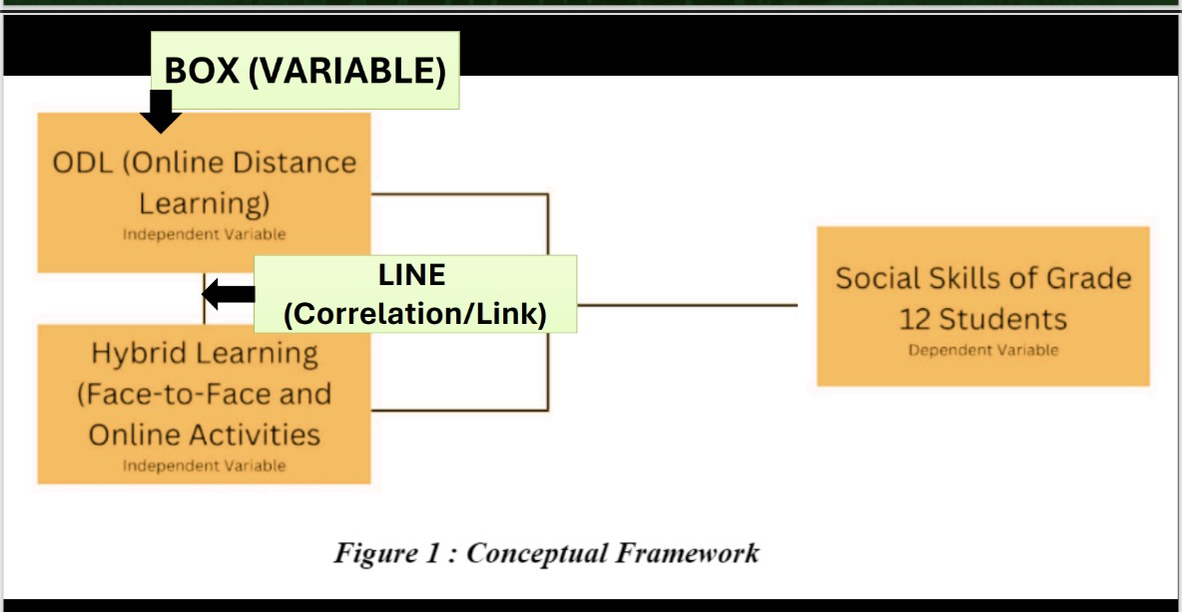
Conceptual Framework
Illustrates how a research problem will be investigated.
It uses depicted using visual guides to represent the main idea of the study.
Explains the relationships and connections of concepts, and the means of exploring the problem.
Example:
“The Relationship of Chronotypes and Academic Performance of Statefields School Grade 12 Students” (Dollentas et al., 2022)


Theoretical Framework
A theoretical framework pertains to the theory where the researcher based their study. (Imenda. 2004).
Theories help the research understand the phenomenon under study.
Example:
“Analysis on the Relationship between Media Representation of LGBTQIA+ and Self Conceptualization of Adolescent of LGBTQIA+ Members ages 13-21 years old” (Abiño et al., 2022)

THEORETICAL
Presents a general or wide scope of the study;
Adapted from established and existing theories from literature;
Applies a certain theory
Broad application and may extend from a certain study or research problem
Evaluates theories and may extend from a certain study or research problem
CONCEPTUAL
Pertains to more specific or narrower concepts related to the study
Constructed when existing theories are insufficient in explaining the study.
Integrates concepts and ideas gathered from different sources.
Restricted to a certain study or research problem
promotes the development of a theory that can be beneficial to researchers studying the same area of interest.
CONSTRUCTING A CONCEPTUAL FRAMEWORK
Example:
“Perception of SSI Grade 12 Students in relation to their Social Skills during Full Online Distance Learning vs Hybrid Learning” Panerio et al. (2022)
“The Effect of Reward System on the Level of Competitiveness of Senior High School Students of SSI” Caisido et al. (2022)

STEPS:
Finalize the research topic.
Conduct a literature review.
Decide which variables are to be investigated.
Construct the Conceptual Framework.
Definition of Terms
The researcher defines terms in research to set boundaries on how specific terms are going to be used in the study.
TYPES OF DEFINITION
Conceptual Definition
Easily described as the definition found in the dictionary.
NOT SPECIFIC ENOUGH to qualify for research purposes
Operational Definition
How a concept was used or measured in a particular study
Important for researcher to replicate other studies.
LET’S EXAMINE:
“The Effect of Reward System on the Level of Competitiveness of Senior High School Students of SSI” Caisido et. Al. (2022)

Note:
Avoid defining terms by merely repeating the word
Simple and familiar words are preferred in defining terms
Terms defined should be arranged alphabetically
ACRONYMS should be spelled out completely.
CONSTRUCTING A RESEARCH FRAMEWORK (RESEARCH HYPOTHESIS)
Research Hypothesis
An ASSUMPTION about the variables being explored in the study.
The assumptions you will be formulating should be tested by gathering relevant data and analyzing the results
VITAL FEATURES:
It is a tentative proposition. (Testable statement)
Its validity is unknown.
In most cases, it specifies a relationship between two or more variables.
CHARACTERISTICS: RESEARCH HYPOTHESIS
It should be falsifiable
It should be capable of being disproved, given the results of the study.
It should be predictable.
Must be able to predict relationships among two or more variables.
It should be simple and specific.
Must test only one assumption at a time.
It should be based on an existing body of knowledge.
Should be able to address a research gap in the existing body of knowledge or theories that are already established.
It should be capable of being operationally defined.
It should be capable of being measured.
It should be reflective of the research problem.
The argument and interest of the study must be clearly expressed in the research hypothesis.
TYPES OF RESEARCH HYPOTHESES
Null Hypothesis (H0)
An assumption wherein there is no difference or no relationship between the dependent and independent variables.
Alternative (H1)
Indicates a change in direction
There is a difference or relationship between the variables being investigated.
If the result is significant → reject the null hypothesis
If the result is not significant → retain the null hypothesis
Example:
Null Hypothesis
There is no relationship between weight loss and diet Program A.
There is no difference between anxiety and stress levels under Therapy B.
There is no relationship between brand image and sales.
Alternative Hypothesis:
There is a relationship between weight loss and diet program A.
There is a difference between anxiety and stress levels under Therapy B.
There is a relationship between brand image and sales.
Example:
Title: Study Habits and Academic Performance of Grade 12 Students
Null Hypothesis
There is no significant relationship between study habits and academic performance among Grade 12 students.
Alternative Hypothesis
There is a significant relationship between study habits and academic performance among Grade 12 students.
APPLIES TO ALTERNATIVE HYPOTHESIS
Non-directional hypothesis (General)
Used if you believe that the variable being tested will differ, but cannot determine which direction the variables will pan.
Examples:
Normal and mutated alkaline phosphates enzymes react differently at optimum pH 10.
There is a significant relationship between study habits and academic performance among Grade 12 students.
Directional hypothesis (Specific)
If the groups being studied will differ and have a particular direction in mind regarding how the variables will pan.
Examples:
Normal alkaline phosphatase enzymes reacts best at optimum pH 10 more than mutated alkaline phosphatase does.
Students who use a structured study schedule have significantly higher academic performance than students who do not
SETTING THE SCOPE OF THE STUDY
Scope of the study: (what your study handles)
The extent of the content that will be covered by your study and the areas of study that will be focused on. (Eze, 2018)
It should also determine who will be the participants of the study and for what specific reasons are they chosen.
Delimitation of the study: (what your study does not handle)
Potential weakness in a study that are not within your control as a researcher.
This promotes a holistic, more verifiable, and stronger findings at your end as a researcher
Specific characteristics that limit scope of the study
The dependent and independent variables must be also indicated as part of this.
Example:
“Fact-Check!”: The Consuming Media Literacy of Teenagers and Their Response towards Text Message Scams. Gonzales et al. (2022)

CONSTRUCTING A RESEARCH FRAMEWORK: SIGNIFICANCE OF THE STUDY
Significance of the study
This section details the contribution or benefit that your study provides to different people and organizations, including the academe and other sectors of the society.
Topical Arrangement (weight or specific research questions)
Done in paragraphs and based on the weight of the individual contributions
It can also be based on how you sequence your specific research questions
If you will use this format, there should be one paragraph corresponding to each of the contributions of research questions.

Enumeration Format (beneficiaries)
The details must be arranged according to the beneficiaries.
Example:
“Consumer Relationship: The Influence of Word-of-Mouth Marketing in Buying Decisions of Filipino Senior High School Online Consumers of Statefields School, Inc.” Ramirez et al. (2022)

The impact of the output of your study to the people is important.
WRITING THE REVIEW OF RELATED LITERATURE
Differentiating: Primary and Secondary Sources of Data
Primary Sources of Data
First-Hand Evidence of Literature
Original copies of theses and dissertations
Also includes original sources of textual, tabular, graphical, or statistical data and mathematical models.
Secondary Sources of Data
INTERPRETATIONS OF PERTINENT INFORMATION FROM PRIMARY RESOURCES
These interpretations may be in the form of syntheses & summaries from academic books, encyclopedias, or synopses and descriptions of works of art (Streefkerk, 2019)

SELECTING RELATED LITERATURE
At least 5-6 (2020 onwards)
MAIN PURPOSE:
Provide a detailed overview of the topics that you have explored.
TIPS:
Select literature based on your statement of the problem.
Select literature that is related to your specific topic and field of interest or field of specialization.
Select literature that uses evidence.
Select literature and studies that are current.
Select literature published locally and internationally.