science revision // exam sem 2 // 2022
Physics
Semester 1
Acceleration
- A measurement of how much velocity changes over time
- Velocity - vector quantity of distance travelled over time
- Vector quantity - has a direction
- Caused by a force
- Deceleration - acceleration in the opposite direction
- Average speed = total distance travelled over time taken (d/t)
Distance, displacement
- Distance = the total length travelled
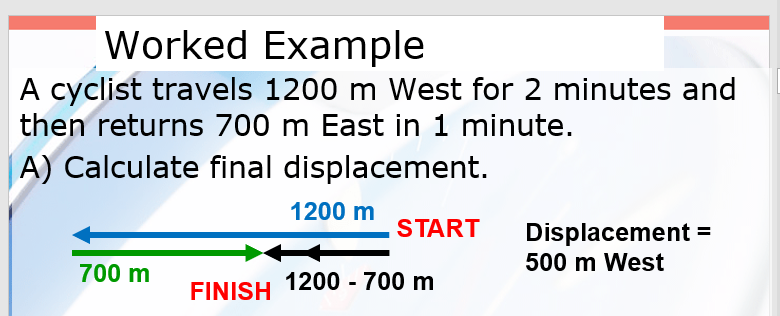
- Displacement = length from point A to B using the most direct and shortest route
- You can calculate displacement via pythag (a^2 + b^2 = c^2)
- Average velocity - the overall displacement of a given motion with direction
- Displacement over time + direction (d/t) + a direction
Quadrant bearings
- Refers to the angle between two quadrants - eg, North 30 degrees East is just saying that from North, if you turn 30 degrees in an east direction. you’ll be at that angle.
- SOHCAHTOA - get the values of the lines that make up the angle you want to calculate, and plug them into the calculator (eg, sin^-1(opposite/hypotenuse))
m/s → km/h
- To go bigger, times by 3.6
- To go smaller, divide by 3.6
- \
Position time graphs
- Shows how far/close an object/person is from a set distance. The end of the line on the right represents displacement.
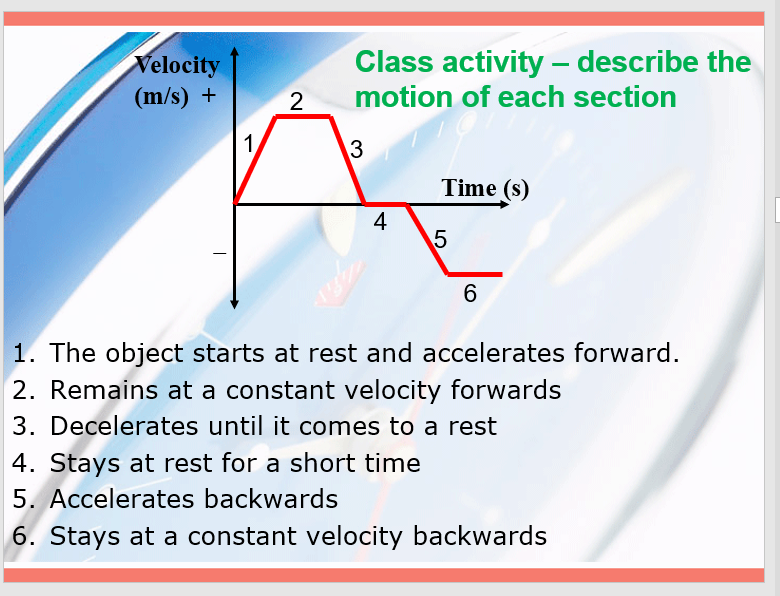
Velocity time graphs
- The area is equal to the total displacement
- Look at the area between the origin and under the line for positive axis, and do the same but reversed (over the line, under the origin) for a negative axis.
- Subtract the negative axis stuff from the positive :)
Vector diagrams
Terminal velocity
- Maximum velocity that can be achieved by a mass
Semester 2 N/A
Biology
Semester 1
DNA
- Deoxyribonucleic acid
- Purpose: Stores genetic information
- Shape and structure
- Shape: Twisted double helix is formed via two chains.
- These chains are formed via multiple subunits called nucelotides
- Nucleotides - consist of a phosphate group, sugar, and nitrogenous force.
- Nitrogenous force - Adenine and Thymine, Cytosine and Guamine. These form complementary pairs.
- Chromosomes - tightly coiled up DNA
- Each human body cell has 46 of em, or 23 pairs. 22 of those are homologous pairs. Half from your mother, half from your father!
- The 23rd pair is a sex chromosome - these could either be the same (XX) or different (XY)
- Genes - a sequence of DNA on a chromosome that codes for a particular protein that codes characteristics such as eye colour
- Inherited from our parents
- How is DNA replicated?
- Two strands of DNA separate, and then each strand provides a template for making a new strand, and then they link together with those nucleotides.
Mitosis and meiosis
- Mitosis
- The process that all cells except for sex cells use to divide
- A single cell forms into two IDENTICAL daughter cells, which carry the same amount of chromosomes and genetic info as the parent cell.
- The stages:
- \
- Interphase.
- \
- Prophase
- \
- Metaphase
- \
- Anaphase
- \
- Telophase
- \
- Cytokinesis (split)
- Meiosis
- The process sex cells (sperm and egg) use to divide.
- They have half the number of chromosomes than the parent cells
- Genetically different from parent cells.
- Produces 4 unique sex cells called gametes.
- The stages:
- \
- Interphase.
- \
- Prophase
- \
- Metaphase
- \
- Anaphase
- \
- Telophase
- \
- Cytokinesis (split)
- From here, we repeat the process in those two split cells
- \
- Prophase II
- \
- Metaphase II
- \
- Anaphase II
- \
- Telophase II
- \
- Cytokinesis (split, now we should have four varied gametes)