Cells
MRS C GREN
Movement - Getting from point A to B - Walking
Respiration - Release of energy in cells - Aerobic Respiration
Sensitivity - Responding to surroundings - Eating
Control - Regulating internal conditions - Regulating internal temperature
Growth - Increase in maturity - Going from a baby to an adult
Reproduction - Creation of offspring - Having kids
Excretion - Removal of metabolic waste - Urination
Nutrition - Intake of nutrients - Eating
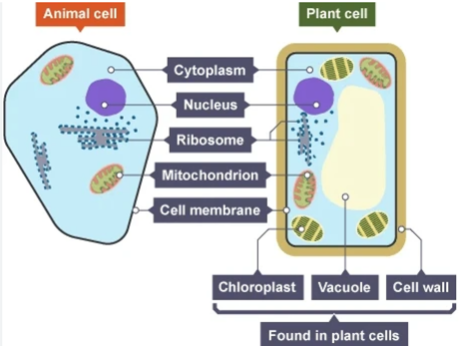
Organelles
Vacuole - Controls cell sap.
Cell Wall - Provides support to the cell.
Cytoplasm - Where chemical reactions occur.
Ribosome - Protein synthesis.
Mitochondria - Respiration
Chloroplast - Photosynthesis.
Cell Membrane - Controls what enters and leaves the cell.
Nucleus - Controls the cell.
Plasmid - Contains DNA of the cell that can be replicated
Plant cells’ cell walls are made from cellulose
Fungi cells’ cell walls are mode of chitin
Bacteria cells’ cell walls are made from peptidoglycan
Organelle → Cell → Tissue → Organ → Organ System → Organism
Features of Eukaryotic cells
Multicellular or single celled
Nuclei
Alive in fertilization
Features of Prokaryotic cells
Circular chromosome, no nucleus
Single celled
 Cell Movement
Cells can move through three main methods:
Active Transport - Movement of particles from a low to high concentration.
Diffusion - Net Movement of particles from a high to low concentration
Osmosis - Net Movement of water to a high to low water potential
The rate of cell movement can be changed by four factors:
Surface Area: Volume ratio - higher = quicker
Distance - lower dist = higher
Temperature - Higher temp = quicker
Concentration Gradient - higher = quicker
Surface Area = w h number of faces
Volume = w h d
Simplify the ratio!!
Cell Magnification
mm → micrometre (µm)
45 * 1000 = 45000
Multiply by 1000
Cell Magnification = Length on diagram / Actual length
Pathogens
Pathogens cause harm / disease.
Some bacteria are pathogenic, like pneumococcus which causes pneumonia
Some fungi are pathogenic, causing diseases like athletes foot. Mushrooms aren't pathogenic.
Protoctists can be pathogenic, like plasmodium which causes malaria.
Features of various types of cells:
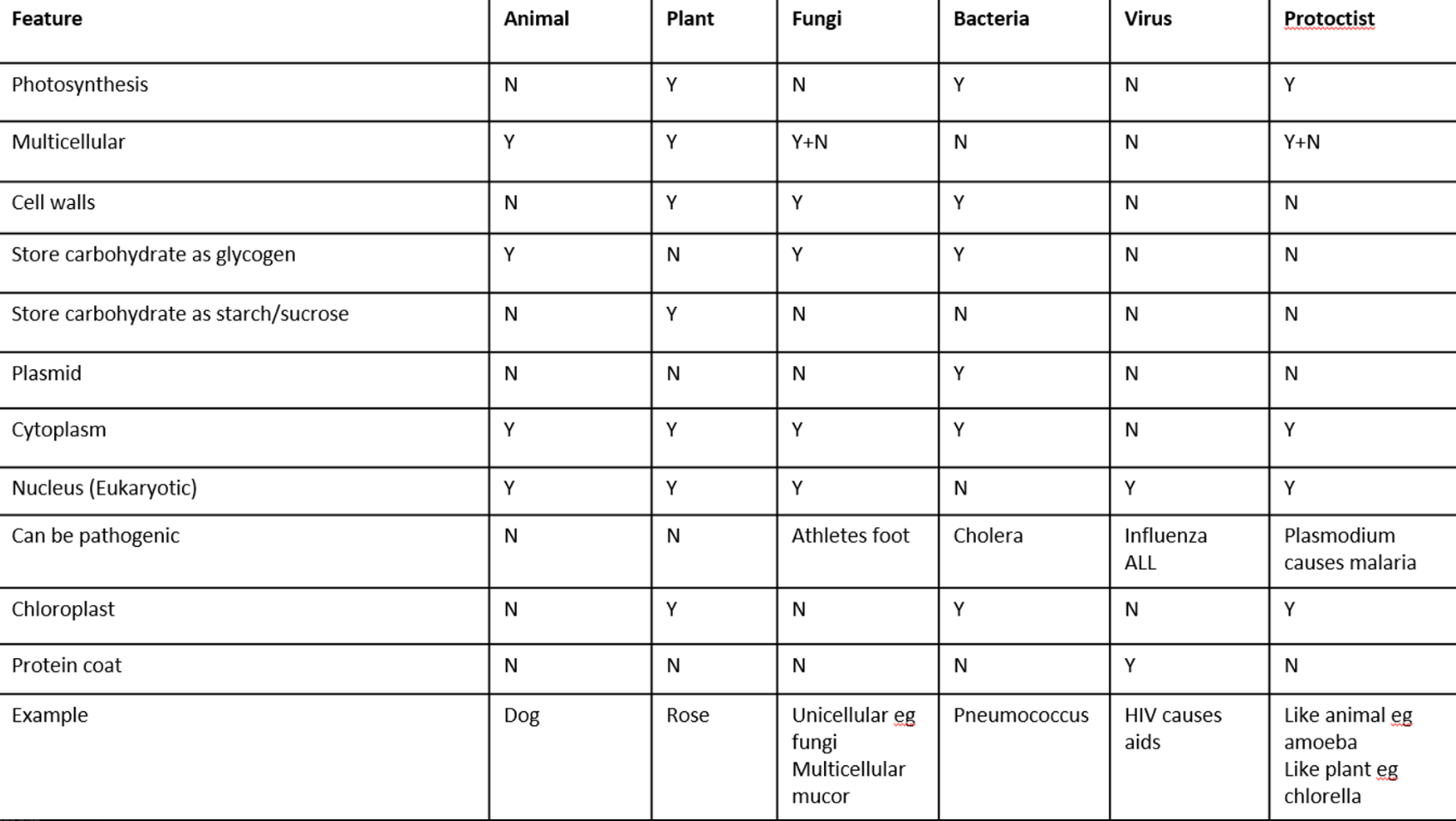
https://quizlet.com/833046811/bio-topic-1-flash-cards/
(m) - Y/N