Perception Notes
Perception Overview
Focus on interpretation of sensory information rather than mere organization.
Restored Vision After Cataract Surgery
Blind adults regained sight but struggled with shape discrimination (e.g., circle vs. triangle).
Brain changes due to lack of exposure to visual stimuli affect perception.
Facial Recognition Issues
After surgery, blind adults recognized individual features but not faces.
Normal observers misidentified faces with altered lower portions, showing issues in feature detection from the visual cortex.
Sensory and Perceptual Deprivation
Example: Kittens raised without horizontal lines fail to perceive horizontal objects later, indicating vision is partially acquired.
Lack of stimulation changes both sensation and perception.
Perceptual Adaptation
Humans can adjust to distorted visual fields (e.g., upside-down goggles).
Adaptation takes time, but re-adaptation to normal vision is necessary afterward.
Perceptual Set
Definition: Mental predisposition to perceive one thing over another, influencing interpretation of stimuli.
Contextual images can shift perceptions based on immediate and cultural contexts.
Schemas
Characteristics of concepts developed through experience help organize and interpret unfamiliar information.
Children create schemas based on limited exposure to the world.
Context Effects on Perception
Context can alter perceptions, e.g., comparing serious scenarios to trivial ones.
Cultural contexts also modify perceptions of visual stimuli (e.g., different interpretations of images depending on cultural background).
Perception: Innate or Acquired?
Perception shaped by biological (sensory analysis), psychological (gestalt principles, perceptual sets), and sociocultural factors.
Human Factors Psychology
Focus on designing products that align with human perception to minimize errors.
Two-thirds of airline crashes attributed to perceptual errors.
Extrasensory Perception (ESP)
ESP: Perception without sensory input; lacks scientific support.
Types include:
Telepathy: Mind-to-mind communication.
Clairvoyance: Awareness of remote events.
Precognition: Prediction of future events.
Psychokinesis: Mind's influence on physical objects.
No credible evidence supporting the existence of ESP through scientific testing.
Visual Illusions
Muller-Lyer Illusion:
Two lines of identical length appear different due to the direction of arrow-like fins at their ends.
A line with outward-pointing fins (><><) typically appears longer than a line with inward-pointing fins (<><>).

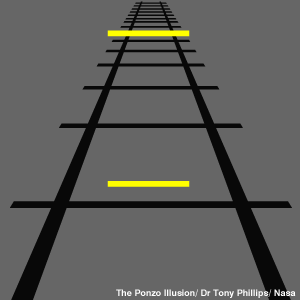
Ponzo Illusion:
Two parallel lines of the same length are placed over converging lines (like railroad tracks).
The top parallel line, appearing farther away, is perceived as longer than the bottom parallel line, even though they are the same length.